We have already cracked solar and battery tech. Coal is dying. Nuclear appears to be near dying as well. This has happened in the past three years or so.
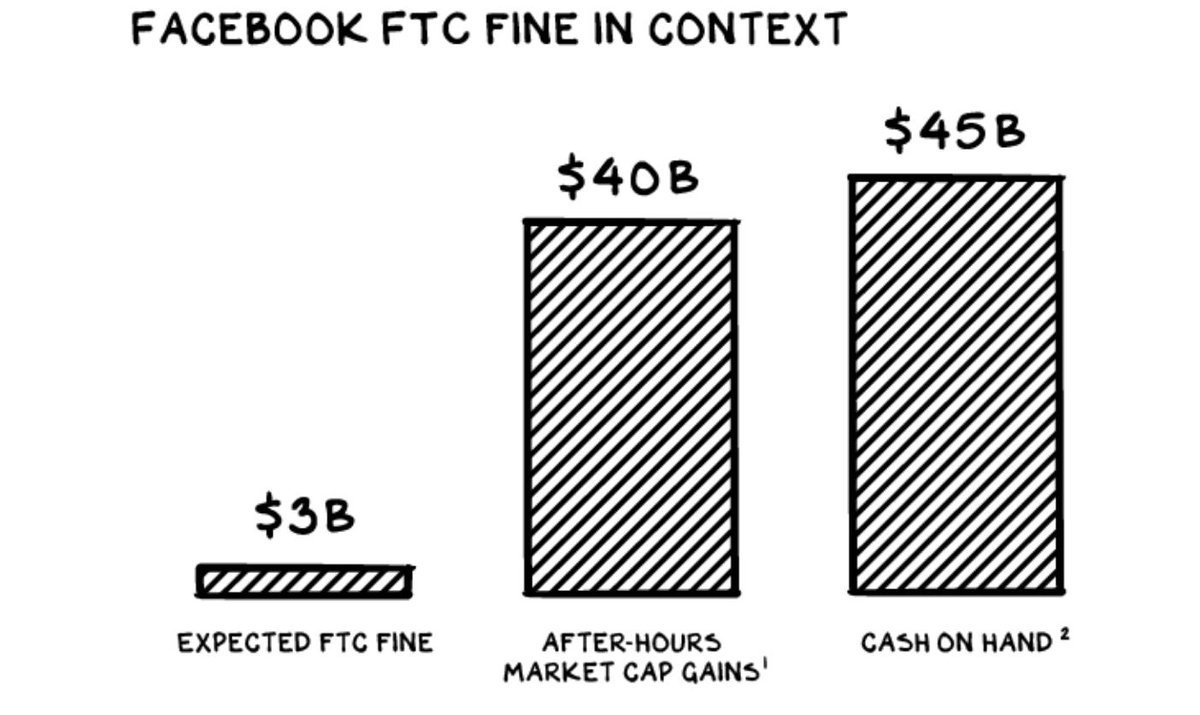
There is zero impact to Facebook from this fine. They are celebrating with champagne and looking at new yacht prices in Menlo Park.
Nobody goes to jail, everyone keeps their jobs. They only broke Democracy, it seems like that would be the one crime you wouldn't just get off scot free for. The FTC is complicit, we don't seem to have a functional regulatory system in this country any more.
The massive spike in FB stock as this was announced is not exactly encouraging. All those executives getting paid largely in equity learned... what exactly did they learn?
They don't even have to admit they did anything wrong? Zero fault? For breaking Democracy? What the hell.
The spike is significantly greater than the fine (of course the expected fine was likely already priced beforehand and the unexpectedly low fine has reassured investors that Facebook is back to business as usual).
If you're a director that's a new Maserati. Who's my candidate? I have never voted, not sure what you're trying to project on to me.
They broke Democracy. That's putting it nicely, I think, and being charitable to Facebook when you could use much more malicious phrasing based on their actions.
They broke Democracy. Get used to that phrase, you're gonna be hearing it a lot in the coming years, because they broke Democracy.
So any website can make arbitrary requests to localhost or any internal LAN server? You could have a field day with just a little bit of internal knowledge on that one.
Do random malicious web pages in IOS still have the ability to open the app store too? Was that the genesis of all this nonsense, just trying to make the app store easier?
It doesn't matter if a company takes your data, does a poor job of anonymizing it, and then decides to label it as "training" for their "AI" or if they just stick it all in a flat .txt files and process it in Fortran.
It's the exact same thing. You should be mad about the data being saved and used. Splitting hairs over implementation details to try and find a loophole is just a waste of time.
You could also compare this to hospitals sending voice files to India to be transcribed. This is not automated at all. It's not clear that hospitals are any better at getting informed consent for this than Google.
1) A person going into a hospital, having their voice recorded, and then having the recording sent to another hospital where it might help treat and/or save their lives
vs
2) A company exploiting the lack of regulation and public knowledge/education on the dangers of mining personal data, to mine personal data and make a profit with no regard for the safety of the individual
If explicit consent had to be obtained, with the requirement that the person consenting be fully informed on the details of what they're giving up, in which of the scenarios above do you think people would be more likely to refuse consent?
Identity theft, regular theft, harassment, stalking, sexual assault, discrimination, reputational harm, etc.
Example scenario:
I tell a friend that I voted for Trump, my Google home hears it, a Google employee eavesdrops, leaks on twitter that I voted for Trump along with my home address, the likely times I'll be in my home, and even the pin to disable my alarm, etc. Then a group of left-wing extremists uses that information to harass/rob/murder me.
Alternate scenario:
Google employee uses their access to find an attractive woman with a Google home, steal nudes, spy on conversations, etc. That escalates into stalking, and eventually sexual assault and/or murder.
Both of those scenarios are possible today, and we're just supposed to "trust" Google is being responsible because they say so.
Whether these threats are realistic depends on how good Google's internal controls are. It's likely that there are Internet companies where internal controls are very weak (random Internet of things companies) and others where they are stronger. Stalking cases have happened, so you can say it's "possible," but to assess risk we need to do better than making a binary distinction between possible versus impossible.
In the case of the contractor described in this article, it sounds like they are pretty well isolated, so I don't see these scenarios happening: On the one hand, the audio snippets are more personal, being recorded in the home. On the other hand, having any idea who they're listening to will be rare, the snippets are short, and they are unlikely to hear the same person twice. I don't see them getting enough data to do damage.
You might compare with a store employee or waitress hearing a bit of conversation, or someone eavesdropping on your conversation or screen on a bus or plane. While people should be on guard, often they're not, and an eavesdropper can find out a lot more of any one person's data.
Other Google employees might have different access (for example tech support), but they'd be foolish to basically give employees remote root on Google Home devices, and I don't think Google security is that foolish.
I don't get your point here. You start off by questioning if the threats are realistic, then questioning if they're even possible, then you end by saying it's not that bad because waitresses can overhear your conversations too.
1) Those threats are 100% possible and realistic. If you think they're not just because the guy in this article is a contractor, then you're being incredibly naive and shortsighted.
2) Google employees have complete access to this data, and to think that they don't means you've decided to trust their word. Maybe you like Google, and that's fine, but it's not smart to trust them on this whether you're a fan or not. If their internal security policies for this type of data are terrible, they're never going to admit it and will definitely lie about it.
3) What people say in a restaurant and what they say in the privacy of their own homes are completely different. Can't believe I have to explain that.
> but they'd be foolish to basically give employees remote root on Google Home devices, and I don't think Google security is that foolish.
Why would you need remote root access when Google Home already uploads conversations to Google servers by default? That's the only part that matters.
Why do you think "Google employees have full access to this data?"
It seems strange that they would have permission, unless there were some reason it was necessary for the job.
This is sort of like assuming telephone company employees can listen to whatever conversations they want. Wiretaps exist, but it's not like just anyone gets to use them.
> Why do you think "Google employees have full access to this data?"
Because they do. It's literally there on their servers. You're assuming that they have some really good policies to prevent employees from accessing that data. Maybe they do, I don't know. But it doesn't matter because those are just internal policies. If some employee just says "fuck it" and ignores those policies, then if they're caught they'll just be silently fired and we'll never hear about it. There's no external audit; this is all unregulated territory.
Since this is HN, I'll give you a scenario that might hit closer to home: let's say you want to apply to work at Google. You send in your perfect application/resume, but you never hear back because your recruiter peaked into your Google Home files and noticed that you once told your friend that the Dodgers suck. Since your recruiter is a Dodgers fan, they decided to just throw your resume in the trash.
This is a great read. I spend so much time fighting the web. If you want to maintain a shred of privacy you then have to regularly read about all the latest trackers, dns monitors, browser fingerprinting techniques, shady vpns, blocking social domains, etc, and even then you're probably not very anonymous or private.
I hadn't ever really considered just giving up on the browser before. But I think yeah, maybe it's time. The web has become such an awful cesspool of surveillance capitalism, I'm tired of fighting it all.
IBM was a true pioneer in the bullshit AI industrial complex with all that Watson nonsense.
Many companies seem to have copied that strategy of just pretending they are sprinkling some AI fairy dust on whatever and that it's better somehow, while actually doing zero work.
Outside of that accomplishment I have no idea what IBM has been doing since the 90s.
The primary role of subs has been intelligence for as long as subs have existed. One of the first missions subs carried out in WW1 was cutting undersea cables.
Despite all the undue attention placed on the combat U-Boats and their limited success in sinking merchant ships, the history of submarines is primarily the history of getting in good positions to tap cables or radio frequencies or put people in places.
There is very little need for torpedoes or missiles anymore, outside of creating dramatic scenes in the movies.
The nuclear deterrence is definitely a capability and something they drill on regularly, but at the end of the day it's a low priority mission, even on a modern nuclear attack sub.
They don't just patrol waiting to launch nuclear weapons though. Subs track other ships first and foremost, they have to for their own survival. And as has been pointed out previously in this thread, they can also tap cables as well as eavesdrop on radio transmissions. They can even use hydrophones to detect things like construction, mining, and even weapons testing.
>Intelligence, Surveillance, and Reconnaissance (ISR). Submarines provide the nation a crucial intelligence-gathering capability that cannot be replicated by other means. Operated with care and cunning and deploying multiple sensors, submarines can monitor happenings in the air, surface, or subsurface littoral battlespace, providing a complete picture of events across all intelligence disciplines. They are also an intelligence "force-multiplier," providing tip-offs of high interest events to other collection assets. Submarines are able to monitor underwater incidents and phenomena not detectable by any other sensor. Since they are able to conduct extended operations in areas inaccessible to other platforms or systems, submarines can intercept signals of critical importance for monitoring international developments. The unique look-angle provided by a submarine operating in the littoral region enables it to intercept high interest signal formats that are invisible to reconnaissance satellites or other collection platforms. Furthermore, the ability to dwell covertly for extended periods defeats efforts to evade or deceive collection by satellites and other sensors. The intelligence gleaned from submarine operations ranges from highly technical details of military platforms, command and control infrastructure, weapons systems and sensors to unique intelligence on potential adversaries' strategic and operational intentions. Our submarines can provide real time alertment to National Command Authorities on indications of imminent hostilities. And unlike other intelligence collection systems such as satellites or reconnaissance aircraft, submarines are full-fledged warfighting platforms carrying significant offensive firepower.
Now that all? of the nation's major media orgs are behind paywalls I kind of wonder what the point of even writing this article is?
The few rich dudes on the coasts with WSJ subs found this read interesting I'm sure, and will talk about with their friends at a party maybe. The history of Hong Kong is truly fascinating.
I didn't read it. A bunch of other commenters will chime in without reading it. No regular or poor people subscribe to any of these media paywalls, so who are you informing? Who gets to be part of the debate? Who are you writing for and why?
There is another WSJ article floating around today that I would really like to read, it's defending the history and practice of share buybacks. Nobody but rich white dudes will read that and use it to continue their ever increasing share buybacks. I would really like to understand their thinking, but I can't.
It really seems beyond just negligent and greedy to me, it's almost like Boeing was just running a malicious social experiment just to see what they could get away with.
I understand the goals of the plane and how avoiding pilot retraining is more important than any other priority in the world of aviation, but even then the design is just so bad it's hard to even make sense of.