In terms of P/N/P layering I believe (from my limited understanding) that what you're saying is generally true. However, given two diodes you can't make a transistor, so it is not equivalent to say that a transistor is just two diodes. Especially at this ultimate scale, proving a diode is not the same as proving a transistor. The mechanism of semi-conductivity is not the same at 0.5nm as it is at 14nm.
No, but you can be forgiven for thinking that with an NPN junction of a BJT looking terribly much like two PN junctions of two diodes wired together.
So let me give the physics backstory here. Both N-type and P-type doped semiconductors are conductors, and they're both electrically neutral -- but in one of them (N-type) we've added atoms which have "too many" electrons in their outer shell (compared to the semi) and those electrons form conduction states shared among all of the atoms; and in the other (P-type) we've added atoms which have "too few" electrons in their outer shell, and then these electron-holes form conduction states shared among all of the atoms.
We join these two at a PN-junction, and then something very "obvious" happens: the electrons fall into the holes. This is actually maybe not as straightforward as it sounds because we say that there is no "bias voltage" across these two but there is certainly an internal electric field, as the P-type side has more electrons than makes it neutral and the N-type side has fewer. What's actually happening is that what we call "voltage" is generally the "chemical potential" of the electrons which is normally dominated by electrical potential, but in this case we see a competing effect from diffusion, the excess electrons from the N-type dopants have diffused to the P-type dopants and thus both conduction bands evaporate in this "depletion region", where the diffusion tendency is balanced out by the electric field that points from the N-type side to the P-type side.
Now we put a "forward bias" on it, this means raising the P-type voltage relative to the N-type side, so we are putting more holes into the P-type side, more electrons into the N-type side. And they attract each other across this divide, but as they try to connect they get overwhelmed by the electric field between the two, and "roll back" to their side. This happens until the voltage bias is exactly large enough to cancel out the electric potential difference of the boundary: then electrons in the N-type side successfully can fly a little distance into the P-type side and holes from the P-type side can fly a little distance into the N-type side, allowing the local electrons to "fall into" the holes: and a net current can flow again! This voltage difference is actually a material property for the semiconductor in general; so for Silicon this "diode drop" is 0.7 volts; when forward-biased the diode appears to be something like an 0.7V battery wired against the current, when reverse-biased the diode appears to be a circuit break, and in the middle you might have some sort of interesting linear and nonlinear regions.
If you just connect two diodes together backwards, one or the other of them is going to be reverse biased unless you inject or extract current out of the region between them -- the only flows possible are "outside to center" and "center to outside" until you get to the breakdown regions of the diodes.
Okay now that we're clear on diodes let's talk about the NPN in a typical bipolar junction transistor. The key here is that the P region is actually very small. Usually we call one of the N regions (which is usually more heavily doped than the other) the "emitter" and the other the "collector". The usual recipe for the voltages in normal operation is,
Vb > Vc > Ve
so that electrons, wanting to flow from lower to higher voltages, really want to move from the emitter to the collector and most of all would like to move into the base. In addition, this Vb - Ve is generally about the same magnitude as a standard diode drop, so you will see a little diode symbol in the BJT circuit diagram symbol, which helps to remember this.
Since Vb - Ve is a typical diode drop, we see that holes in the base have no problem with combining with electrons in the emitter and current flows freely between these two. On the other hand we see that the depletion region between the base and the collector has actually grown.
This is where the thinness of the base is really important. The depletion region isn't really a place where electrons can't move, it's just a place where electrons coming from the N side find themselves repelled by an electric field from excess electrons on the P side. But we just said, the electrons coming in from the emitter are no longer being repelled by the excess electrons in the base; they're penetrating into the P side. Well, once that happens, the electrons from the emitter might also get far enough that they feel these electrons "behind them" pushing them into the collector, where they are likewise attracted by the unbalanced positive nuclei on the other side. So it's kind of a rollercoaster ride where electrons with high enough energies can fly into the base and then find themselves dumped into the collector.
This causes an electron current from the emitter to the collector which tends to be proportional to the electron current from the emitter to the base -- and the proportionality constant is usually governed by how thin this interface is, since it requires the electron to diffuse far enough across the base for the residual forces to push it into the collector. For modern BJTs this proportionality constant can be in the hundreds or thousands: for each hole that makes its way into the emitter to recombine, hundreds or thousands of electrons could be coaxed past this point-of-no-return where they fall into the collector.
The mental model you want here is that there is this base-emitter diode which, if it's reverse-biased, you usually see nothing (unless you totally reverse the BJT and pretend the emitter is the collector and vice versa --- usually the aforementioned current gain is much smaller) -- and you have an ideal current source connected pointing from the collector to the emitter, and the magnitude of that current source is given by this proportionality factor with the comparatively weak current going from the base into the emitter.
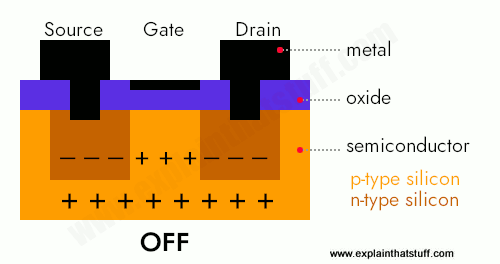
A standard field-effect transistor has four connections: gate, base, source, and drain. In MOSFET logic circuits, two of those connections are wired together, depending on whether it is NPN or PNP, and which side of the circuit it is on.
Applying voltage between gate and base affects the size of the conductive channel between source and drain, like pinching off the flow from one garden hose by wrapping another hose around it.
If you slap two diodes together, you still need to send current through it "sideways" to see a transistor effect.
For a BJT which you're talking about, the structure resembles two diodes back to back (like this: -|<--->|-), but the middle material has to be lightly doped and must be very thin as well.
The rough mechanism of operation is that when you pass current through one of the diodes, the charge carrier current doesn't all get siphoned off through the middle terminal (base), and most of it goes to the other "reverse biased" diode and gets siphoned off through the reverse bias electric field.
That's a field effect transistor. A diode is made from a P/N junction in normal silicon (i won't say i know it's the same in other materials). A Bipolar Junction Transistor is made from an N/P/N junction, or a P/N/P junction. On the surface it looks like you could make a transistor out of two diodes because of the junctions, but the problem is that you have to bond them on the silicon to get close to the effect of a transistor, the metal leads and bonding wires inside a normal diode prevent that from working. What this does mean however is that you can use half of an NPN or PNP transistor as a diode, and it's a somewhat common thing to do to minimize the types of parts you need on a circuit board if you're already using the transistors for something else.
I would expect two diodes facing each other would just act like one diode with two connections. A transistor uses one input to control the flow through another path. So something more like a diode that is 'programmable' by another diode.
A co-author makes bolder claims. I guess in context, the meaning is different, more of a metaphor. And even though, diodes can form some logic gates (diode-logic).
> ... simple chemical changes within a molecule, can have a profound influence on the electronic structure of molecules, leading to different electrical properties.”
But what's really interesting is the size of 14 atoms in the core of the molecule. How does that compare to 14 nm feature-sizes of different FET-technologies?
My understanding is that in theory two diodes can provide (at least some of) the functionality of a transistor. In practice, using current semiconductor technology, this is impractical/impossible. My reading of the article is the claim that it is possible to provide the behavior of transistors with the single molecule. That is not the same as claiming a single molecule mechanism uses the same technology as current integrated circuits. The analogy I would draw is that transistors have many of the same behaviors as vacuum tubes...or more perhaps more visually the same behaviors as valves in the British usage.
Of course I may be completely misunderstanding the article and it's claims, but that is how I resolved the various confusing implications.
>My understanding is that in theory two diodes can provide (at least some of) the functionality of a transistor.
very false. bipolar junction transistors have the structure of two diodes back to back but just because you sandwich two diodes doesn't mean it's automatically a transistor. the middle material has to be lightly doped and must be also very thin, or else it won't "trans" much.
Sorry for not being as clear as I would have liked. I am not sure that current semiconductor approaches are relevant to the work of the lab. The analogy may be that the lab is developing a technical approach that is different from current techniques in a manner similar to the way semiconductors were different from vacuum tube techniques.