It's strange to me how there are many among the Hacker News crowd who can read an article like this and have doubts about its thesis. You lived through the 80s and 90s right? I can't count how many times in my life I was told no one would ever need a computer in their house, we've gotten along for decades just fine without them. No one will ever buy books online, that's ridiculous, you can go to the store and have one right now. The internet is just a niche chat program that will never have any use in business, etc.
Our uses of cryptocurrency and blockchain technology now are similar to how we once used the power of the web to create Geocities pages with nothing more than MIDIs, scrolling text, and under construction gifs, because we didn't know what we were doing yet. But the early computer and internet pioneers were able to see past the proofs of concept and build on those ideas, to create the modern internet we have today.
Bitcoin may cease to exist as a software product, but I think the innovations that it has spurred on will be with us for some time. This technology has the possibility of making business much more efficient by reducing costs that are associated with distrustful parties having to rely on (and pay money to) third party escrow/auditing services. If I want to send a large sum of money to someone else now, I have to rely on third party services such as banks or Western Union to facilitate that transfer.
If you still continue to think "well that can be done with a SQL database now", you're completely missing the point. There's nothing wrong with relying on third parties, but now we have technology that allows us to choose not to if there's a need for it. In that regard, cryptography shares many of the same characteristics. We could communicate securely before public key cryptography was invented, but it broadened the scope and security of such operations, to the point where we espouse using https for all websites, not just ones requiring security. When the time comes, why would you trust a third party if you didn't have to?
Pretty much everything successful now was ridiculed or dismissed in the past, but that doesn't mean everything that was ridiculed or dismissed became successful.
And even those things that became successful did so in a form that the contemporaneous positive predictions did not expect. The 1990's predictions of the Internet was of decentralised power and freedom of information, what actually happened? There was a land-grab, and a new generation of billion-dollar corporations have become established. Where once there was Blockbuster, now there is Netflix...
My prediction is the same will happen with cryptocurrency and blockchain applications. The technology will live-on, mostly in non-currency applications (e.g. behind the scenes settlement rather than day-to-day transactions); most of the "land grab" phase will die off though. Then, one day, ten or twenty years from now, we'll realise that "fiat" currencies have been blockchain based since some un-trumpeted central bank upgrade eighteen-months prior. But no-one will have noticed, as they still spend "dollars" on a credit card... same as they always did.
> Then, one day, ten or twenty years from now, we'll realise that "fiat" currencies have been blockchain based since some un-trumpeted central bank upgrade eighteen-months prior.
Tom, Dick, and Jane may not notice, but I would hope that those investing in that space, and those building out the technology, would :) The general public may not have an appreciation for the complexity behind it, but I assume many of Hacker News's readers, now and in the future, will be working on the forefront of developing this new technology.
So the logic of the first part of your post boils down to this:
There were people in the past skeptical of an outlandish claim who turned out to be wrong as that thing became something great, therefore people who are skeptical of another outlandish claim today are also wrong. Did I get that right?
No, you didn't get that right at all. Doubt and skepticism are inherent parts of creating new ideas, and at no point did I express that the people who are skeptical are wrong.
Rather, I am surprised to see comments on a technical website like Hacker News that are treating the long, drawn out development of cryptocurrencies and blockchains as something that is completely different than the long, drawn out development of the personal computer and the internet. It took the Internet more than 10 years to be useful, and so I think saying "shut it down, this is going nowhere" about Bitcoin today is not a useful viewpoint to take. Even if you doubt the technology itself, there is no reason to stifle its continued research and development.
So your point is that some technologies take a lot longer to mature than average, for example {some examples}, and the delay itself should not be held against such late-blooming technologies.
I'm onboard with that. Although your argument may benefit from better phrasing, because it actually does come across like that, which is a disservice to your advocacy effort.
Back on topic, I don't see a lot of people in this thread saying "it's been forever and nothing came of it, let's just end the whole thing." What people are saying here is that there is no foreseeable legitimate (and legal) use case for the crypto currencies, hence let's not start the frenzy just yet. We should have a proposed legitimate use case first and a frenzy second, otherwise it's indistinguishable from millions of other exciting idea. Just because this particular idea excites you doesn't mean it has potential.
> I'm onboard with that. Although your argument may benefit from better phrasing, because it actually does come across like that, which is a disservice to your advocacy effort.
In the end I'm just a programmer, not an essayist :) I appreciate the feedback.
> So where is the potential? What is the use case?
I work in fintech and can speak firsthand about the potential use of this technology to reduce costs and reliance on third party auditing firms. I think people focus too much on cryptocurrencies just like people focus too much on AOL and Geocities. Those services weren't the internet, and cryptocurrency isn't the only use of blockchains. If anything, I would love for the shitcoin frenzy to die down so our efforts can be focused toward more useful/less scammy uses of the technology.
So far, the best use case of the block chain tech is to remove the necessity for a variety of industry associations few people have ever heard of.
That's not world changing.
Digital nearly frictionless currency is another use case, but so far it seems there is a vicious cycle of value, scarcity, hoarding, boom, and bust in most of these that makes them unsuitable for use as a medium of exchange.
To go a bit further, I'm willing to wager that there is an inherent tradeoff in crypto between usefulness as a currency (stability vs fiat) and usefulness as an investment (appreciation). a stable store of value is also useful, just not as an investment.
The crypto currency that eventually works won't make anybody rich.
> So far, the best use case of the block chain tech is to remove the necessity for a variety of industry associations few people have ever heard of.
The same could be said of many of the early hardware and software makers of the early internet.
> The crypto currency that eventually works won't make anybody rich.
I think the bigger point I was trying to make is that we have a technology, and so far the killer app for it has been cryptocurrencies, but that we've not yet developed the technology to the point where its broader uses can come to fruition. We didn't have Facebook or Twitter in 1995, partly because of technological implications, and partly because the idea of social media hadn't been fully formed yet. These things take time, and I think there's a bright future ahead for these new technologies once they mature and people find more uses for them.
I don't think cryptocurrency will be the be-all-end-all use of blockchains, and the idea of technologies like Bitcoin may seem as quaint as services like CompuServe in the future.
The ultimate use case is control and tracking beyond any form created thus far.
Paper currency that may be in your pocket has serial numbers printed on it. Those numbers cannot be readily associated with an individual. Bitcoin and all other blockchain systems can be connected to a user directly or through alternative methods. This is ideal for government and is the direction most are taking - control over blockchain systems and therefore control over the system's users.
Pointing to credit or debit cards is a poor comparison since those require significant hurdles for participation. Cryptocurrency requires only a smartphone or some kind of computer and a rudimentary internet connection. The infrastructure for the entire system is already in place, unlike growth of the early internet needing computers and modems. Transactions work now and have been for years; higher level functions such as decentralized exchanges, asset registration and such are gradually being tested and implemented.
Meanwhile, users are voluntarily joining. Government needs do little other than take some corrective actions and dictate rules for usage of cryptocurrency that can be enforced within borders. It's a control-freak's dream come true.
This is a great point that I don't see a lot of people making. The US government would love nothing more than having a USDCoin that allows them to see exactly how money flows from person to person and institution to institution, as well as having a way to revoke your coins at will.
The draconian implications of this technology, like many others, concern me greatly. Thanks for providing this perspective.
I would argue that Bitcoin is the coin, not a national cryptocoin. Russia world not trust a US coin, the US would not want to use a Chinese coin, etc. Bitcoin is effectively neutral territory but is effectively controlled through centralized mining operations that can certainly be collectively monopolized by the largest sovereign nations. It would be the modern version of mutually assured destruction.
Bitcoin is already a reserve currency in crypto thanks to longevity and stability of the protocol. Another may become the primary transactional currency and there may well be national variants for local trade, but reserve is effectively established.
I don't have the link offhand but all privacy coins can be unmasked by large enough organizations. Monero is currently the most resilient to direct analysis.
Keep in mind that enough data points from outside the system can be used to associate an identity with an address.
Try to setup a payment solution that can be used world wide. Including the necessary banking. This is a use case where cryptocurrencies really shine. It is basically effortless comparing to the alternative (i.e. legacy banking).
Just my two cents after spending months dealing with banks and PSPs.
Yes, except, personal computers didn't have negative side effects like raising funds illegally outside of investor production regulations (icos) or facilitating dark web trade.
> Yes, except, personal computers didn't have negative side effects
I disagree with this sentiment. In the early days, the dissemination of information like pornography and texts like the Anarchist Cookbook, which had instructions on how to create bombs and other weapons, were two examples of why the internet was a bad thing. Using a computer was considered by many to be antisocial due to the perception of people staring at screens 12 hours a day without talking to others in person. Even today, we have those arguing that the proliferation of computer technology has been detrimental to societal interactions.
I lived through the 80s and early 90s. The difference is that I could do stuff with the early Internet. I could do stuff with BBSes. I could do stuff with early PCs. These things were almost immediately very useful to a lot of people.
The reason I've become a bear on cryptocurrency is that I don't see the utility to justify the monstrous amounts of money pouring into it. It's almost 10 years old and today it's actually less useful than it was a few years ago due to runaway fee growth. The feedback system works in the wrong direction. Did the Internet get less useful the more people used it?
That and I see a ton of scams. Almost all cryptocurrency projects seem like either scams or delusional vaporware projects akin to badly thought out Kickstarters or over-funded boil-the-ocean startups. These things rarely accomplish anything other than to blow a lot of money.
Want to change my mind? Show me the cryptocurrency killer app that people are climbing over each other to use.
... and no, gambling and virtual MLM / pyramid schemes don't count. I mean utility in the real world.
> I lived through the 80s and early 90s. The difference is that I could do stuff with the early Internet. I could do stuff with BBSes. I could do stuff with early PCs. These things were almost immediately very useful to a lot of people.
You must have hung out with a nerdier crowd than I did :) I was the only person I knew who owned a personal computer until well into the late 90s.
> The reason I've become a bear on cryptocurrency is that I don't see the utility to justify the monstrous amounts of money pouring into it. It's almost 10 years old and today it's actually less useful than it was a few years ago due to runaway fee growth.
So I think cryptocurrency here is getting conflated with the underlying technology, just like Geocities came to be the poster child of the early web. I agree with you that the current systems have much work to be done, and that many of them will be abandoned before they're fixed. But cryptocurrency is not the blockchain anymore than gopher was the internet. Services like Bitcoin built on blockchains may cease to exist in their current state, but just like we still have TCP/IP, I think the blockchain piece will be essential moving forward.
> That and I see a ton of scams. Almost all cryptocurrency projects seem like either scams or delusional vaporware projects akin to badly thought out Kickstarters or over-funded boil-the-ocean startups. These things rarely accomplish anything other than to blow a lot of money.
I get a lot of scams via postal mail, telephone, and the email, but that doesn't negate the purpose of the technology :)
> Want to change my mind? Show me the cryptocurrency killer app that people are climbing over each other to use.
I think you misunderstand my viewpoint. I don't think the technologies of today are the solutions anymore than Geocities was the be-all-end-all of the web. My comments are more directed toward those who believe this technology leads to a dead end and that reducing the reliance on third party trust is not a problem that needs to be worked on.
I liked your answer. But you didn't answer his/her other criticism: "...It's almost 10 years old and today it's actually less useful than it was a few years ago due to runaway fee growth. The feedback system works in the wrong direction. Did the Internet get less useful the more people used it?"
The fact that network effects to some extent works in the wrong direction for this technology is concerning. What happens when the current speculative cycle comes to an end and crypto needs to justify itself by its utility to end-users as opposed to investors?
P.S. Beside this point but one thing that can work in favor of crypto is the conflation of investors & users. You essentially get so many evangelicals for your project from the investment perspective "for free". If you can turn them to users, then you are in a nice shape. Though issue is that most these investors are only summertime soldiers.
Cryptocurrency isn't blockchains anymore than AOL is the Internet. Bitcoin may be getting less useful, showing that a proof of work system that incentivizes miners the way it does may be broken, but this doesn't fundamentally cease to justify the use of blockchains as a data structure. It just means we need to figure out a way to keep blockchain security while improving/replacing proof of work.
That's a totally inappropriate analogy. AOL was a company, not a class of technology like cryptocurrency. You could compare a specific instance of cryptocurrency, like Bitcoin, to AOL, but not the category as a whole.
Cryptocurrency is a vital component of the distributed blockchain architecture. It provides the decentralized economic layer, without which blockchains would be centralized by virtue of their dependence on a centralized payment processor.
> AOL was a company, not a class of technology like cryptocurrency.
You know this, but many users of AOL didn't. To them, AOL was equal to the internet, like many people believe that cryptocurrency is the only application of blockchains as a data structure.
> Cryptocurrency is a vital component of the distributed blockchain architecture.
It is now, but that doesn't necessarily have to be the case. Cryptocurrency is one of many applications that can be built on top of a distributed ledger. There are many applications that have nothing to do with payment processing.
You didn't respond to the fact that cryptocurrency is a technology class or my reasoning for my cryptocurrency is vital for blockchains to have the property of being distributed.
The way I view cryptocurrencies is that they're a service like HTTP or SMTP on top of a blockchain, which would be analogous to TCP/IP. Cryptocurrencies are only one of many uses of blockchains.
I disagree with the notion that a cryptocurrency is a vital property of the distributed nature of blockchains. The purpose they serve now is to incentivize individuals to participate in the network who wouldn't otherwise participate by paying them a currency to represent the value of the service they've provided.
But for instance, you could also have private blockchains where the incentive for running a node is access to that blockchain's data. There does have to be an incentive to run nodes, but it doesn't necessarily have to be monetary.
Just because it's private doesn't mean it's decentralized in a protocol sense. The nodes in the private blockchain would still be distrustful of each other and would still undergo decentralized consensus.
As for compensation, rather than receiving a coin as a reward for doing proof of work mining, you would gain a key to enable you to read certain encrypted data on the blockchain, for instance.
What you're describing is not an open AND decentralized (however way you want to define 'decentralized') platform, and its applications are much more limited.
And your scheme does require some amount of trust. Induction into the consensus node set would need to be controlled to prevent bad actors from disrupting the flow.
The problem is not PoW. The fundamental problem of cryptocurrency is scalability. In my understanding, a system is called scalable if adding 1 unit of resource to an existing amount of resource m, improves the performance by roughly (m+1)/m.
This is not a property these systems possess. The computational power of the system remains is bounded by the computational power of weakest full-node.
But gambling is a real-world use case. There is plenty of real-world illegal activities that benefit from bitcoin, and they can all deal just fine with high transaction fees, delays, volatility, etc.
Not sure the parallels are as strong as you're making them out to be; there are deep, deep flaws with proof of work as a concept because of the energy consumed.
There will probably be a better end state for distributed trust, but we're legitimately not there yet.
> there are deep, deep flaws with proof of work as a concept because of the energy consumed
What is the energy consumption of all the bank offices and computer systems in the world? Even without this comparison, I think the amount of energy required is not a flaw in itself, but rather an aspect of the technology we should seek to improve upon (for instance, proof of stake is an attempt at this). I don't think it's sustainable long term (2400 baud internet wasn't sustainable long term either), but that doesn't mean we don't have the kernel of a great idea today. I agree with you 100% that we're not there yet, but I disagree with those who say this road leads to nowhere.
Bitcoin mining (not even counting other cryptocurrencies) uses more electricity than most countries in the world. If you look at transactions per Watt, I would guess that the banks are doing better by multiple orders of magnitude
If reports are to be believed, the entire sum total of energy consumed by banks, credit card processors, their computer systems, offices, and personnel...is dwarfed by the amount of energy wasted on Bitcoin alone.
Banks and credit card processors can handle billions of transactions per day. Bitcoin, ethereum, and the other cryptocurrencies struggle to handle a few thousand, and are technologically incapable of non-linear scaling.
The energy consumption of the bitcoin network is not inherent to proof of work as a consensus mechanism. Bitcoin uses a difficulty setting to keep the rate of block creation relatively constant even as the hashing power dedicated to it increases. The reason so much energy is being used boils down to speculation in the price of bitcoin. At $10,000 per coin and with a block reward of 12.5 coins, successfully mining a block yields $125,000. That means that for each individual miner it would be profitable to spend up to that much per block they win. $125k can buy a LOT of electricity. But on the other hand, if the price of bitcoin were closer to $1 again and nobody expected it to appreciate very much then the level of investment, and thereby power usage, would go way down.
Is it just me, or do people keep staying "proof of stake" as an answer to the proof of work concept, when it's not even a given that such a thing is a feature as opposed to completely undesired?
Maybe Directed Acyclic Graph technology (instead of blockchain), such as iota and raiblocks? Iota seemed to make its enterence into the top 10 of cryptocurrency, so I guess we're there.
My main issue with the blockchain hype is the inability of its proponents to explain what the future landscape will look like. Twenty years from now, what will the top three benefits of widespread blockchain adoption be? It shouldn't be that hard to offer concrete descriptions:
In 1984, middle managers at Sears and AT&T were able to accurately predict how we'd use the internet in 2014.
In 1999 a now-defunct ISP explained how Netflix streaming would work.
When I talk to crypto folks, I rarely get any predictions to this level of fidelity. There's a lot of talk about "Sovereign Individuals" and the decline of the US dollar as global reserve currency, but very little in the way of intermediate steps. How about this as a starter:
Which will be the first public tech company to cite a blockchain project as the reason for a missed quarterly profit target? Is it Filecoin pinching Amazon? If not, who?
I don't doubt that I'm missing something, but it seems like many are overly-concerned about joining the litany of Luddites:
"Everything that can be invented, has been invented!"
"There's a world market for five computers!"
"Apple's not just gonna walk into the phone market!"
That they've checked their critical thinking faculties.
From a fintech perspective, I'll make a thirty year prediction that blockchains will be used to reduce costs associated with third party clearinghouses and auditing firms by strengthening assurances that data hasn't been manipulated while reducing the amount of staff necessary to carry out the required verifications.
While an excellent use case, how big on an overall economic level is this? $20 billion?
The big four accounting firms bring in about $40 billion in revenue each. Thus $160 billion would seem to me to be a reasonable order of magnitude estimate for the max value audit-free fin-tech can create.
Is there a better estimate of total value this can create?
> Is there a better estimate of total value this can create?
I don't think there'll be a way to realistically estimate this for at least another decade. That would be like asking what the effect of TCP/IP will be on eCommerce in 1980. What I've laid out is very, very high level, while the technology is still in what could be considered pre-alpha stages.
Many financial transactions take place between parties who don't necessarily trust that the other side isn't fudging their numbers in order to get a better deal for themselves or to conceal information. Auditing firms exist to pour through the financial books of both sides to say, with our due diligence, we've confirmed that the financial statements both parties are claiming are supported by evidence. This is a time consuming process that involves dozens to hundreds of staff, depending on the size of the transaction.
If all of the transactions of a company existed on a blockchain system, this would greatly simplify the auditing process. In order to have access to this system, your financial institution or business would run a node on the network, spreading out the overall cost of using the system. Because of cryptographic assurances, you can guarantee that past data hasn't been manipulated. Using smart contracts, you can also guarantee that every transaction follows certain conditions, making it impossible to do trickery like backdating documents. Security additions (like zkSNARKs today) would enable concealing specific aspects of transactions while allowing third parties to verify their validity.
Long term, you could theoretically have an entire exchange that runs on a blockchain, with asset transfers mediated via smart contracts. The clearinghouses that exist to verify the assets of those who buy and sell, and complete the paperwork to document such transfers, could be largely automated.
All of this can be achieved today with third parties, but you pay a lot for that trust. Once the technology has matured to a point where it's deployed widely and these types of transactions can be automated, I expect the associated costs of that trust to be reduced.
I know you're no partial to this line of reasoning, but please humor me...
Could we achieve the same end by creating a big Git repository under control of the SEC? Anyone can make a clone, SEC will approve pull requests as needed. Or would you argue that this effectively becomes a blockchain as soon as we use start using hashes?
I think it's useful to have a paper-trail of hashed blocks/files, gives you a simple mental model to reason about immutability. I just don't quite understand the need for the decentralized commit protocol. For any legitimate (legal) purpose one could rely on a large central entity yielding much higher speed and lower expense/complexity.
I don't think you can underestimate how important immutability and trustlessness are in cases like these. Don't get me wrong, your setup would be an improvement over many manually curated processes (and in my own business, I use ledger-cli.org with the files under version control), but the lack of the two aforementioned attributes makes it a technological change that doesn't change the underlying politics.
In the end, you're just moving the third party elsewhere, and you'd still need staff to verify that people are committing their finances regularly and aren't trying to sneak in retroactive changes in large commits. If someone ever decides to try to get away with rewriting their git history and arguing that the SEC accepted an erroneous pull request that contains the wrong history, that would need to be audited/litigated out to resolve whose tree was correct (just because the SEC owns the master repo doesn't necessarily mean that their custodians of it haven't rewritten history themselves). Also, the fact that the "authority" repo is centralized means you may have issues if for some reason it's inaccessible (these issues arise in reality when GitHub goes down).
Abstractly, I do not see how, economically, devolving trust can reduce cost. You pay for trust either to a third party as now or you pay it to the network verifiers. Somewhere there is a cost.
Now, keeping all records digitally and openly accessible, and having automated processes to replace human processes, that can certainly reduce cost, but it's a business process change and orthogonal to the blockchain.
In another reply, I explained the use case for government is control and tracking via blockchain.
From the consumer perspective, the benefit will be convenience. We have car find that automatically open doors. Automation of the world around us will increase significantly, and instead of having a key fob for each item it will be a single device registered on a blockchain which everything else is registered as well. Permission can be automatically granted by machine to machine communication.
Why not a normal database? Maintenance, trust and universal accessibility.
So are you saying that it's more rational to simply think 'anything is possible' even though the available evidence and information seems to point to the fact that that isn't the case? After all you don't go around thinking that a country like (insert small insignificant country) is ever going to pass the United States in ability but sure 'anything is possible'. It could happen after all the US surpased Europe in many ways and at one time that was unthinkable.
Also with respect to things like 'nobody will ever need a computer in their house' or what Watson of IBM said (regarding the need for only a small amount of computers in total) you are also not looking at the times that that type of statement ('will never work and here is why' or 'not needed because xyz') was true. You are only looking at the survivor bias type of things where people were wrong. Because you don't know of or keep track of the times things didn't work out (like flying cars but there are most likely thousands of other examples out there I am sure).
> So are you saying that it's more rational to simply think 'anything is possible' even though the available evidence and information seems to point to the fact that that isn't the case?
At what point do you believe the internet had made its case as a technology? 1975? 1985? 1995? 2005? In each of those years, you had naysayers saying the internet would never become something people use in their daily lives, but here we are. The evidence of today should not stifle the innovation of tomorrow.
> Also with respect to things like 'nobody will ever need a computer in their house' or what Watson of IBM said (regarding the need for only a small amount of computers in total) you are also not looking at the times that that type of statement ('will never work and here is why' or 'not needed because xyz') was true.
It's not just Watson who made that statement. Many business owners in the 90s looked at computer and internet technology and dismissed it as a fad that would cease to exist in 5 years (and after the bubble popped, they were 100% sure they were correct). I believed in computers and the internet then because they solved unsolved problems, and offered better solutions than existing ones. In the field of trustless services, I believe the blockchain will be an essential part of that. And maybe it won't exactly be the blockchain we have today, but it will either be an improvement upon it, or an alternative idea created to address the problems of the original. Regardless of how the blockchain is and will eventually be used in practice, it's a simple theoretical model that offers a proof of what's possible in this space that we didn't have before.
If you don't think the blockchain is "it", then what other technology do we have today that solves the same third party trust problems as the blockchain? Or do you believe that reliance on third parties in business and finance is something we don't need to overcome?
I have to agree with your overall sentiment. After the Bitcoin boom in 2013 (and its subsequent bust in early 2014), I kind of stopped paying attention to the crypto space for a while. Little did I know that Buterin & Co. were busy building and launching Ethereum, which has profound implications of its own, some entirely orthogonal to Bitcoin's implications. We are definitely in Geocities days.
I sold cell phones to senior citizens in the early 00's, and that was a HARD SELL. Most of the ones that did buy, bought the minimal $20 / month, 60 minutes + nights & weekends plan because they thought "they would only use cell phones for emergencies". Don't even get me started on mobile web WEP browsers. It was unusable crap 15 years ago. And I would have to convince people that surely they would be checking their stocks, the news, etc. on their cell phones. The scoffs I got were unbelievable today.
Now, 15 years later, everyone and their grandmother has an iPhone / Android.
Where are all the hackers and dreamers on HN? I thought that's what this site was for. Irrational optimism is the fuel that feeds technological revolutions. So much negativity with crypto.
> Many business owners in the 90s looked at computer and internet technology and dismissed it as a fad that would cease to exist in 5 years
Well I've been around this for much longer than the 90's. Since the late 70's actually. I don't remember it that way at all. What I remember was that at the time it was either to expensive or the company (small ones) didn't have the time or resources to stop what they were doing and get a system up and running (say for inventory or shipping). There was not at all (and I was around plenty of small businesses btw) any sense that it wasn't something they needed. Anyone who typed invoices at the time (on a typewritter) and had to look up or remember pricing and/or work with inventory could easily see what a computer could do for them. The only issue was the cost.
With respect to the internet it was seen as unusable and not needed because of the speed primarily. If the speed wasn't fixed by broadband it would not have taken off. If you told people back then 'in 2 years you will have 'always on internet'' they would have thought differently.
Out of curiosity, where did you live and what sector did you work in? From my own experience, I agree that the businesses that were excited about computer technology were businesses with high amounts of inventory and paperwork where automation could greatly simplified their business processes, and that many of these businesses were located in urban centers that were at the forefront of infrastructure. These large businesses can make large profit by cutting margins by a few points, so it made sense for them. It was from small to medium sized businesses where I saw the most resistance, both from a cost and a cultural point of view. I demonstrated broadband internet to individuals at the time and still couldn't convince them of its merits, so I don't think everyone then understood the implications of fast, always on internet.
Even just 5 years ago, I worked for a tech company in the self-storage industry, and many large operators were still running their entire businesses in physical ledgers with no equivalent computerized records. There is still a strong resistance among many older businesses to convert to computerized records, despite the clear cost savings that can be demonstrated at this point. Reasons include not wanting to learn a new system and being afraid that the business couldn't run if the internet goes out. As I said, this was in 2012.
>You lived through the 80s and 90s right? I can't count how many times in my life I was told no one would ever need a computer in their house, we've gotten along for decades just fine without them. No one will ever buy books online, that's ridiculous, you can go to the store and have one right now. The internet is just a niche chat program that will never have any use in business, etc.
Why do you assume that Bitcoin is one of these few winners, rather than the multitude of losers? The default position should be "failure"; it's not irrational.
> Why do you assume that Bitcoin is one of these few winners, rather than the multitude of losers?
I didn't state that Bitcoin would be a winner, and in fact stated in my comment that Bitcoin may cease to exist as a software product. My criticism is more directed toward those who don't believe the blockchain is a useful data construct and that the research taking place today into blockchains and cryptocurrencies are a dead end.
The point isn't that existing technology can already do what new technology provides. There has to be some increased value from using the new technology. E-commerce took over because it's more convenient and offers a wider selection of products.
The end user doesn't care what database you're using. They care about utility.
> The end user doesn't care what database you're using. They care about utility.
I agree, but this isn't just about the end user. Many businesses incur costs to third parties that could be reduced or eliminated by trustless systems whose validity of data can be verified mathematically without an auditing team. The blockchain of today can't do that yet, just like the internet of 1985 didn't allow you to buy books, but I think we're headed in the direction of progress.
You don't have to trust the miners. They act as randomly selected notaries to the chain that have provably fronted considerable resources to accurately notarise the transactions in exchange for being paid handsomely (in specie). If they want to lie when they finally have the opportunity to get paid, and subsequently be caught lying because they don't have enough resources to rewrite the chain then they can, but this would be a pretty foolish errand which would still result in the fact you don't have to trust them.
I agree that the current system involving miners is fraught with political implications. But that doesn't mean the system is broken, it just means it needs to be improved (proof of stake, for instance).
> Many businesses incur costs to third parties that could be reduced or eliminated by trustless systems
The way you phrase this it sounds like a marginal reduction of costs, and maybe a marginal reduction in the auditor workforce. That’s great, and it will bring about some efficiency in the businesses it applies to, but it doesn’t sound like a story of transformational change and an unlocking of new value. Even in the worst case scenario, how big are auditing costs to a business?
moving electronic payment cost from 3% to 1% is a marginal reduction, but if we get that reduction across a few trillion in transactions it becomes real money.
Unfortunately, a lot of the cost of the 3% is providing fraud and chargeback protection that lets customers be comfortable paying online.
So, while it's conceivable that a stable block chain based payment method could revolutionize ecommerce payments, the present incarnations have trust math (before we even begin to discuss volatility's effect on suitability of a medium of exchange)
GP was talking about auditing costs at financial institutions which is a different issue than credit card transactions (I think).
Another portion of that 3% cost is marketing in the form of cashback and rewards points which can be eliminated if the market or regulators demand it. In Australia they capped credit card fees to around 0.5% on the basis that the fees were a market distortion. They review them regularly and have suggested that lower fees are appropriate [1]. It doesn’t actually cost Visa that much to handle transactions, and there are proven solutions to fixing credit card fees if that is what is desired.
this community has been reactionary to bitcoin since day 1. crypto is a generational shift, more so than web 2.0 and the glory days of hacker news. the audience here is predominantly the pre-crypto generation, much like slashdot is the voice of the dot com generation.
we all need skepticism in our arsenal and that is what you can expect here, brilliant at times but hn is simply not the voice of this moment. you will be frustrated if you forget this rather than accepting it.
Thanks for your observation. I was an old /. user who eventually found his way here and have always felt to be in likeminded company, but I understand that technology often outpaces culture, even among the tech vanguard. I hope that people remain openminded despite their criticism, and are willing to reevaluate cryptocurrencies and blockchains as the technology matures and becomes more widespread.
You have a really good point. My issue is that the speculation is tied so closely with cryptocurrency.
The future will definitely have cryptocurrency used in ways we can’t even imagine. Digital cash will be huge. That I believe. That any of the current currencies warrant any value at all much less the speculation, I’m iffy on.
Both statements “the future is crypto” and “current crypto is a bubble and all are worthless” can both be true.
The main use case of crypto currency, digital cash for digital transaction, does not require a bitcoin worth $1M. Successful cash doesn’t mean massive increases in crypto portfolios.
So the article doesn’t seem in conflict with my HN reading, 80s/90s surviving self any more than me thinking AOL and Broadcast.com sucked back then even though I bet my whole career on the Internet.
> So the article doesn’t seem in conflict with my HN reading, 80s/90s surviving self any more than me thinking AOL and Broadcast.com sucked back then even though I bet my whole career on the Internet.
I think we agree and I haven't made my point clear. To use your analogy, my criticism was more directed toward those who think AOL = the Internet. I'm not cheering for Bitcoin per se, but I'm cheering for the development of the technology underlying it, and disagree with those here in the comments who are saying we don't need blockchains because we already have relational databases.
My main concern are the transaction fees. The software needs to let me set whatever fee I want to pay, knowing that I might be totally fine waiting a month for the transaction to go through.
It's just really hard for people to see beyond the present. Innovators in one cycle are often blind to the opportunities in the next. I see it in a couple of my successful friends that built their own companies on the web and mobile when it comes to crypto.
I'm reminded of the quote about the radio:
“The wireless music box has no imaginable commercial value. Who would pay for a message sent to no one in particular?” — Associates of David Sarnoff responding to the latter’s call for investment in the radio in 1921.
And then a couple of years later, for someone that made their stake in radio:
“While theoretically and technically television may be feasible, commercially and financially it is an impossibility, a development of which we need waste little time dreaming.” — Lee DeForest, American radio pioneer and inventor of the vacuum tube, 1926
And remember TV didn't really come into its own until decades after 1926.
---
Yesterday, I was reading about past objections (circa 2007) to using Git vs CVS or SVN, and most of the objections were things that turned out to be unimportant. The objections focused on how their team doesn't have a decentralized workflow that the Linux Kernel does, so they don't need git. Or that the interface sucked, so they don't need git.
Turns out everyone mostly uses git in a centralized way (via Github), to coordinate, but the decentralized design reveals secondary affordances that are really useful in practice. The decentralized design allows you to work and commit offline--great as laptops became more pervasive and more people worked on them. (You use to have to be online to commit, and can sometimes take minutes) The decentralized design also used content hashing with parent chains, which allows for inherent self-checking--no object modification can escape detection. Git's data structure makes commits fast, which in practice makes fine-grained commits possible. And the decentralized design gives everyone a backup of the repo, so the central repo getting nuked by the intern doesn't take down the org. Nowadays, in saying these things, I'm preaching to the choir. But back then, it was completely non-obvious.
The only people that got it right back then are the ones that dug into the technical details, and then actually tried it out. Notably, the guy at X.org. https://keithp.com/blog/Repository_Formats_Matter/
And I think it's a similar thing with cryptocurrencies, in the way that the fundamental different design and architecture of blockchains allows for secondary effects that are harder to see (until you've actually used or programmed in it) that aren't available to you at all otherwise.
The trap most people fall into is that they compare the new X with what the old Y does very well. But they never consider that if it's actually got a new underlying concept, it might suck at what the old Y has had time to get good at, but it allows for some other thing that we just couldn't do at all before.
I can't tell you how excited I am to have an aerial drone deliver a keto-friendly pizza to my driverless hotel room minutes after I get out of a hyper loop station.
Most world changing technologies have visionaries forecasting their effect, even in spite of the naysayers.
You are correct that the presence of nay-sayers has no impact on the viability of a technology.
But you're looking at the wrong variable.
Where are the visionary descriptions of the beautiful future? The absence of visionaries, I think that has a substantial impact on how we should estimate the viability of a technology.
When a technology has visionaries, technicians, skeptics, and speculators -- it has a real shot.
When a technology only has technicians, skeptics and speculators - well, we will see what that leads to.
As a technologist, the tech of blockchain is pretty cool. Distributed trustless consensus, Wow!
As an economist and futurist, I've searched for good uses for going on five years now. There's nothing I've found yet to be excited about.
I agree with a lot of what you say, but I don't think we're at the visionary stage yet. Right now we're inventing TCP/IP. At that point, the best you could say is that we're developing technology for a global communications network. And people would reply "We have that, it's called telephones, and we already own the equipment today".
TCP/IP alone wasn't enough to sell people on the idea of the Internet. We had to invent POP3 and NNTP, then eventually HTTP. Even after we had the web, people still weren't sold on the relevance of the internet, but at that point, we had visionaries who could start to paint a clearer picture.
To compare them to the internet, blockchains and cryptocurrencies aren't even out of the DARPA yet, by at least 20 years. The point I was trying to make is that the Internet took more than a decade to really come into its own, and blockchains will take as long as well. Skepticism is welcome, but closemindedness isn't.
What's the point you're trying to make? Cuecat is a product. It's not an industry, medium, or platform, like TV and radio is. Your quote is a false equivalence.
It's not a product that's useful on its own like a toaster or CorelDRAW. Instead it sits at the middle of a two-sided market -- on the one hand publishers, on the other hand readers. If it had caught on it would have caught on.
I don't understand the transit example presented in this article. I feel like I am missing something fundamental about the utility of any of these distributed services backed by their own type of coin.
For the transit example you have some people who want to request rides, and some people who want to provide rides. OK. Someone develops an application to process these requests, in some kind of bidding system...
How are the rider and driver matched up? I assume there needs to be some publicly accessible list of all open queries. Is that list what would be stored on the TransitCoin blockchain, and would that imply that all records of requested and completed rides are public, such that someone who knows your TransitCoin address can read all your previous trips, which are stored in this immutable chain until the end of time?
Would the TransitCoins be 'mined' by people running a 'node' that does the ride matching? Then in order to pay for a ride you send a TransitCoin to the driver? The driver would then have to sell his earned TransitCoins on an exchange for USD (or GroceryCoins) at the end of the day?
In the end I don't see why a new currency needs to be included in every proposed use of a blockchain, if the people who want to participate as a consumer and as a service provider are the ones running the nodes of the blockchain.
This - all things that can by done by SomethingSpecificCoin can be equally well done on smart contract platform ala Ethereum.
There is no reason (except for rewarding founders and early investors) someone who want to provide taxi rides own specialized mining equipment for maintaining blockchain of a proprietary coin.
I rode a taxi few months ago, and I don't remember having to change my currency for a TaxiCoin which would be the only token the taxi driver accepts. In fact, it is illegal for him not to accept the national currency.
it is illegal for him not to accept the national currency
According to the United States Department of the Treasury’s site[1], there is no federal law requiring that businesses accept currency or coins as payment for goods or services.
Yes but not accepting currency[0] or coins is different from not accepting USD. In the United States a creditor may choose to only accept certain forms of USD (ie. no $100 bills at some stores) but they still must accept USD in some form.
[0] It is obvious from your link that the Treasury intends "currency" to be interpreted as paper money, see this:
There is, however, no Federal statute mandating that a private business, a person or an organization must accept currency or coins as for payment for goods and/or services. Private businesses are free to develop their own policies on whether or not to accept cash unless there is a State law which says otherwise.
I'd be interested in your reference. I think it's obvious that businesses aren't required to accept credit cards, checks, ACH transfers, whatever else. If they also aren't required to accept bills or coins, it would seem as though they don't need to accept payment in USD in any form.
This creates a problem for them, but why do you think they must accept USD in some form?
The policy is stated on every bill: “this note is legal tender for all debts, public and private"
You can put your question in a search engine and find many references. Businesses in the US must accept dollars, but can choose what form they come in.
post-service payment is a debt, taxi payment is usually post-service, and as your own link says “This statute means that all United States money as identified above are a valid and legal offer of payment for debts when tendered to a creditor”.
The import of this is that such an offer (even if rejected) has a substantial impact on the creditors legal ability to pursue a debt.
I agree that limiting one's accepted methods of payment is problematic for a business, but it's not illegal for a business to not accept bills and coins.
It's not illegal for a business not to accept bills and coins, true; but there are potential adverse consequences on ability to collect debts and otherwise available nonpayment penalties (interest, etc.) if you reject a legal tender offer for valid debt.
Lots of businesses (e.g., typical retail) deal primary with payment in advance of providing goods and services and don't mainly deal with debt, so this isn't a concern. Legal tender is (as the text on paper US currency lays out fairly explicitly) an issue that comes into play with settlement of debt.
The average person defines trust very differently than the average hacker, Hacker News reader, crypto-anarchist, or Ethereum developer.
For the latter group, trust means that mathematically nothing can go wrong. Everything is cryptographically proven, and short of being able to factor large primes, there is no logical way for the protocol to result in an incorrect answer, and no central authority that can abuse its authority.
For the average person, trust means nothing has gone wrong. When you first encounter a stranger, you open up a little bit, trust him with small secrets or small tasks, and see what happens. If she doesn't abuse that trust, you entrust her with progressively more vulnerability. Once someone or something has a long-time record of being in a place where they could have abused your trust but did not, they're considered "trustworthy".
For many people, Uber is still a trusted third party. Ditto Facebook and Google. For most of the media, they're not, because Facebook and Google together fucked over most of the media in a pretty large way. But half of America - and much of the rest of the globe - doesn't trust the media anyway, because the media's story is unrepresentative of their own lived experience. The average person determines who to trust on their own, irrespective of what the math says. For them, the fact that Ethereum has been hacked even though mathematically it can't be hacked is a big strike against it - unless they have another reason to trust it, like having made a whole lot of money speculating in it.
Works pretty well. If you want to minimize trust you can add signing, encryption and hash-chaining to your central database, but I doubt people actually care much about any of that.
I mean, you are still running some client code you have to trust. People who want to take taxi rides aren't going to build their own client to interface with the taxi blockchain. What is the difference if the database is distributed instead of centralized?
Is it legal for a business in the United States to refuse cash as a form of payment?
Section 31 U.S.C. 5103, entitled "Legal tender," states:
"United States coins and currency [including Federal reserve notes and circulating notes of Federal reserve banks and national banks] are legal tender for all debts, public charges, taxes, and dues."
This statute means that all United States money as identified above is a valid and legal offer of payment for debts when tendered to a creditor. There is, however, no Federal statute mandating that a private business, a person, or an organization must accept currency or coins as payment for goods or services. Private businesses are free to develop their own policies on whether to accept cash unless there is a state law which says otherwise.
It's tricky, but this is generally interpreted to mean that while a business can choose not to accept cash/USD up-front for payment, they must accept USD to extinguish any debts (i.e., payment after the fact). This is because a non-standard form of payment must be agreed upon prior to the sale/service at issue.
You hit the nail on the head, the challenge with Blockchain and Bitcoin is that it did two things, which together were supposed to tackle the original problem, peer to peer monetary exchange without a trusted intermediary.
So for that the blockchain provides the trust mechanism which is useful. However, the blockchain is just the channel, it needed a medium of exchange, you couldn't very well use USD because then you are back in the banking system.
Here, BitCoin is introduced.
However, the problem with BitCoin is that it initially has no value. So if I bought a nice coffee mug for $10, and I wanted to give it to you for BitCoin, well your BitCoin is currently worth nothing, so we can't have an exchange.
This is where the scarcity argument for BitCoin comes in, which is supposed to inflate the value of the currency, because it is limited. You can also see by the amount of BitCoin initially envisioned the scale of how large the peer to peer exchange network was supposed to be.
We are used to paying $1 for coffee, but are you used to paying 0.0000000001 BitCoin for a coffee?
Now absent speculation, the price of BitCoin would be reasonable, and determined by the effort of the miners, since they are exchanging their fiat currency for computers and energy, and that creates a stable layer for the price.
It would also stand to reason that until all of the Bitcoin are mined the price would continue to increase, because the amount of energy used to mine them increased, while the supply was limited.
If instead an equal output of energy produced and equal output of BitCoin, then BitCoin would have a stable price, that would track energy prices globally, and then the coin would have value because it would still take work to produce it, or you can simply purchase one if you don't want to waste the time mining it yourself.
And you can pay a premium for that already mined coin because it's more convenient.
It's also important to note that the system was already incentivized for miners because they are the ones processing transactions and they collect a fee. So if mining produced a 1:1 BitCoin exchange for fiat currency based on energy usage they would still make a profit from transaction fees like VISA, or for selling the BitCoin for a slight profit because some people wouldn't want to setup a miner themselves, or wait for their coins to be minted.
Speculation occurred because of the limited supply and the increasing difficulty of mining, absent those two things, the value of BitCoin once established would actually be very stable and could in essence become a medium of exchange.
> Now absent speculation, the price of BitCoin would be reasonable, and determined by the effort of the miners, since they are exchanging their fiat currency for computers and energy, and that creates a stable layer for the price.
You've got it backwards. The effort by the miners is determined by the price of Bitcoin, not viceversa.
Also, I think requiring what you suggest is a fallacy, since I, as a user of some tech, don't care about how hard it is to maintain that tech, I only care for its utility to me. If that utility is lower than the cost, I won't pay for it, even though the creator might have poured more effort.
That would imply that Miners need an incentive in order to mine bitcoin, which would make sense. However, don't forget that there are also transaction fees that they get. So technically when mining is finished they will be making a return on their investment from transaction fees alone.
I'm simply saying that the value of Bitcoin has outpaced what is it's potential intrinsic value through the above mentioned exchange of value.
If you removed the limit on the number of bitcoins and rearranged mining so that difficulty would increase more in parallel with the increase in performance of computers, then you would end up with a stable currency that would have the potential to achieve the original vision of the white paper.
The proof of work is destructive and it does not imbue some sort of magical value to bitcoin. The value of bitcoin should not come from the energy wasted in mining it but in its utility of moving value in a trustless medium. It's like saying a hammer is more valuable the more glass panes it shattered.
Mining is wasteful but the main thesis of BTC is that waste is less than the current monetary system maintenance waste. I think it might just be right but can't tell right now. If some sort of working secure alternative to POW comes up we should seize it, seeing as it would reduce the cost of transaction ans would make a currency more appealing and useful (the less a transaction costs, the more the currency can be used for smaller payments).
> If you removed the limit on the number of bitcoins and rearranged mining so that difficulty would increase more in parallel with the increase in performance of computers
But the mining difficulty _does_ increase in parallel with the computing performance. That is the beauty of it.
People can say all they want about cryptocurrency and greed and politics, but I think Satoshi was a fucking genius. I think he was a true visionary and I was stunned the clarity with witch he could see problems arising and the fixes and incentives for the actors in the system.
I hope the technology matures beyond 'blockchain' and marketing drops the 'coin' moniker and the gold rush dies down.
Cryptographically verified distributed log files should have negligible hype value and be hidden part of the infrastructure. I predict that 10 years from now normal relational databases have infrastructure for shared, authenticated and verified rows and columns and we laugh at the ICO era.
>I predict that 10 years from now normal relational databases have infrastructure for shared, authenticated and verified rows
I'm not sure I understand what you're predicting exactly. The big breakthrough of bitcoin is having a globally shared ledger without requiring any trust. In my experience most relational databases have a relatively straightforward trust model (i.e. the DB belongs to the organization using it and is fully trusted). In these situation the blockchain is completely overkill and unnecessary as far as I can tell.
There are cases where one might want to distribute the database for redundancy or archival (like the contents of Wikipedia for instance) but in this case you trust the original issuer and you only need to be able to validate the authenticity and integrity of a copy which can be easily achieved by having Wikimedia signing a hash (or merkle tree) of the dump. All these technologies are involved in the blockchain but they're not innovations. Basically you have bitcoin minus the mining, so just a fancy linked list of SH256 hashes.
On the other hand if you have a use case where you want to arbiter a database across untrusted people then you must make mining rewarding enough that you reach a critical mass that makes attacks impractical. I can't imagine how you could do that without the "coin" part. People mine cryptocurrencies not because they want to protect it but rather because they want to make a profit out of it. Remove the mining rewards out of Bitcoin and watch as the mining power collapses to a tiny fraction of its current value. If you want to protect your distributed Wikipedia article history and there's no direct monetary reward for it I doubt you'll reach a very high hash rate which will make it relatively easy for a dedicated attacker to rewrite history.
The "coin" moniker is not just a lack of imagination by people working with this technology, it's an integral part of why it works in the first place.
>I'm not sure I understand what you're predicting exactly
General bookkeeping and shared transaction logs that improve trust and transparency. Improving trust don't always require massively distributed ledgers. Just sharing them with counterparty and having mutual cryptographic agreement is enough for many applications.
Calling that "blockchain technology" would be pure marketing though. Bittorrent and the various linux package managers would fit your definition for instance.
I view the current cryptocurrency wave as proof of concept experiments of some very exciting technology. Building blocks that allow new design oportunities for things that were not viable or easily previously.
Hopefully we do leave the laughable ICO era behind, and even if traditional relational databases get cryptographic features, but I feel the sum of capabilities the new technology can offer is larger than that.
I'm unsure if incentives (the coins) must be a part of every application of this technology. I was open to thinking that it might not, but recently saw this presentation from a Andreessen Horowitz's partner [1] where he strongly asserts that yes, it must, and I'm thinking he might have a point.
Coins are unavoidable in currency-like applications such as Bitcoin. But it is perfectly viable to run a coinless network. Energy is one area where coin backed Proof of work mining isn't very useful
On the upside, a lot of old banking infrastructure has been re-tooled and upgraded under a billing of "Bitcoin something". I'm hoping we can get our public digital infrastructure similarly budgeted for upgrades before the bubble bursts.
Hmmm. Good point, I too hope ten years down the line we laugh at the ICO era. But the 'coin' part is actually more than a moniker. It has provided a PoC that value can be proved and transferred digitally. I hope governments actually continue research in this space, while effectively regulating this speculative fad.
The 'coin part' already has a name and it's not a new innovation.
Large part of financial innovation in the last century is based on the idea that is now called coin. It's called derivative.
If you have something valuable that can be traded, it can be made into derivative and traded in existing markets. Practically anything, physical things, electricity, indexes, future events or prices, insurances, storage capacity, contracts, mortgages, price differences, ... only the sky is the limit.
New technological solutions can hopefully expand this existing trend but it's already very efficient.
> If you have something valuable that can be traded, it can be made into derivative and traded in existing markets
Nitpick, though an interesting one. What you are describing is "securitization" more so than a derivative.
There are essentially five things you can do in finance: move cash flows in time (e.g. lending), move them between holders (e.g. buying and selling shares), chop them up into securities (e.g. an IPO), assemble them into portfolios (e.g. CDOs) and write derivatives against them (e.g. insurance). The newcomer is securitization. It first arose in 900 CE in the Song Dynasty in common memory through the 1602 Dutch East India Company public share offering.
ICOs look like a combination of the first (buy a token now, redeem it for services later) and third (they look like shares, though what exactly we're chopping up continues to evade me). Bitcoin itself looks like number two minus any cash flows. Or, more simply, gambling.
Good point. Securitization is the process of creating new financial instrument for an underlying illiquid asset. As a result you have underlying and derivative.
Derivatives are just instruments to bet against or for market trends of assets. There are futures contract, options, swaps and other derivative vehicles for every market, be it cryptocurrency or forex. What makes you think the coin part represents that derivative?
A derivative is a security with price that depends on the value of the underlying asset.
Bitcoins are derivatives for the blocks in the blockchain. You find a new block and you have a coins. Bitcoin value depends on the value of the underlying, the blockchain network.
Bitcoins are asset, plain and simple. Fiat currencies are derivatives, gold is not. There are derivative instruments on top of gold that let you make money on its market trends, but saying gold is derivative is totally meaningless. The bitcoin protocol gives bitcoin asset value. Now the speculative price market is a derivative, but that's not bitcoin, that's an instrument for people to make money on top of bitcoin.
It's sometimes said that fiat currency is a derivative, since removing bonds/T-Bills will collapse the currency. However, in practical reality, fiat currency is fiat, a decree with no underlying asset.
Bitcoin is structurally deflationary fiat, but it's still fiat. It's not scarce if no one wants it.
Why would people want it? Possibly because mathematical limits suggest it's going to be a store of value -- people want gold because of a kind of civilization-scale madness. But Gresham's law might just kick in, everyone hoards bitcoin to the max and then it has no value because it has no liquidity.
Thus the value of bitcoin is either zero or infinity.
> I predict that 10 years from now normal relational databases have infrastructure for shared, authenticated and verified rows and columns
Agreed, though with the caveat that this is for transactional systems closer to the settlement/long term storage layers where the added assurance is useful. The performance hit for a traditional (linear) log is too large otherwise... though you can do a causally consistent version instead to reclaim some of the performance. But for more analytical workloads, I doubt it.
I'd actually go one step further and predict that in 3-7 years we'll start seeing early-stage startups, in fields completely unrelated to blockchains, using a smart contract enabled enterprise (private) blockchains for the majority of their backends... dropping most of the backend application layer (currently filled by django/rails/etc) in favor of a Vue/React <=JSON=> private blockchain arch.
The _reason_ such a shift might make sense is what you get in return:
- distributed w/ BFT (no _there's a problem with one of the nodes in the etc.d/consul cluster and its down/screwy_ problems)
- complete commoditization of high availability + disaster recovery
- good enough un-sharded write performance (a few 1000 tx's a sec) with unlimited read performance (writes are the expensive part)
- high-security env comes for free
That being said, the current state of smart contracts (specifically solidity but also plutus and tezos') makes this prediction laughable as, at the moment, writing/writing safe blockchain apps is quite difficult. However, if something _like_ Kadena's Pact (disclosure: am founder) finds traction it doesn't look too crazy.
Something like a procedural SQL for key-value DBs + capability-based auth + native REST support... which Pact effectively is when you strip away the blockchain context.
Given that the language is designed for safety and for technical executives/lawyers to be able to read if not write (similar to Excel's/SQL's usability by non-devs) it's stupid simple for a dev to learn. For example, a toy TodoMVC (Vue+Pact): https://github.com/kadena-io/pact-todomvc. Moreover, when you write a contract in Pact you get, for free, a REST API (pact types have native JSON reps) + an RDBMS representation. As if that weren't enough, it has a H-M type system (opt-in) + formal verification.
The only way this prediction can happen is if the smart contract language is far more effective at traditionally app-layer roles (e.g. django, rails). I'm not sure if it'll ever come to pass, but the combo of trivial to learn (and thus hire for) + abundant safety + formal verification could be enough to achieve it.
You are not seeing the whole picture and don't understand the goal of the "coin" in a "blockchain". I would strongly urge you to do some research so that you can make up your mind from a place of knowledge instead.
Coins are just the last part of long trend of financialization with somewhat different technological implementation. You take an underlying asset and you create financial instrument that enables more efficient trading and valuation in the marketplace.
I understand blockchain and cryptoeconomic angle better than I understand the current system and I suspect that it's the same with you. When I talk to people who understand current finance systems, including clearing and settlement I think my own enthusiasm is party based on my own ignorance of what already exists.
The tokens on a blockchain fulfil the goal of providing economic incentives for the perpetuation of the network itself.
I would gladly spend time explaining this over and over again but it seems all my comments are downvoted so I'm not motivated to provide free content on hacker news.
Your comment isn't very helpful. How about your share some of your insights about the "whole picture" instead of posting some giant list of random links about something called "cryptoeconomics". To me, cryptoeconomics currently seems to consist of designing unscalable systems to convert fiat currency into CO2 and useless digital tokens, some of which can manipulate other useless digital tokens, etc, all achieving pretty much nothing.
I've looked at that first article before. Nearly every single example listed could be done with a standard DB and/or required centralised trust. The author of the article doesn't appear to have put two and two together that if the land registry in Ghana wants a centralised public DB then obviously only the land registry itself should ever be allowed to write to that DB and why on earth do you need a massive, slow public network that the registry would need to pay to use just to confirm that it was in fact the land registry when it could just use a private key?
I do however think blockchains are an excellent, useful concept. Verifiable, non-repudiable, write-only audit logs are a fine idea and I can think of many uses for them. I've never heard a reason why they need to be run on inefficient, unscalable, power-hungry, untrusted, adversial public networks, however.
So, for transparency... I'm the author of both articles.
It's true that they could be done with a standard DB which would be managed like most of the other public / government IT throughout the developing world. The key to understanding the use cases is to look at the blockchain capabilities one by one and see where Ghana benefits from having a hard to modify public database.
If there is any subject that you would like to see developed or answered feel free to let me know. I usually write my articles as a way of responding to FAQ I receive in my consulting business.
> Ghana benefits from having a hard to modify public database
I am very much on board with that idea. I work in finance and write-only is practically a law. I just don't see why you need ethereum to implement it; in fact it seems a terrible, overly complicated way to do it.
It is good though that the blockchain hysteria is inspiring governments to think about these concepts though.
On your disclosure - despite my criticism they are good articles and do get one thinking.
So, I've worked in finTech for 20 years before changing careers to focus on Blockchain in general and Ethereum in particular, so I'm biased when I see the possibilities of an internet-of-agreements as well as mechanism design and cryptoeconomics in general as complements for real-world policy making and governance.
This to say, we could debate the relative merits of any solution so I'll simply say that transparency is a powerful tool in most government use cases. Ethereum was just a tool.
There's a reason this "CLEARLY YOU DON'T UNDERSTAND" has become a meme [1]. It's a card readily pulled anytime someone is critical of the crypto hype. What I've found more often to be true is proponents of crypto hype lack basic finance and economic knowledge. There's a reason most economists aren't on the crypto bandwagon, and it's not because they're afraid of it.
There's two separate things that get conflated in these discussions.
The first is the blockchain, which is a technical innovation that allows a client to decide which version of a shared event log to trust, even if it doesn't trust any of the servers attempting to perform the update. The ELI5 version is that the record that took the most total work to generate is correct. Since generating a fraudulent record requires doing more total work than was done to generate the correct one from the point of the fraudulent change forward, creating a fraudulent record quickly becomes computationally infeasable as changes get older.
The second are cryptocurrencies, which are an attempt to mint a currency (a literal, if not physical, coin) independent of any government by, essentially, reintroducing the gold standard. Except instead of gold we're using blockchains, which it turns out can be engineered to behave economically like precious metals do under the right circumstances.
Separating the two concepts, and specifically avoiding putting on your engineer hat when you're thinking about the half that's more political manifesto than anything else, will go a long way in helping you get a toehold on what's going on.
The problem with the 'blockchain without a coin' idea is the incentive. Why would people spend money to mine a blockchain which provides nothing to pay them back for it? Without the incentive, why would you care who is mining the blocks, and why would care about mining blocks faster then other people? You wouldn't.
But at the same time, without having that race to have the most mining power, the argument that it is computationally infeasible to change the blockchain becomes incorrect. There is now no guarantee that the amount of 'work' currently keeping the network going is actually enough to be computationally infeasible to change if someone buys enough computers.
Bitcoin technically doesn't guarantee the last detail either, but by paying miners it becomes worth it to them to keep buying the fastest hardware and most hardware they can.
It's true miners have to have some incentive, and Bitcoin chooses to make that incentive a financial reward, but it's not the only possible incentive structure.
For example, imagine banks wanted to replace their clunky old ACH system with a blockchain. They could design their protocol such that it refuses to process transactions from or to an address that hasn't contributed a block to the chain in, say, the last 24 hours.. That requires each bank to contribute some minimum amount of computing power to maintaining the chain, even though it doesn't directly reward them for it.
(I've spent literally 2 minutes thinking through this example. I'm sure it has some glaring holes in it. Still, I hope it illustrates the point.)
> For example, imagine banks wanted to replace their clunky old ACH system with a blockchain. They could design their protocol such that it refuses to process transactions from or to an address that hasn't contributed a block to the chain in, say, the last 24 hours.. That requires each bank to contribute some minimum amount of computing power to maintaining the chain, even though it doesn't directly reward them for it.
But that is pretty much exactly my point. All that does is encourage people to mine just enough to keep the chain going, which does not ensure the security of the chain. There is no incentive to mine more blocks then anybody else.
With that said, I think the exercise is a bit futile to begin with - if banks have a serious dispute between them, they're going to handle it in the courts, so at the end of the day the existence of the blockchain only serves the purpose of holding the transactions and hopefully allowing then to be done faster and more efficiently. Which, a regular database could do just the same - you could even use Merkle tree to hold the data to ensure you could verify that older data has not been changed (By having banks keep their own synced copy of the database). Basically a blockchain without the mining. It requires a certain amount of centralization, but since the only parties are banks it wouldn't be extremely hard to handle that part. Which, you could technically still call this a blockchain, but without the mining and a decentralized way of deciding which chain is correct I think that's a stretch for what most people think when they're talking about blockchain. Specifically, per your definition, the blockchain requires some type of PoW/proof-of-whatever and a decentralized consensus, which this doesn't have.
And the above isn't actually all that theoretical. Ripple is a blockchain without a coin, but they fix the mining problem by not having any mining at all and instead having a central blockchain that they control. It's basically just an immutable database. So again, per your definition, they aren't really using a blockchain at all. And I'm not saying I disagree with your definition, but currently there are no examples of a decentralized blockchain using PoW that doesn't use a coin, even though there's basically everything else in-between.
I'm honestly not convinced that that there are really any situations that don't involve a coin where the blockchain with mining is a viable option, and where there aren't any better alternatives that would make more sense.
This. I don't think a lot of people grasp that cryptocurrency is more than just a distributed ledger. It's as much of an economic innovation as a technical one.
Nobody fails to grasp the possibilities of these currencies, what they disagree with is utility to hype value. When people throw out "you don't get this" as an argument against skepticism, it sounds naive and a little insulting.
This quote was in that NYT "Everyone's Getting Rich.." article:
The tone turns somber. “Sometimes I think about what would happen to the future if a bomb went off at one of our meetings,” Mr. Buttram said. Mr. Hummer said, “A bomb would set back civilization for years.”
I don't mean to sound insulting or naive but maybe I am doing so by accident. Let me try in another way, what is the motivation for hobbyists and companies like Fidelity to buy mining hardware to secure a public blockchain?
I don't understand the nature of your question, but I'd say: to make money. That is the primary overriding incentive in this discussion. People will lie, cheat, and steal for a dollar, they'll definitely do it for 1 million.
Ok, so people make money by running mining hardware that keeps a blockchain network decentralised and trustworthy.
The value of the token increases with the number of people who participate in the network (Metcalfe's ...) and due to speculation on the underlying value of having trust and consensus without a centralised authority.
The problem with centralised authority is that, despite the very best intentions of those involved, the centralisation of power reduces the overall ability of a market to operate freely, and the blockchain is the product of Anarcho-Capitalists who believe markets should be free from any central power.
I think this is clear to pretty much anyone interested in this. The technicalities are not the point. Question is, what is the actual problem to solve? That doesn't get solved by postgres? Not a potential one, but a real, existing one.
I don't have detailed knowledge of the project but from memory, the proposition was to leapfrog the govTech infrastructure needed for land registries. Traditional infrastructure can be expensive to maintain and in many regions the paperwork is still just that; paper.
A move from paper copies to a digital format would already be a good enough solution, which I think is your point, but here there is an opportunistic use of a single tool to avoid the costs of a couple of servers with remote backups times the number of locations needed for full coverage.
edit: I was responding to the wrong thread but I'll leave it anyway. This refers to the use of blockchain for land registry in Ghana.
This was a necessary phase. Mass adoption couldn't have been achieved without the exponential price rise of various cryptocurrency tokens. There would not have been media coverage of this proportion, had it not been for the gains.
People now talk cryptocurrency, read more about the underlying technology and accept that it will positively affect the industry in the upcoming future. I hope the market stabilizes and some of the tokens actually become useful.
> Mass adoption couldn't have been achieved without the exponential price rise of various cryptocurrency tokens.
Has mass adoption really happened? Yes, speculation is in the news but compare that to the frequency with which you hear anyone talk about using Bitcoin instead of cash or a credit card: the bubble inflating has actually reduced those already low numbers since it's driven transaction costs through the roof (which has been a reason for major sellers to stop accepting it) and the deflationary design strongly incentivizes hoarding if you can avoid making a purchase.
This matters a lot because most normal people are learning about it at the top of a bubble. Those speculative dreams won't end well and based on past performance there's a very high likelihood that some of them are going to lose even more money because the exchange they're using won't let them cash out quickly enough on a downturn. That seems more likely to sour them on the entire concept since, unlike earlier cycles like the .com bubble, there's no fundamental draw for most people beyond the chance to get rich quick.
If we do see something coming out of this, I think it will be based on the interests of programmers who are just learning to code, who are excited about blockchain and see new uses for it. For some young kids out there, discovering cryptocurrency is probably like discovering Gopher or MP3 piracy for the first time.
I guess we'll see in a few years when younger people have moved into the programming space as professionals.
I’m not sure I agree. It’s true that lot of people now talk about cryptocurrency but all the people I have overheard or listened to talking about it are only talking about price and trading on exchanges and how they don’t have to work anymore and can just live off crypto. I don’t think I have heard people talking about it genuinely believing in it’s usefulness. All the time some of these newcomers talk about it they are just shilling and often they are not even technical people and don’t understand what blockchain is and are using bunch of buzz words from internet to try to spread the word and get more people to invest in it.
> People now talk cryptocurrency, read more about the underlying technology and accept that it will positively affect the industry in the upcoming future.
Do they really though? I don't hear anyone outside of people who have actively bought into the cryptocurrency hype saying that it is going to have a positive affect on the industry. I hear a lot of people saying things like "it's a bubble" or that "the rules these currencies are designed to circumvent are there for a reason", etc.
To be fair, there are people at financial services companies and blue chip multinationals running blockchain projects.
But then there are also people in financial services companies and blue chip multinationals running projects as vaguely defined as "cloud" or "big data" and as specifically niche as "graph databases" and "deep learning-based object classification" without get-rich-quick schemes and libertarian antieconomics attached to their hype.
I think cryptocurrencies are here to stay. I'm not convinced that's actually going to "positively affect the industry in the upcoming future".
I don't think cryptocurrencies are going to remove the need for some big middleman like Visa to sit between individual consumers and their partners. Things like reversible transactions and on-demand small loans are too attractive to the median consumer, so someone's going to be layering them on top of the underlying currency, whatever it may be.
I don't think they're going to have a big impact on the financial sector. They can trade and leverage and loan with cryptos just as easily as they can with fiats, just with a lot of the safety rails like bankruptcy pulled off.
I don't think they're going to impact most governments' ability to levy taxes and to borrow. There are dozens of governments that don't mint their own currencies, and by and large they still maintain taxing authority about as easily as they maintain the rest of their infrastructure and bureaucracy.
I do think it's going to prevent central banks from doing their thing, but I'm not convinced that's a good thing. Central banks have their issues, to be sure, but I'm pretty sure they're better than the huge boom & bust cycles they replaced.
Cryptocurrencies will certainly make the world different in meaningful ways. Different doesn't necessarily mean better.
Not in the "all the depositors discover all of their money is worthless because it actually can't be redeemed for gold like the bank note said" sense, no.
No, I'm implying that central banks are less prone to booms and busts than not having central banks. Just because they're an imperfect solution doesn't mean they're not addressing a real problem.
I don't think that is necessary. I could imagine a world where bitcoins are used for large portions of the economy, but the government still wants to use dollars.
But there is no indication anything but online drug sales are actually being conducted in bitcoin. And even online drug dealers are looking for a replacement because bitcoin is an awful currency.
And how do they do that really? Just to remind you, I see even some of the brightest mind in technology get confused with the explanations on cryptocurrency side. Specially when it comes with a healthy dose of made-up jargon - side chain, off chain, colored coins to name a few.
I love Stephen Johnson, the author. His show on Prime/PBS "How we got to now" was an incredible series about how small innovations with glass, sound, and light made the modern world possible, and he does it with a lot of charm. Highly recommended for the HN audience!
I am personally hoping we can survive the speculation craze and reach a point where we can use the block chain technology in revolutionary (or even evolutionary) ways.
Since it’s tax time I can’t help but feel that the true long term danger to block chain technology isn’t draconian government regulation, it’s the IRS.
For example I have a transaction earlier this year where I purchased some software for $15 BTC equivalent. Transaction fees back then weren’t as brutal so I will ignore that issue as I believe it is 100% solvable. What was truly brutal is that using standard FIFO accounting practices I owe an additional 30% tax on the “money” I spent. My cost basis for that particular coin amount was 10% of what the current price of BTC was when I made the transaction.
A new user will have no idea that they even need to worry about this. Worse, Coinbase is fucking awful when it comes to transparent tax information. So as soon as the IRS starts publicly punishing intentional (or worse, unintentional) tax evaders it is a very real possibility that the interest from the broad public will wane.
Now if prices stabilize this problem starts to recede. But even if it does and prices only fluctuate 1-2%, I STILL need to worry come tax time.
Edit: I understood and knew I would owe capital gains when I purchased the software. I am not complaining about having to pay it personally, I am pointing out that this is a pretty significant problem for widespread usage and that the average user of Bitcoin right now probably has very little idea of the consequences of actually using a crypto currency for any kind of transaction that is considered a taxable event by the IRS.
Transaction fees back then weren’t as brutal so I will ignore that issue as I believe it is 100% solvable. What was truly brutal is that using standard FIFO accounting practices I owe an additional 30% tax on the “money” I spent. My cost basis for that particular coin amount was 10% of what the current price of BTC was when I made the transaction.
For tax purposes, Bitcoin is not considered a currency, it is considered an asset.[1] When you used it to buy some software, you were treated as exchanging that BTC for the software. Because that BTC had increased in value, you were tax on the gain in the value of the BTC actually used in the software-purchase transaction. This analysis generally applies in all of the Western world.
[1] Even if Bitcoin would be considered a currency for tax purposes, it would be considered a foreign currency (meaning, not the legal tender of your jurisdiction), so the same analysis applies. When transacting in foreign currency, you need to do gain/loss calculations for each transaction. Note that IRS advice for calculating digital currency gains/losses is essentially the advice they give for calculating foreign currency gains and losses, but simplified to layman's terms.
You legitimately made gains on those coins though and in this country we currently have a capital gains tax.
What would you prefer? A loophole the size of a mountain for bartering appreciating assets? A special carve out for bitcoin? A removal of the capital gains tax (which would result in raising taxes for the poor or large deficits)?
The system works the way it does for rather decent reasons.
I would prefer that the government control the supply of money and take a part of a preset emission to fund itself.
A second part of the emission could be used for UBI protecting the poor and getting buy in from the populous.
It would rid ourselves of the debtor's prison and the government would no longer be providing a yearly negative reward signal to it's financially successful citizenry.
Oh well enough fantasizing, time to guess how to report income tax on low liquidity asset income that hasn't, and sometimes can't, be liquidated. If I'm wrong it's time for bank account freezing and fines. Maybe jail time if I upset the wrong employee.
Feeling pretty scared in the home of the brave right now..
> Since it’s tax time I can’t help but feel that the true long term danger to block chain technology isn’t draconian government regulation, it’s the IRS.
Sorry but no, one country's tax authority is not a long term danger to block chain.
The tax authority behind the world's reserve currency? I don't think they'll do anything or even need to, but if they wanted to, they absolutely could.
Unfortunately this one country is a leader in tech and has millions of people with the disposable income to actually use the block chain. I am not myopically focused on the US, but to say that it won’t hurt block chain adoption is willful ignorance.
Might hurt blockchain adoption in the US, but there is much more than BTC out there. There are specific chains that many Asian companies are adopting for use that will proliferate and generally stay out of American news. There's a lot happening in the crypto space beyond BTC/ETH/LTC.
Adoption may still not take off, but it won't be because of the IRS.
For a while I have been thinking about a startup idea, a Stripe Atlas for tax free cryptocoin trading if you will. There are tax free vehicles, but so few people actually understand the initial tax implication of buying and selling coins like yourself, I don’t think the market would be there.
Curious, what might you be will to pay for such a service?
Isnt the author, well, supposed to keep his private key private? It was quite easy to create a text file with that 1b0be2162cedb2744d016943bb14e71de6af95a63af3790d6b41b1e719dc5c66 key and "geth account import key.txt" into a ethereum wallet to get a seemingly valid account. Please tell me that i am missing something very important here.
I think there is a glaring omission in the structure of the internet as dicusssed in this piece: the underlying hardware and supply chains that physically construct the internet, which I will term InternetZero.
InternetZero relies on humongous-scale manufacturing with minuscule margins, which in turn relies on massive natural resource extraction, transportation, and refinement. Even the integrated circuit - ubiquitous in contemporary computing - could have taken many more years than it did to hit the scene if not for NASA’s shoveling piles of money into ICs for the Apollo 11 lunar lander.
The “new code” that the article calls for at the end is a start, but is still just one small facet of a very centralized, controlled, and arguably corrupted system.
What happens if we end up using bitcoin (or any coin) for currency and then for some reason (like earthquake) we lose electricity for 24h or more... how we would be paying for things?
Is anyone else tired of hearing the word 'bubble' applied to everything? Whether we're talking about tech stocks, chicken futures, tulips, or Bitcoin, it's become a really tired and meaningless term. You can't know if an asset is in a 'bubble' until long after the bubble has burst. Bitcoin is far from having burst, so this article and all those that came before it offer nothing new or insightful.
Please, let's move past the name calling. Calling something a bubble does not make it so.
Well, I think it's more proper to inform and educate friends and people instead of scarring them. For me what SEC and regulators in majority of other countries are doing is scarring people (with all the warnings) - I'd find education more effective.
Not really, first of all when SEC warns it is usually when people already actually get scammed. Second - if my father kept telling me "son, don't go there" I wouldn't know why, and how to distinguish safe places from unsafe.
All I mean is that by scarring you don't protect people from being defrauded. And I wouldn't care if I'd like to see people being defrauded, but in fact I do care, and don't find the "scarring/warning approach" to be working.
My opinion is, if you read that and believe this is the SEC attempting to merely "scare" you, that you really shouldn't be investing in Bitcoin. None of their statements seem incorrect.
Bitcoin is new, but it is most similar to forex IMHO, and all the disclaimers to forex apply. Forex has higher than average risk, particularly in developing countries where volatility can be very high -- the possibility of losing almost everything is above average. It is also quite a bit more prone to scams compared to other investment platforms. It can work out well, but I wouldn't plunge into forex without doing a heck of a lot of research, and I wouldn't bet the farm on a single forex investment.
That applies to Bitcoin too. But there are some additional specific risks not linked to forex though. With forex, you can use various economic indicators of the nation of the currency to attempt to make a more solid investment. I'm not sure what economic indicators are out there to help with Bitcoin. Bitcoin's not backed by any government, furthermore, so there is higher risk for government intervention as we've seen to some degree in China and South Korea, which will at the very least cause greater volatility. Furthermore, bitcoin has a huge disadvantage compared to forex right now: it is relatively illiquid. All that adds up to a very risky investment from my perspective at this point. Some might be willing to take the plunge anyways. But the office talk I hear on Bitcoin is way too casual compared to the actual risk.
My dumb friends can go get defrauded all they want, but if they know it is a bubble, and know they are mostly likely in the gambling unINformed losers end of the deal they will probably only get defrauded and gamble with what they are willing to lose. Like going to a casino.
In all your posts you write "scarring". I think you mean "scaring," if you refer to what which will scare. Scarring somebody means they are being scarred.
Every time theres a crypto for which I can explain why the value makes no sense, there's another ten that pop up that are the next big thing, which they 'researched'. There's no way to keep up with this stuff.
Just the fact that a tweet from John McAfee can push a crypto up over 100% is reason for me to stay away from that stuff. Too much manipulation and FOMO going on.
I'd consider investing in a regulated crypto IPO though, if there's serious due diligence and a product that's actually being used.
There are plenty of things being called a bubble that aren't, but cryptocurrency is almost certainly one right now. The formal definition of a bubble is something that's priced far above its inherent value. Unless you want to argue that there's currently $500B+ of actual value in cryptocurrencies right now and not just speculation, it's absolutely a bubble.
That said, bubbles don't always have to end in a burst. If real and sizable use cases for cryptocurrency arise, the value could eventually catch up with the prices.
We had the dot-com bubble, but it didn't stop the internet from changing everything in fundamental way. Google, Facebook and Amazon are in the top 10 most valuable companies in the world - all completely dependant on the internet for the business model. Granted webvan and pets.com didn't make it, but it didn't mean the internet had failed as an idea.
That’s a common marketing claim but the comparison has problems: Bitcoin is turning 10 without a single application where it has a significant advantage over the status quo unless you count ransomware. In contrast, as soon as the internet became available to normal people they had immediate new or improved options for a bunch of different activities.
Yes, speculators backed a lot of bad business ideas but that was because people were getting online in droves because there were so many uses. Those companies failing didn’t change that, especially since there were so many examples showing that concepts were solid: e.g. a dotcom losing money on each sale didn’t mean online stores were doomed since Sears had proven the model many decades earlier.
It all depends on where you start counting. In 2008 it was just Satoshi and a few cypherpunks. I would argue it looked a lot like Arpanet [0]. So Fast forward 10 years from 1973 ... and was the internet really useful in 1983?
On January 1st 1983, "every machine connected to ARPANET had to use TCP/IP. TCP/IP became the core Internet protocol and replaced NCP entirely." [1] ... hardly a huge commercial success at that point.
I don't think that comparison holds so tightly, but if it did it seems to make it worse: ARPANET had significant dependency delays in availability since computers cost a fortune, modems were slow, and you had to pay by the minute for phone calls. In contrast, despite Bitcoin being available to everyone on the first day most people have never had a reason to use it other than speculation.
That said, there were still plenty of ARPANET users in the early days if you look at the subset of people for whom network access was an option. The benefits of email were obvious and group forums like Usenet (1980[1]) had similar quick adoption, at least in technical or academic fields where communicating with people outside of your location was important. Similarly, FTP (1980[2]) had clear value and the pricing made sense more often than it might have seemed since all of the other alternatives cost money, too.
The other thing to remember is that this wasn't happening in a vacuum — while the internet was emerging, there was popular mainstream usage for companies like The Source, CompuServ, etc. starting in the late 1970s[3] and so again there was clearly a business opportunity if you could bring the access costs down. The number of people willing to pay by the minute to chat, shop, etc. suggested that an even large number of people would be interested as that per-minute rate dropped.
It's that last part which makes me question the current valuations: even if you assume that all of the operational problems were solved with Bitcoin, it's hard to see what value it has to the ordinary person beyond possibly reclaiming the ~3% overhead of a credit card transaction — and that's assuming that VISA, et al. wouldn't just lower their rates to beat whatever the operational cost + fraud insurance costs ended up being for Bitcoin.
It seems we are both cherry picking to back up our beliefs. Just to show the other side of the coin:
> the number of [Usenet] hosts nearly doubled to 940 in 1984. More than 100 newsgroups existed, more than 20 devoted
How does that compare to the number of Bitcoin miners today? or the number of nodes (11,000)? or the number of users (>30M)?
> people have never had a reason to use it other than speculation.
I did. I paid small amounts for small jobs in various countries of the world with nearly zero fees. (Back in 2013). Had I used Paypal, 50% of the amount sent would have been eaten up by the exchange rate and fees. Bank transfers between these countries cost 100% of the transaction. I also use it to buy hosting, domains, vpns, etc.
> there was clearly a business opportunity if you could bring the access costs down.
Well, guess what? If you can bring the fees down in Bitcoin and Ethereum, there are clear business opportunities. And yet, still in the 90s people said "People will never shop online. You need to go to the store to see and try the stuff."
> and that's assuming that VISA, et al. wouldn't just lower their rates
They easily could, their current rates contribute a lot toward cashback and points rewards and other marketing programs. Australia regulated a cap on rates at 0.4% iirc, and Visa still covered its costs.
Their profit margins seem like a good estimate for how low they could go without much pain, and given the size of the revenue stream I’m sure they could go lower.
It’s not just their profits because they spend a good portion of their revenue on customer acquisition and retention. We may have a more stable economy if there was less customer acquistiin in the consumer credit space.
But just because there was an internet bubble and there is a bitcoin bubble, doesn't mean the internet and bitcoin are similar.
The internet had explosive growth. New uses and technology were coming out constantly.
Bitcoin? It's not clear actual use of bitcoin as a currency is even growing. It's very possbile nobody uses bitcoin at all in 5 years. The internet on the other hand was an eventuality. We knew it wasn't a fad.
You certainly can guess whether an asset in in a bubble with reasonable accuracy, though. Is the asset inherently valuable or is it only being valued because it is currently trendy? Some tech companies provide valuable products but most in the dot-com bubble didn't even have a working product for sale.
The answer to the fundamental ills of both Ethereum and Bitcoin is addressed in Cardano, which has been hard at work for 2+ years to create Ada and the first formally verified PoS type algorithm, Ouroboros.
I wish more people would wrap their heads around the rigid approach to developing Ada that Cardano's taken so the light will come on... sort of like seasoned imperative language programmers who get bitten by the FP bug, the same kind of cathartic effect is achieved once you begin to understand the fundamentals of what Cardano is doing.
Visit CardanoHub.org for more info and get ready to be processing new info for at least a week to begin to understand it.
Sure, we can implement the good ideas behind Cardano to see if we can improve some areas of existing financial system. But I don't think the society needs to help pump cardano tokens.


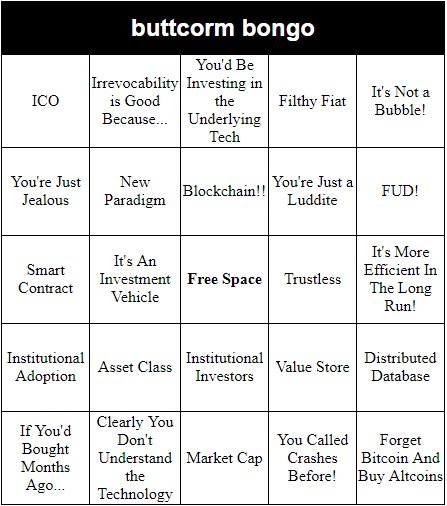
Our uses of cryptocurrency and blockchain technology now are similar to how we once used the power of the web to create Geocities pages with nothing more than MIDIs, scrolling text, and under construction gifs, because we didn't know what we were doing yet. But the early computer and internet pioneers were able to see past the proofs of concept and build on those ideas, to create the modern internet we have today.
Bitcoin may cease to exist as a software product, but I think the innovations that it has spurred on will be with us for some time. This technology has the possibility of making business much more efficient by reducing costs that are associated with distrustful parties having to rely on (and pay money to) third party escrow/auditing services. If I want to send a large sum of money to someone else now, I have to rely on third party services such as banks or Western Union to facilitate that transfer.
If you still continue to think "well that can be done with a SQL database now", you're completely missing the point. There's nothing wrong with relying on third parties, but now we have technology that allows us to choose not to if there's a need for it. In that regard, cryptography shares many of the same characteristics. We could communicate securely before public key cryptography was invented, but it broadened the scope and security of such operations, to the point where we espouse using https for all websites, not just ones requiring security. When the time comes, why would you trust a third party if you didn't have to?