Let's hope that it decides to offset the cost of all those planes hauling its boxes around the country by selling tickets to paying passengers.
I don't know how accurate this is, but a private jet pilot I was sitting next to on a flight told me that excess passenger airline baggage space was already being used to ship packages. If that's true, then baggage fees make a lot of sense. Passengers would be competing with Amazon and other companies for that space.
You are correct. It was government contracts to haul mail that turned flying airplanes into an industry back in the early days. Passenger service was added later.
Cargo remains more profitable than people even today. That's why you can still ship packages via passenger bus. Or at least you could the past time I did it in the early 2000's via Greyhound Package Express.
I'm not saying it Amazon Airlines should look like United, with a couple of hundred people up top and all the cargo down below. But maybe add 50 or 60 seats in a space in front.
One of the problems with cargo is that it's so ephemeral. A plane on a particular route can be full of packages at Christmas, and then half empty the rest of the year. This is exactly the sort of problem that Amazon seems good at solving.
Maybe make the passenger compartment modular. Add more seat modules when cargo loads are low. Add more cargo pods when demand is high.
But why? Passenger transport is already well catered for and extremely low margin. Also, passengers are annoying and generally not cardboard wrapped. They require seats and toilets and cabin attendants and pretzels and infant flotation devices. Cardboard boxes also don't videotape you when you offload them last minute to make room for something more valuable.
And that's before accounting for scheduling. Freight flights are often late nights, because cardboard boxes don't have eyes that can go red.
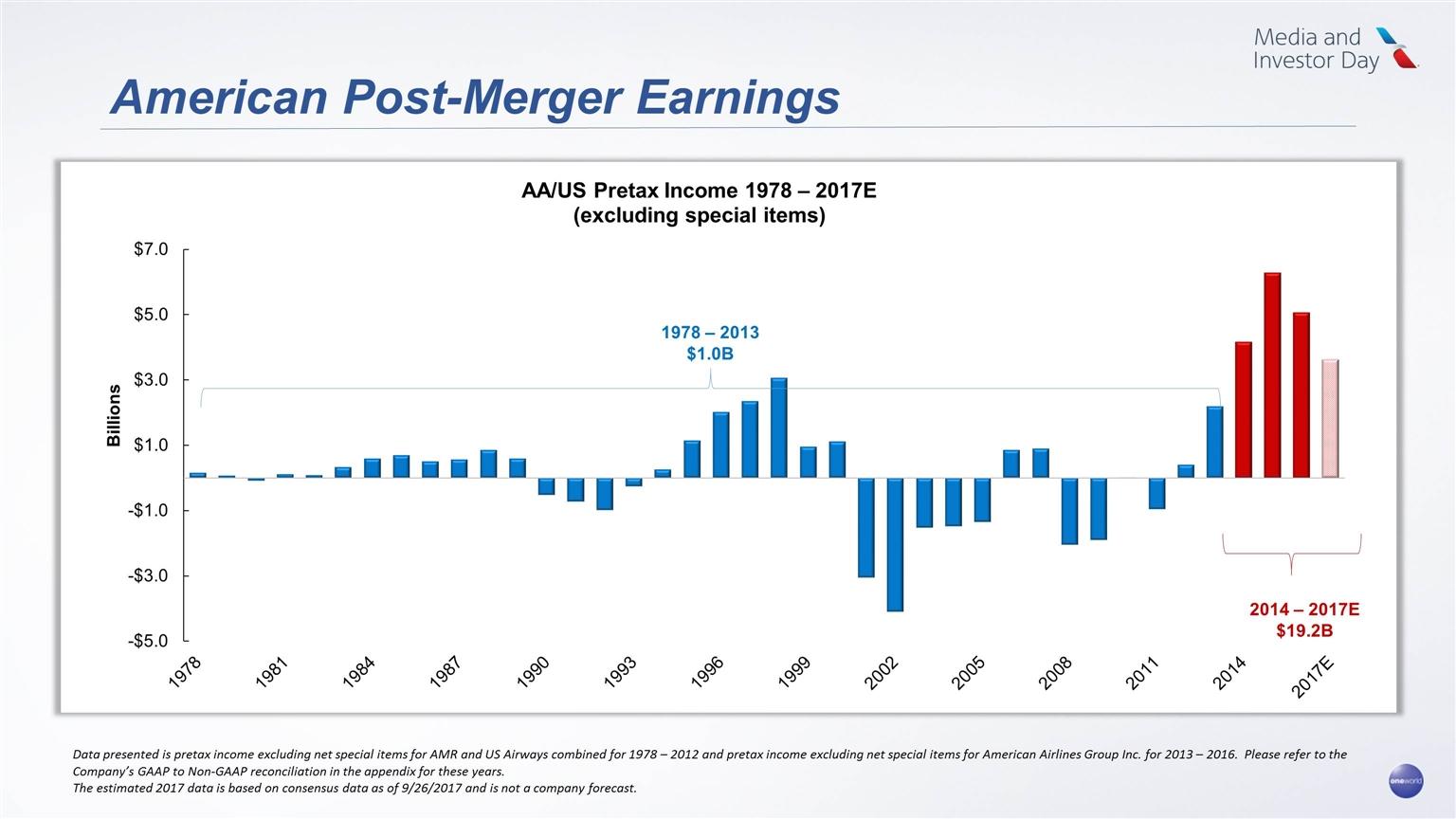
AA filed chapter 11 in 2011. They are doing well now, but they are very vulnerable to things they can't control well, like fuel prices, unions, etc.
In fact, the bankruptcy is part of why they are doing well now. It allowed them a free pass to invalidate all union contracts and start over with lots of leverage.
That $10B is a high number, certainly, but it's historically high. It's worth keeping context in mind here: this profit is earned on 446B passenger miles. Every time you fly a mile on AA, they profit a whopping 2.2 cents, and that's in historically good years. Even on a 7000 mile long-haul, that's just over $150 average per passenger. Devil's advocate says that smaller legroom is the reason they can turn a profit at all.
Low margin would be if they made $5. A $150 profit is pretty good since there are 200+ people in the plane. That's $30,000 a flight.
And remember, we're talking profit here, not income. I can't think of a scenario where a business with millions of paying customers would sneer at merely making a profit of $150 off of each one.
I'm not saying Amazon will switch to passenger transport, but you can imagine that their strategy would be to dominate the market by subsidizing ticket prices, then once they have the proper penetration, to raise ticket prices and be the first airline to increase margins in some time.


I don't know how accurate this is, but a private jet pilot I was sitting next to on a flight told me that excess passenger airline baggage space was already being used to ship packages. If that's true, then baggage fees make a lot of sense. Passengers would be competing with Amazon and other companies for that space.