A couple years ago I had the privileged of getting to overhear an adjacent table where a scam cryptocurrency founder was pitching their ICO to an investor in a restaurant in mountain view. At the time I hadn't even heard of it but it went on to raise a lot of money then end up mired in legal trouble.
The central premise of the pitch was to repeadily go over how Bitcoin market price had changed from 2009 to whenever it was (probably around $3000 at the time), and then suggest that their new asset would experience even greater increases even faster because <jargon>. Paraphrasing: "So if I invest $1m today, in seven years...?" "Your investment be worth 100 billion! maybe more, but I can't promise that. 100,000x growth is the _minimum_ but the maximum is anyone's guess". They looped over and over again, I think with the prospective investor making extra sure he understood before writing the guy he was talking to off as a scammer.
At that point I stopped worrying about the particular pitchee was going to get scammed, it was too absurd. (I'm sure my numbers aren't exactly right, for one they had a bunch of excess precision in reality, presumably based on the day's Bitcoin price, but whatever it was was totally absurd).
> or even a VC that is not tech savvy
Honestly, I think being "tech savvy" is a liability. Someone who doesn't think they're tech savvy knows they don't know. It takes a certain level of expertise to talk yourself into something extremely dumb. They might not fall for this particular pitch deck (or the one I overheard), but there are scams for every skill level. And the more confident you are in your understanding, the larger the "investment" you will being willing to make.
Part of the "certain level of expertise to talk yourself into something extremely dumb" is because we've all heard the stories of genius ideas that were dismissed as crazy. And if someone considers themselves "smart", then they think they can identify those opportunities before the general population.
This leads to both/either FOMO ("I don't want to be considered dumb because I didn't invest in X") or self-optimism/egotistical ("I'm smart because I found the Next Big Thing"). These two factors explain a lot of the cases where supposedly smart people talk themselves into stupid decisions.
Or as another commenter posted, these people are not really "smart" or are smart but not "wise", because a wise person would recognize such situations and be on the other side of the stupidity mountain into enlightenment land.
I think at some level expertise does become a robust defense against scams; it's just that the level required is incredibly high. Scamming Cynthia Dwork or Wei Dai with a new cryptocurrency would presumably be a waste of effort, because they'd jump straight at that <jargon> bit and even a very good con artist wouldn't keep up. Likewise, top physicists, cryptographers, and mathematicians hear from a lot of cranks without ever getting taken in. (Or, I suppose, they're too embarrassed to admit it.)
But most people aren't at that level of expertise, and no one is that good at everything. If you're an expert at one thing, you're bound to be merely informed on a bunch of topics at the periphery of that thing. And "tech savvy" more or less means "informed by not an expert", so I think you're exactly right - that, more than cluelessness, is where danger lies. As we gain knowledge, we rely more on our own expertise than on consensus wisdom. And that's often right for spotting bad ideas, but it doesn't work for spotting scams. If someone is trying to hide the flaws where your knowledge is lacking, learning twice as much gives you far less than twice the resilience.
I definitely can't identify the next bit thing in gene therapy or concrete additives, so there's no point in even trying to pitch me. I'd turn down the real deal and not regret it later, because I have no chance of getting it right. But I first heard about Bitcoin in 2011, so it's not quite unimaginable that I'll get a shot at the next one also. And a "not quite unimaginable" shot at riches is pretty much what scammers live off of.
I think the only thing that might protect Cynthia Dwork or Wei Dai would be if they were wise enough to not believe they were immune to being scammed.
Yes, the person I was talking about wouldn't be successful against a more sophisticated target. But there is no amount of technical sophistication that makes you immune against the right scam because even the most technically adept has finite time to consider things, and they're all still human.
Your excellent point about "learning twice as much gives you far less than twice the resilience" means that essentially no one can be completely immune, once you factor in time.
So I think only the wisdom to really appreciate your vulnerability is universally protective, even if you are an honest to god super-guru.
Case in point, witness the fact that one of the early Bitcoin developers publicly endorsed and obvious fraudster claiming to have invented Bitcoin but who can't even get basically technical points about Bitcoin right, much less some new and unfamiliar system. In some alternative universe where that hadn't happened his name might have easily found its way onto your list.
I agree with you that the kind of top flight technical background needed to shunt off even fairly unsophisticated scammers is very rare.
> But I first heard about Bitcoin in 2011, so it's not quite unimaginable that I'll get a shot at the next one also.
Indeed, but there you wouldn't have needed to expend much-- and not anything that could have directly made a scammer money.
I've always thought it was weird to see people who in 2011 said Bitcoin was a scam and didn't mine any though they could have at little cost... years later turn around and dump their life savings into super sketchy premined altcoins. I think they learned the wrong lesson. Their skepticism wasn't a problem.
"Once you factor in time" is a very good point, and one I shouldn't underestimate because it's almost always a factor in scams. Most people can avoid being scammed with enough time and space to consider, and most scammers are excellent at denying those to their marks.
And yeah, now that I look at the list of people who've claimed to be Satoshi, it's pretty alarming to see how many have gotten at least one major Bitcoin figure to vouch for them. Even Craig Wright, who claimed he'd move the genesis block and then simply didn't - I guess being a Bitcoin guru isn't enough to make sure you actually verify somebody's published transactions.
I suspect that you need several times the technical sophistication of a scammer to catch them out, and if they know who they're pitching to the bar might rise unattainably high. The fact that it normally doesn't, that even I know enough to catch out scammers, has less to do with protective expertise and more to do with not being in their intended demographic of marks. Which ties into your last point: I don't really regret not buying into Bitcoin given what I knew, but my takeaway is "don't be afraid to throw $100 at a crazy idea", not "try to search out hidden gems", and so I'm not likely to be a high-dollar target for later scams.
> Honestly, I think being "tech savvy" is a liability. Someone who doesn't think they're tech savvy knows they don't know. It takes a certain level of expertise to talk yourself into something extremely dumb. They might not fall for this particular pitch deck (or the one I overheard), but there are scams for every skill level. And the more confident you are in your understanding, the larger the "investment" you will being willing to make.
Blockchain's probably the prime example of that. Understand a potential real world use case and you can probably identify the extent to which mutability of records loses value, and pay someone to audit the code if the real problem is that centralisation is impractical and stakeholders can benefit from manipulating the records without having any incentive to modify the physical product. If your fundamental understanding of a business model convinces you the real business problem is mutability of records, you can hire someone skilled to evaluate whether the codebase is likely to fix that. More difficult if your starting point is that the code and team certainly deliver on promises and the only problem that needs due diligence is everything else about why people would ever use it.
On the other hand, outside the VC world there are a lot of people in corporates who broadly understand use cases but don't have an in-depth knowledge of the tech whose job depends on saying yes to enough innovation initiatives
> outside the VC world there are a lot of people in corporates who broadly understand use cases but don't have an in-depth knowledge of the tech whose job depends on saying yes to enough innovation initiatives
Both inside and outside the VC world, I think.
You make an extremely good point about use cases: you don't have to be an expert on the tech to avoid scams as long as you're an expert on the problem it's being used for. If you can say "but we have a trusted source and we want to fix mistakes in old records, wouldn't a database be better?", you're past 90% of blockchain puffery. But if you have to say "what if there's a trusted source?", you can still get snowed by talk about all the hypothetical ways that could fail to apply.
If you're picking tech someone else will use, or investing in products you think the market will value, you can't rely on knowing the problem in detail. It's like the difference between a beta tester saying "can I buy this?" and saying "I'll bet tons of people will buy this". The first tells you what they think about the product, the second other just tells you what they think about other people.
>Honestly, I think being "tech savvy" is a liability. Someone who doesn't think they're tech savvy knows they don't know. It takes a certain level of expertise to talk yourself into something extremely dumb.
All those pages that you found of people having exactly that same combination of educational background can be simply explained. They are the default sample content of the Team page on certain Wordpress themes (Therefore also the WP in ‘Blockchain WP’). A quick Google search shows that for example the FinanceCo theme from Radius has the same exact Education listing.[0]
So the other profiles you found could just be sloppy webmasters who didn't remove the default Team pages of their Wordpress theme.
Interesting, ok never thought that it might be the wordpress template. Will update the text. Even so, that "Sam Chester" page on that first linked site is legit. I think I found the legal guy too (US lawyer by the looks of it), this is his twitter page: https://twitter.com/richardnacht
Over on the employment side, I got a summer job pitch in college from a hot new startup building some kind of app to help turn activity tracker output in actionable info. A startup of four people.
"This sounds interesting, but I'm wondering why you're looking for a fifth employee who's only going to be around for a few months instead of someone committed?" "We don't want to shorten our runway with salaried hires too fast, but we're expecting to close funding within the next year, so we can bring back the summer hires full-time after graduation and you'll already be ramped up."
"So you have some runway now, and you're negotiating more funding - you've raised angel funds and are working out Series A?" "Well, we're still at 'friends and family' and we haven't pitched VCs yet, we don't want to dilute the company too quickly. But we're starting to sound out investors and we've had a lot of interest!"
"So if you're that early on, are you looking at hiring purely in stock? How will that work with the temporary role?" "Obviously we can't give people shares just for a summer of work, and we don't want to plan too far into the future since we don't know our timeline yet. But once we close this funding we'll of course be making very competitive salary hires with stock grants."
"So it's contract work with the potential to become an early startup employee later? I don't mean to obsess about salary, but I see it's in New York City and I'm going to need to pay rent." "Well it's not contract work as such, we want people more dedicated to our mission than that. But I guess I could talk to the other founders about putting together some sort of housing stipend."
"So, it's an unpaid internship in NYC, and you're not willing to put anything beyond that in writing?" "..."
Just for fun, I kept talking for long enough to find out the top-secret details of what the app actually did, which took some doing. It was going to assess your activity level and "holistic well-being" to present a "supportive audiovisual experience". They'd stapled a 2000-era WMP music visualizer to a mood ring.
I’m glad you were aware enough to ask the right questions. However, I will add that whatever poor judgements people make there is just this line that is crossed with actual falsehoods that is hard to undo.
Whatever mistakes these would be employers made, at least they told the truth.
Very true - I don't think I was told anything factually false, and that's hugely to the founders' credit. It's the distinction between caveat emptor and fraud, I suppose, and since some friends had gotten suckered by similar offers I knew what to beware.
Perhaps this story fits better under the other thread here of legitimate arrangements with scam-like effects on their partners. The pitch I got reminded me more of a doomed restaurant than an MLM: the founders seemed sincere about the merits of their idea at least (they demanded an [now-expired] NDA, even!), and I really don't know if their optimism about the company's prospects and the job's quality was faked. They knew something was wrong well enough to bury the problems, but an outright work-for-free scam would probably have been pitched more smoothly, maybe as a "take-home interview assignment". As is, they might well have followed through on the promises if they had somehow gotten their millions. They didn't exactly have my best interests at heart, but like many people overselling failing projects, I think they were aiming at a wildly unlikely success rather than pushing a strictly negative deal.
Thanks! I can't exactly take credit for being insightful, but perhaps well-read - a friend and several people on HN had stories getting jobs with essentially hopeless startups, and I figured that "what would a VC ask about this situation?" was a good starting point for due diligence.
Oh, man $1billion just waiting to happen yeah that's suspicious.
That would be pretty brave of Honeywell there ... I guess it wouldn't technically cost them anything to have a PO where they maybe had to deliver a product first but big company like that looking at someone without a factory would more likely get a "lol k thanks bye" than a PO ;)
Seems unlikely they'd bother to even plan to sell a product that isn't a thing yet tied to some nobody without means to produce it.
But I think the worst scammers are those that operate in a semi-legit way. They're actually out there, in person, trying to raise money for some product which may work on a fundamental level, but that does not mater, as they have no plans on developing anything. Maybe they have legit experience from before, and even have serious people that can vouch for them, if needed.
They put together startups, have a couple of good months, but then go back to regular programming of funneling VC money into their own account, while starving out their startup.
Then when the startup goes under, they disappear, only to resurface a year or two later somewhere else. Probably with a new name or alias.
They almost never go for the real big fish / tens of millions, or even millions - but just enough to live a cushy and flashy lifestyle. Nice leased penthouse, cars, etc.
Totally agree. I came across a few of these over the years. Entrepreneurs that have done 5-10 companies in the past and none succeeded. They always raise money and fill their coffers and their friends' too. They stiff good vendors. Because if you can get real work done for free, it gives them the optics of having created something but they still have more money to squander before it goes belly up. And when the company closes down, unless you can prove fraud there's no recourse.
In the movie Goodfellas they articulate it well - obtain the goods on credit, move it in front door and sell it at a discount out the back. It doesn't matter. It's all profit! Then they even light it on fire and collect insurance money.
Here in Norway they have a name (to the Goodfellas ref.), in the lines of "bankruptcy jockeys/riders", meaning that they ride companies into bankruptcy.
They are especially rampant in construction, where it's easy to get bank loans, by showing contracts and won bids (which are won by aggressively undercutting competition), and inventories can be flipped with ease.
We do have laws that essentially gets them banned from owning companies, if they pull that off too many times - but they easily circumvent that by just persuading friends and family to start companies on their behalf. It's a scummy business.
I get the feeling that it's easier to raise money for some vaporware, and then have fun for a couple of years with that pile of money than to spend a couple of years self-funding something that actually works and trying to find a buyer.
The more frustrating version: you work hard and self-fund for a couple of years to make something that works. Then along comes clueless bunch 1.0 who are bankrolled by clueless VC who then undercut you on price, over promise and do not deliver leaving you with potentially years without sales because you can't match the hype train. I've seen this a couple of times and it isn't pretty. By the time they finally go belly up you may have preceded them down that path.
> I have no idea what the graph has to do with the words, maybe there is some connection here but I haven't found it yet.
With the slide saying: "The lack of direct integration with operating companies and associated funding sources creates volatility and eventually subjects other coins or tokens to disintermediation and extinction."
(Or, translated "other tokens die because of $reasons")
I think the point of the graph is to just reinforce the mood. Be an emotional influence that makes you take the slide's message more seriously. Where the text talks about the reasons why other tokens fail, you see a line representing something going down in value fast. For some reason, just looking at it makes me feel sad, the "oh no my investments" kind sad. Which I believe was the whole goal.
Total aside, but this notion that before the invention of minted coinage all exchange was done via "barter" is just completely ahistorical. Before currency exchange was done via favors. Instead of countable coins, you contributed to your community and built up a reserve of "honor" or "cred" that you could use to call in favors when you needed any kind of help or support. It's usually referred to as a "gift economy," but people get thrown off by the term "gift." It's less about the stuff you give or do and more about the obligations you have as a member or friend of any given community.
The main thing to remember is that people just had a very different way of thinking about the exchange of goods and services back then. It wasn't about financial transactions or maximizing economic returns, it was much more about building up cred and standing within a community.
Where financial transactions really come in is being able to facilitate exchange between two communities where that underlying foundation of trust and persistent social connection doesn't exist. This is why marriages between "clans" or "tribes" or whatever would often be marked by exchange of things that hold value like livestock, heirlooms and handicrafts, or parcels of land. These aren't really "barter" exchanges though, they're more like collateral or shows of good will between two groups or people who don't necessarily have a strong basis for trusting each other.
This is why coinage really starts to come around when you have large kingdoms or empires. Those rulers mint the coins because they control larger swathes of territory than could be governed by the sort-of-feudal interractions of familial obligation. So you start keeping track of things via precious metals instead.
This should not be downvoted. It is definitely a factor, just not quite in that way. Founder diversity is a thing and female CEO will get you funded in some cases where a male CEO would not. There is a huge push to level between males and females and in some cases the balance is shot through to the other side and critical thought loses out over the gender balance thing.
>According to researchers from Columbia Business School and London Business School, businesses led by women are 63 percent less likely to obtain venture capital (VC) funding than those led by men.
That's not in any way contradicting what I wrote. Yes, men are much more likely to obtain funding than women. But, in some cases women are funded when men would be passed over with the same idea. It's similar to affirmative action.
Making the fictional company a cryptocurrency startup is lazy writing in my opinion, they are too easy to criticize. This article would be more compelling if it were analyzing a more “stealth” scam in a different market sector.
Thanks for creating this post! Fascinating read. You mentioned in the post that a lot of the links in there would probably right t away with time - do you think there's any value in archiving the links and linking to the wayback versions so they're preserved for education for posterity?
It's interesting to look at these slides because I so strongly prefer simple straightforward "ugly" presentations to slick vector art ones that include a timeline from 9000 BC. Slick presentations prime my "this is BS" suspicion.
I know this preference is a trope for people on HN (I mean, look at the HN layout) but it's strange to me that VCs apparently have such different preferences.
I'm not sure if I'd be able to resist asking the presenter how they got data from 4000 years before the beginning of recorded history if I was presented with a slide like that.
What's immediately remarkable about this deck is the frequency of poor phrasings and misspellings, especially as you get deeper into it. Virtually none of the "legitimate" pitch decks I've encountered have suffered from this degree of sloppiness.
Maybe it’s like the apocryphal rumour that spelling mistakes in scam emails are really a filter to get rid of a large chunk of people who wouldn’t fall for the scam anyway.
The author speculates this as well in the article:
> Maybe this strategy is similar to how the Nigerian scammers work: put some obvious errors in the text, anybody that misses those is probably well worth the time invested and those that cancel early would have cancelled anyway, an optimization strategy.
Does that make sense from a behavioral-economic perspective? What is the scammer’s incentive to filter certain people out? Wouldn’t it be better to move more people down the “funnel” and filter potential troublemakers as they appear?
Generally in a sales process, the further down the funnel you get (as a prospect) the more of your counterparty's time you'll be consuming. A mass-email might trigger a call, for example.
I think the idea is that the scammers might be pre-qualifying their prospects for gullibility before committing further time to closing the sale.
Via the book Think Like A Freak which I’d guess extrapolates from it. But it seems like one of those ideas that has gone from plausible explanation to fact in popular imagination.
The more invested someone gets, the more likely they are to kick up a fuss when they decide it's a scam. If you were pitching this deck, you don't want prominent, angry VCs posting publicly on Twitter about how it's a scam.
If you weed them out right at the beginning, exposure doesn't happen as quickly.
Moving down the funnel means increasing time investment for the scammers, too. Better to spend those hours on someone gullible.
As with scam emails, I suspect that's to weed out overly skeptical potential victims early on so you're not wasting time on someone who will realize it's a scam.
Yeah, I'm blown away by the fact that "chauffeur" is part of the brand name but no one seems to have spell checked it first to make sure they weren't accidentally talking about a portable stove.
I have a question. How in the world do VC's ever fall for this bullshit? I mean in most situations they have made enough money on their own to invest, so they aren't stupid right?
1. Most VCs don't create value. Compared to a passive fund, like an ETF, they lose money (and take large fee, regardless of performance).
2. Most of the people staffing VCs were not necessarily successful investors. Many were people in their 20s escaping the NYC banking scene to be analysts in VC. These days, there are many people on the capital side that are ex-entrepreneurs, but that still doesn't mean they know how to spot a deal.
3. It does not always make economic sense to try to out a scam. If your model is that you find one mega-return to erase 100 failures in your portfolio, you actually go around looking for deals that sound insane (like Theranos). If other reputable VCs have already led the round, you just throw your money in without even investigating.
4. Most importantly, most VCs don't fall for anything this crappy. The target is likely individuals with net worths in the millions who aren't very business savvy. There are lots of such people (children of wealth, for example).
Related story: Around the turn of the century I was talking to a VC friend about the dot com boom. He said "Watch out if the dentists start investing." Meaning, people with high net worth, inflated sense of knowledge, and not much tech savvy. Next teeth cleaning visit, my dentist enthusiastically told me about a start up he was investing in. Coincidental or not, the crash soon followed.
I was involved in a bitcoin ATM company and left... two years later, was sitting at my current company in the bathroom and I hear someone from the non-technical side go 'Dude, you have to invest, it's at nearly $20,000, it could go to a million'.
You'll never guess what happened when it passed $17,000
There are a lot of parts to the answer, at least in my experience with VCs.
Probably the biggest is just that they have a bias to be bullshitted (bullshat?). The are constantly searching for the next big thing, so they need these things to be true. They want them to be true. And human nature makes them scared of missing out.
Also, most of the VCs out there are not investing their own money, and have never actually operated a business. This is why they ask the same questions with slight variations, and get obsessed with metrics that may or may not apply to a given business. This also makes them easier to fool, although many make up for this hands-on inexperience with enough years of watching startups that they can "pattern match" rather than understand things from first principles.
Most also develop specialties. You're not going to fool an experienced blockchain VC with the made up or cherry-picked bitcoin numbers. But go next door on Sand Hill Rd and you can probably get away with it.
I once pitched around my own startup... and VCs all refused it, just in case it was "another scam".
Then I found out... they DID got scammed, in a rather elaborate way:
some guy (that I won't name here, but you can find out who it is) seemly created a mobile games company, made some simple but wildly successful games (in donwload numbers), and then started to put ad fraud after ad fraud on the games, Apple started to ban him, but he would find other ways to get back, meanwhile he would accumulate cash, then he rented an office, built a seemly legitimate company, and asked the VCs for money, and as proof of his business working as intended, gave to the VCs the data about his income...
Eventually Apple and Google figured out how to kind-of get rid of his frauds permanently, seemly he found one last loophole, moved all apps to a new account that was on his name only (not his company), fired all employees, and took off with Apple's and VC's money.
I was told Apple ended taking the hit, they gave all the defrauded money back to advertisers, but couldn't get the money back from the scammer.
So to reply to your question: if you have data, for example (fraudulent) income, it is easy to convince VCs... for the first time.
Since on the second attempt they believe even real business (like mine) is a fraud.
I know two people like that. Both absolute genius level but for some reason the only way they can think about making money is by somehow moving it from someone else's pockets to theirs without creating any value. If they spent 10% of their talent on value creation and the rest on the business end they'd be doing much better than they do now. Really wasteful.
I think that at some level it is insecurity. The idea to make money out of nothing is harder to convince yourself you can do than to take money that is already there and move it.
The games have (I checked and they, and now lots of clones, are still online) descriptive names, and word of mouth make people search for them, and search engines do find them.
They are all simple stupid games (think floppy bird, although games in question are not that one)
Speculation: because the only way he could make these games "wildly downloaded" is a massive advertising spend. If the games can't actually maintain a userbase on their own, they might not be worth anything.
Because money, and its management, is not distributed by I.Q. but rather hazardously. Here are a few categories that I can think of.
- rich people by inheritance. They might have been spoiled and thus required little due diligence in life; or simply they are dumb and believe the hype.
- rich people by accident. They are not particularly bright. They invested in real-estate very early on because that's what they know at the time. Then real-estate appreciated significantly in the last few decades in their area and they are crazy rich.
- people managing other people money. they have to invest in "blockchain" and stuff and they get introduced via their circle. It's not their money at the end of the day; and if the VC fund collapse they'll manage to jump to the next one thanks to the networking circle they were busy building during their last tenure.
Given the amount of VC-funded companies with blockchain-powered products where the blockchain is either useless and can be replaced with a database, or where the product itself is completely flawed I realised a lot of VCs do absolutely zero due-diligence on a technical level.
I remember that hitting home for me when I saw a "stable coin" that was mechanically equivalent the a sort of economic perpetual motion machine raised over $100M from reputable investors. Not just a $100M+ valuation, a $100M+ raise. Nobody I talked to who had actually read and understood the white paper was surprised when they folded after not launching, blaming regulators rather than taking ownership of the fact that it was a flawed premise.
They apparently returned 90% of it, I'm not sure where the $13M was spent. (To be clear, I'm not suggesting this is a scam per your definition, just a failure of DD on the VC's part.)
I don't think most people -- VC, angel or otherwise -- do, but I suppose occasionally some must.
I believe what happens is that they think about the idea. What if there were some kind of bitcoin powered investing platform. Sort of like angellist but the block chain would ensure the funders were real and the money was in some crypto?
Yes, that could work. Wow, it could be worth a lot! Imagine all the startups that could get funded and omg where do I sign?
This wouldn't happen if you went for a visit, and the person -- lets assume they mean well and are not lying -- logged in and the screen was a little awkward. There were zero companies signed up because the authorities had not signed off on it yet. There are two companies waiting: a fast food franchise and a t-shirt company.
The gap between what could be and what probably is, is very wide till you actually look at the thing.
The thing that set my alarm bells is the projected revenue, users, posts, and etc. column charts. They have noise in them. As if someone played with the numbers to make them look like they're real data.
In India anyone can purchase the balance sheet and p&l for any private company as long as you know its name or directors name on a website like https://zaubacorp.com
PS - no affiliation
Edit: Not sure why I'm being downvoted, added this because I genuinely think it is a good additional step for seed investors and HNIs investing in startups to ensure the legitimacy of the claims made in a pitch deck.
P&L is possible to purchase in many other jurisdictions too, including the UK. It's also borderline irrelevant if the theoretical valuation of your startup is based on something which becomes a revenue stream in future (SaaS revenue, enterprise contracts, coin value appreciation). Obviously some startups have more plausible arguments about the magnitude of future revenue streams not based on past performance than others
I was not aware of that. I have tried to find (and even purchase) revenue information for private companies in the USA, with no success (reached as far as SEC filings, but couldn't get detail revenue, P&L info). And I don't trust revenue information on websites like Zoominfo and Owler as they are way off the mark for Indian companies.
Good to know that this is possible for the UK too (I wonder if that is why India Ministry of Corporate Affairs allows this too). As a director in a private company, I always viewed this as a possible privacy violation (that anyone, including bad actors could know my income if they wanted to).
I’ve seen these types of decks pitched internally at blue chips as well. There, an audience being bewildered by innovative words is exciting. Get in, get budget approved, get promoted before the devil even knows you’re there.
I think the most important takeaway from this is how many businesses which are not scams and have real revenues are tempted to flesh out presentations with similar vanity metrics and spurious background info...
This really happens and it almost invariably leads to some pretty pointed discussions during the due diligence. The tough part for the founders is that any surprises during DD cause break off risk or adjustments, sometimes major ones. Not getting funded in some circles leads to you not being able to get funding at all. The tam-tam is pretty powerful in VC circles.
The irony is that whilst posting that I was interrupted by a founder for feedback on market size indicators for an investor presentation. One where the DD guys will have signed contracts in tough-to-enter markets to scrutinise ahead of CIO survey percentages on slide decks, but still feel my less is more advice was justified.
I wish I could be as "religious" about my own company as that pitch deck is about warp. I know it's a scam, but the way its presented, I'm almost excited about it, lol.
at face value is a great idea, you sidestep blockchain adoption by tying it to physical and social services, you sidestep certain taxation like vat because value is gained only when these coin are converted back into money, you're not holding account because people purchase coins for money, so the money you sit on is yours, they only have a guaranteed buy back price.
it's extra funny because I know a startup that did basically that and is quite successful; but of course it focused only on the coin service exchange part and throw away the bitcoin / services nonsense.
While this points to outright scam - I’ve seen a fair number of pitch decks that deserve to be thrown in the trash but get serious attention anyway. It seems obvious but I’ve seen a number of investors who will ignore a history of average growth, simply eyeball next year’s forecast, and go with their gut if the management team has solid verbal skills and looks the part.
My favorite graphics in these slides are the revenue/user graphs that show occasional, apparently randomly inserted, MoM downturns. Could be an effort to make them seem more "realistic", even though I would be surprised if it were possible to make predictions with that kind of precision.
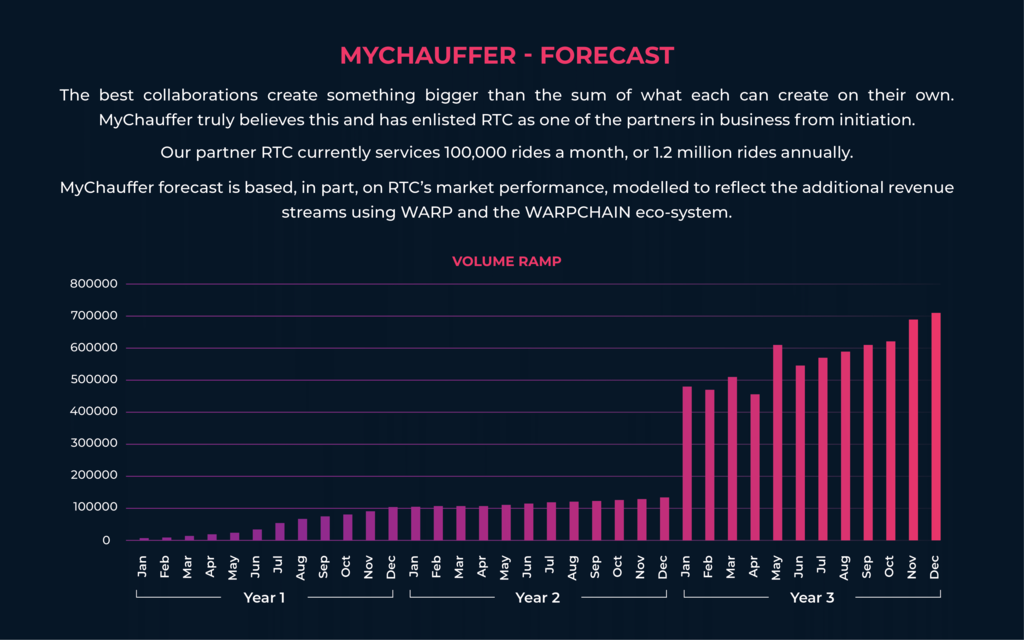
What genuinely puzzles me is the myChauffer revenue forecast quadrupling from Dec of Year 2 to Jan of Year 3, seemingly without any explanation offered in the text: https://jacquesmattheij.com/warpdeck/WarpDeck-14.png
I can't imagine anyone falling for these scams, unless there's a complete and utter breakdown in due diligence. At some point you're gonna go on and have a meeting or video chat, and it'll all come crashing down.


The central premise of the pitch was to repeadily go over how Bitcoin market price had changed from 2009 to whenever it was (probably around $3000 at the time), and then suggest that their new asset would experience even greater increases even faster because <jargon>. Paraphrasing: "So if I invest $1m today, in seven years...?" "Your investment be worth 100 billion! maybe more, but I can't promise that. 100,000x growth is the _minimum_ but the maximum is anyone's guess". They looped over and over again, I think with the prospective investor making extra sure he understood before writing the guy he was talking to off as a scammer.
At that point I stopped worrying about the particular pitchee was going to get scammed, it was too absurd. (I'm sure my numbers aren't exactly right, for one they had a bunch of excess precision in reality, presumably based on the day's Bitcoin price, but whatever it was was totally absurd).
> or even a VC that is not tech savvy
Honestly, I think being "tech savvy" is a liability. Someone who doesn't think they're tech savvy knows they don't know. It takes a certain level of expertise to talk yourself into something extremely dumb. They might not fall for this particular pitch deck (or the one I overheard), but there are scams for every skill level. And the more confident you are in your understanding, the larger the "investment" you will being willing to make.