There is no Republican Snopes because conservatives, since the Enlightenment, don't do sense making that way (i.e. via institutional consensus). At the end of the day unless you were personally there to witness something or can prove something mathematically or do the science yourself, you are ultimately dependent on some network of trust to inform you of the truth or falsity of something. And even then "true" and "false" outside of logical and mathematical domains is entirely dependent on ones values. That's not to say there's no objective universal set of values.
Most people are Liberal (in the American sense) because that's what all the organs of culture promote and reinforce. It's like the "default" position that people adopt. I grew up liberal in a liberal household where we watched Hollywood movies and mainstream news like ABC, NBC, PBS and I listened to NPR and I went to school which was run by generally liberal teachers and administrators and that's pretty much why I was liberal.
This is the Cathedral vs the Bazaar approach to sense-making.
> There is no Republican Snopes because conservatives, since the Enlightenment, don't do sense making that way (i.e. via institutional consensus).
Conservatives have always done sense making via institutional consensus, even moreso than post-enlightenment liberals, though the institutions that they tend to appeal to are those explicitly devoted to their ideological world view (whether it's the organs of a particular Church, or economists of the Austrian School) and not so much those even superficially devoted to objective exploration of facts, even when approaching questions that are, at least on the surface, about objectives facts (what is) rather than ideology (what should be).
> Most people are Liberal (in the American sense)
No, they aren't, unless you are conflating multiple different and incompatible American senses of “Liberal” and thus covering the entire range from the moderate right to the far left.
> objectives facts (what is) rather than ideology (what should be)
What is a "fact" or what is "true" is dependent on your values (aka your ideology). This is one of Nietzsche's main contributions to philosophy.
There are things like mathematical and logical truth and really basic physical assertions (e.g. the sky is blue) but those are qualitatively different than what we're talking about.
Both normative and positive statements about the world of human affairs are ultimately dependent on ideology and that might explain to you why you perceive conservatives as focusing on arguments over ideology. That is what people should be arguing over since from that all else flows. When people don't share substantially similar values even language itself becomes useless as a means of communication because the words themselves mean different things.
> What is a "fact" or what is "true" in dependent on your values (aka your ideology). This is one of Nietzsche's main contributions to philosophy.
No, it's not. That's one of the Enlightenment’s many contributions to philosophy and the foundation on which the advances in knowledge of the universe enabling the explosion of post-Enlightenment technical progress is built.
Obviously, one might have ideological, aesthetic, or other preferences for what facts ought to be, and one might have beliefs about questions of fact that ultimately result from those preferences, but—Roadrunner cartoons not withstanding—beliefs about the material universe don't trump material facts.
(However, it's kind of funny that you are making, as a positive argument in favor of conservatism, exactly the argument that conservatives usually not only reject, but also attribute—not entirely inaccurately though certainly overgenerally—to the “postmodern” left and cite as a key reason for rejecting the left.)
> The same metaphysical view you're describing also enabled utopian totalitarian visions like Nazism and Communism.
Leninism and it's descendants are totalitarian, Communism (even Marxism) more generally is not, but, sure, you can certainly make the case that scientific rationality has some connection to Marxism and thus an indirect effect on Leninism. OTOH, scientific rationality and the proven results are also the explicit basis for the widespread Western rejection of Leninism and it's descendants (and explictly cited as such by wide segments of the Right, including those who generalize that rejection to Communism generally, which the left might argue is an overgeneralization, but even in that argument there is a broad consensus that there are actual material facts that one can draw conclusions about from material evidence which transcends ideology when approached correctly.)
OTOH, Nazism was not based on scientific rationality, except as a reaction against it, and in fact both Italian Fascism and Naziism were explicitly based on the exact Nietzschean view that you advance (both the idea and explicitly crediting it to Nietzche).
> Postmodernism hinges on whether or not there is an objective set of values. Conservatives believe there is (the Bible, natural law, God, etc) whereas Postmodernists believe there isn't.
That may be a difference between your particular worldview and postmodernism, but large number of other conservatives criticize the “postmodern left” not merely for rejecting objective values which you claim is the difference between Conservatism and Postmodernism, but for rejecting objective facts and viewing facts as constructs which depend on ideology—the position you take on the nature of facts is one explicitly rejected and criticized (and attributed as a failing of the left) by most mainstream conservative thinkers, though I will agree that the factions of the Right who adhere to it are at what is, at least, a recent local maximum of prominence.
How can you say this when Nazis famously "pioneered" and promulgated things like Phrenology and Eugenics? Scientific racism was at the heart of the Nazi program.
> the position you take on the nature of facts is one explicitly rejected and criticized (and attributed as a failing of the left) by most mainstream conservative thinkers,
I do agree with you here. What we're discussing really only has meaning when both sides of the discussion are able and willing to have a deeper discussion about this sort of stuff.
What Charlie Kirk and Ben Shapiro engage in is completely sufficient for the audience they're trying to engage with and appeal to. To get into this more abstract kind of discussion would be counterproductive in my opinion. Postmodernism is actually really harmful for people to believe in and at that point where you're lost in a world where most major cultural institutions are pushing that, you just need someone articulating an alternative view point. At that level, getting into a discussion about how they're actually similar would be a bad idea.
> How can you say this when Nazis famously "pioneered" and promulgated things like Phrenology and Eugenics?
They...didn't. Phrenology was was developed at the end of the 18th century and scientifically discredited by the mid-19th century; the Nazis may have adopted it, but that's proof that they weren't motivated by anything like scientific rationalism. Eugenics is overtly ideological (and, again, not pioneered by the Nazis, having become a widespread ideology before they existed), though it relies on scientific results (but even those who take your ideological stance of rejecting objective facts have no problem adopting the results of science that they see as useful for advancing their ideology, so there's nothing surprising about a group who does that adopting an ideological program relying on technology for it's implementation.)
But the reason I can say that Italian Fascism and German Naziism expressly adopted your Nietzschean view is because both said they did, and praised Nietzche for presenting it.
> scientifically discredited by the mid-19th century
I mean the science is bunk but it wasn't "discredited" in the sense that you mean among the scientific community or the policy community across the West who enacted policies based on it well until after the mid 20th century.
> the Nazis may have adopted it, but that's proof that they weren't motivated by anything like scientific rationalism
The Nazis adopted scientific racism and this is proof they weren't motivated by scientific rationalism? I suppose your contention would be that Hitler didn't really believe any of that or something and it was all just about power. That's such a lazy position to take IMO. If you really want to die on that hill I don't think we can go forward with the discussion at least on this front. The Nazis established a whole body of thought and policies around racial hierarchies that were in part dependent on the work of eugenics and phrenology. And yes I do believe they really believed this stuff.
> But the reason I can say that Italian Fascism and German Naziism expressly adopted your Nietzschean view is because both said they did, and praised Nietzche for presenting it.
Nietzsche was highly derisive of nationalism and the examples he would deride were actually those of German nationalism. You can read Beyond Good and Evil to see that.
What you're talking about is actually highly ironic considering that Nietzsche actually predicts some sort of Hitler-like figure coming to power due to how weak-minded and herd-like Europeans were. He didn't call them herd-like as a compliment.
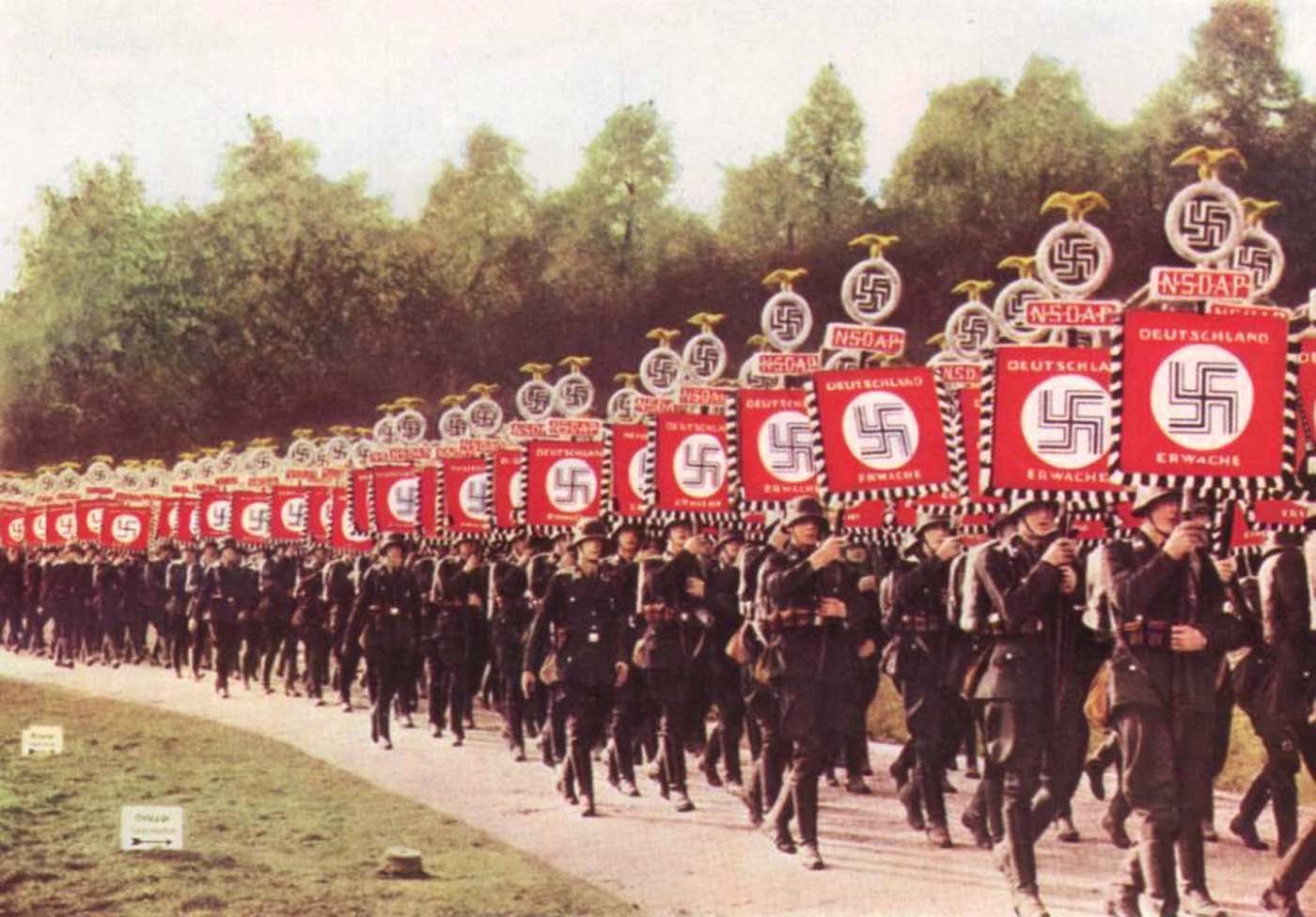
What they adopted among other things was his method of attack on morality itself and in particular Christianity and Judaism. This is what he meant by going "Beyond" Good and Evil (morality itself) to replace it with Strong and Weak or Beautiful and Ugly which was more of the Greco-Roman system of values. That does sound more like Nazism doesn't it? You can see it in the iconography of the Nazis and all the Roman stuff they adopted (e.g. the Nazi standards which harken to the Roman standards).
Nietzsche wasn't perfect IMO. You can read Psychological Types by Carl Jung who does a beautiful job of analyzing and filling in the holes in Nietzsche's positions.
Since you dismiss the existence of objective, non-ideological facts, isn't that necessarily your position on all science?
> but it wasn't "discredited" in the sense that you mean among the scientific community or the policy community across the West who enacted policies based on it well until after the mid 20th century
Yes, phrenology was discredited , and why you posted a link about eugenics to support your rebuttal of a point about phrenology that had nothing to do with eugenics, I don't know.
> The Nazis adopted scientific racism and this is proof they weren't motivated by scientific rationalism?
That wasn't my actual argument, but it works, since “scientific racism” doesn't actually follow the methodology of post-enlightment empiricism, merely adopting it as an elaborate rhetorical flourish for propaganda purposes, much the way that, say, intelligent design does. It recognizes that some of it's audience might be positively disposed to the superficial appearance of empiricism, rather than actually embracing it itself.
This looks like its for questions about Mormonism or theological questions, not current events or other pop-culture things (forwards from Grandma) like Snopes.
Yes, its scope is very narrowly about the Mormon faith. Conversely, Snopes doesn't tend to weigh in on things like the stories surrounding Joseph Smith.
Lumping into an "us vs them" or "republican vs liberal" via
> here is no Republican Snopes because conservatives, since the Enlightenment, don't do sense making
Which is both mixing the some undefined set of concepts of the Enlightenment with some undefined characteristics of "All Republicans", in an awkward ad-hominem against "non-republicans"? It's nonsensical.
> At the end of the day unless you were personally there to witness something or can prove something mathematically or do the science yourself,
All truth is subjective, so there is no truth tautology.
Etc etc. There isn't a point being made or a topic to discuss. It's a "too many ideas" post mixed with too many wild tangents that are intentionally designed to incite.
Whether or not there is truth is dependent on if you believe in an objective set of values. Conservatives believe there is (the Bible, natural law, God, etc) and people like Postermodernists believe there isn't.
And yes all discussions of this type require some generalization and lumping. "Republican" doesn't even mean one thing since the party consists of libertarians and evangelical Christians and neo-conservatives among many others.
I always laugh when I see someone bring up Fox News in this context. You realize your just proving his point, right? I can name dozens or hundreds of major media outlets that that lean left (MSNBC, CNN, NYT, WaPo, HuffPo, BuzzFeed, etc.), but you can only name one or two that lean right.
Most of the "left-leaning" organizations you cite above are not considered particularly left-leaning by the left. A better description of them would be "pro status quo", or if you're feeling punchy "relentlessly pro status quo" with a side of "pro-corporatist" thrown in for seasoning.
Now, Fox News and OAN and Sinclair are not, publically, actually the John Birch Society, so sure, you could say "right wingers don't think they lean right either".
Plot out a chart of US political opinion, and I more or less guarantee you that in most things, you'll find your list of media outlights absolutely "centrist", and the 3 I just named distinctly "to the right" of mainstream US political opinion.
If you're talking about people like Chris Wallace, then I agree with your point. People like him are very much an example of The Cathedral but on the conservative side. Even stuff like The Five is pretty middle brow and establishmentarian but they aren't the vanguards of mainstream conservatism like Maddow and Joy Reid and others are for mainstream liberalism.
Steve Bannon and his movement are more representative of mainstream conservatism. Even someone Tucker Carlson used to be very much like Chris Wallace. The reason why his program is so popular now is because he's shifted radically away from his establishmentarian position towards Steve Bannon's position.
Personally I don't watch Fox News because of how low to middle brow and Cathedral-like it is.
You can only get a plurality in most cases with mainstream media, because like it or not it does tend to be progressive/liberal in most outlets (in the American sense, not European).
Probably because the Cathedral of mainstream liberalism has been mortally wounded over the past decade. That has rapidly accelerated as of late and you're seeing the last dying breaths with the rise of populism on the left and right. Maddow used to have much higher ratings. AOC for example is not part of mainstream liberalism. She is at the vanguard of mainstream popular leftism.


Most people are Liberal (in the American sense) because that's what all the organs of culture promote and reinforce. It's like the "default" position that people adopt. I grew up liberal in a liberal household where we watched Hollywood movies and mainstream news like ABC, NBC, PBS and I listened to NPR and I went to school which was run by generally liberal teachers and administrators and that's pretty much why I was liberal.
This is the Cathedral vs the Bazaar approach to sense-making.