The pound is low against the dollar, as is the Euro low against the dollar.
The pound dropped in value a few days ago, but the price has recovered since then.
The media chooses to focus on the drop rather than the recovery, because the drop coincided with a government announcement of some pro-growth economic policies that mainstream pundits disagree with.
If you speak to people in the U.K. many would agree that paying less tax is a positive thing, especially during a global cost of living crisis. But some people on the Left are angry that the wealthiest are also getting tax cuts.
What a lot of those people don’t realise is that the wealthiest 1% are paying 28% of income tax receipts - and this percentage has increased over the last decade.
In my opinion, I’m glad to see government reduce the tax burden on productive workers, as this stifled well-paying jobs, growth and investment.
I speak from personal experience. Due to the insidious tax policy of withdrawing the personal allowance when income reaches £100K, there is a marginal tax rate of over 60% at that income level. For that reason I chose to quit my job as a software team manager in an investment bank and instead went to work as a developer in a startup.
I decided there’s no point in working long hours in a responsible job helping other people advance their careers if I keep less than 40p of every pound I earn at that point. I may as well do less responsible work that I enjoy instead.
> For that reason I chose to quit my job as a software team manager in an investment bank and instead went to work as a developer in a startup.
> I decided there’s no point in working long hours in a responsible job helping other people advance their careers if I keep less than 40p of every pound I earn at that point. I may as well do less responsible work that I enjoy instead.
This is an extremely funny takeaway in that anyone who doesn't agree with your ideological position is likely to see this as the tax working as intended.
Think of it like insurance of your status in the system. Your insurance premiums are proportional to the value of the stuff you want to protect. Presumably you own a house. A pension. Various other investments perhaps. All these become worthless if civil society fails and we go back to the Leviathan.
It is right that you should pay a higher premium for that type of insurance than those with no such wealth at stake.
I'm not sure I get any more value from the public service than anyone else. Do I get faster service from the police? More officers assigned to protect me?
Any perks from the NHS for the wealthy? Or the same service as everyone else?
One thing I know for sure - less public money is allocated to my children (I live in the countryside) than children in urban areas, due to the funding formula.
The real issue, everywhere, is that the ordinary people are made believe those earning 100k are ultra rich, and should be taxed to death, and not those earning 10M+, or having inherited millions.
Someone making 100k per year but being an immigrant (=no inheritance) is nowhere as wealthy as someone making 60k and having a 500k family house inherited.
>This leftwing ideology seems peculiar to me, having seen the data on who's funding public services, and who's benefiting from public services.
The thing is, even people who pay $100,000 a year in taxes actually gain far more value than that from a properly functioning society with strong public services and social safety nets. It's hard to put a proper price on personal safety or the opportunity cost of having to spend time, energy and money on securing your family and belongings rather than just being able to generally trust the people around you.
How can you possibly justify keeping even more of your money that you earn from profiting from the work of others, when people in need are freezing and starving? I know HN runs libertarian but this is just abhorrent.
Many people make this point, but very few are willing to defend their views with some good old pragmatism. In the nature of HN, let's have a go at that, shall we?
1. Who works harder, an office worker working for 7.5 hours or a nurse who works for 12+ hours?
2. Who works harder, a person who works 37.5 hours in an office, or someone who works 80 hours a week, founding a company?
3. Who has worked harder to get where they are, an office worker who spent 6 months getting an NVQ in Microsoft Office or a nurse who spent 4-5 years getting a degree in nursing?
4. Who takes more risks, a person who works 37.5 hours in an office or a founder who puts their own capital in to try and create a company?
5. Which brings more value to a community, a person who is employed, or a person who employs people?
I feel slightly sad that I numbered the questions and you blew past that but then it seems you've not attempted to answer the actual questions.
> Inherited capital in every startup I've worked at. And enough of it that they got several runs at success. It wasn't risky at all.
In the event this was an attempt to answer, I have to say, feels like a non-answer. You do say "worked at" though, which makes me think not as a founder but as an employee, thus the capital risk wasn't yours so much.
> Too vague a generalisation to have any value. What matters is who does the work and the social value of that work.
It is vague, sure, a doctor probably has more value than someone who employs a cleaner to clean their home. So I suppose, a better question would be:
6. Which brings more value to a community, a person who works in an office doing menial admin work for 5 years, or a person who spends 5 years founding a new company that provides medical services to the community, employs 100 people, and produces tax receipts (direct and indirect) of 1000x the person who works in an office doing menial admin work?
If you're thinking "how can I possibly answer that question?" then you're right. You can't. The obvious answer is that the founder ultimately produces more value, and that's okay. You don't have to hate or dislike people for creating value — creating jobs and providing services is crucial to the economies around the world.
There seems to be a knee-jerk reaction to such a question of "well the office worker has value too", yes, nobody is saying people are value-less, but there is an objective reality that some people produce more value than others.
Ultimately, my purposefully crafted questions lead up to one thing: some people deserve to be paid more than others.
You're really giving it to that straw man. You must be tired now.
> You've not attempted to answer the actual questions
Lol no, this is a transparent plea for validation.
No-one views tax as punitive. The real anger from the nation is directed at:
1. The financial class who has enough wealth to use non-dom status, offshore trusts and similar vehicles to dodge tax, which vehicles are not available to hoi polloi
2. Merely comfortably-rich people who wank off about how they are "job creators"
You DO get paid more. Save your whining for your therapist.
Taxes are punitive when they're greater for some people than others. Not only is the absolute value paid much great, but so too is the relative amount. We're all paying into a pot unevenly and taking out unevenly. It's completely unfair.
You asked "Who takes more risks" not who put more capital at risk. Founders I have known had plenty of capital and risking some of it on startups wasn't nearly as risky to their life as it was for many of their employees for whom this was their only roll of the dice and had no savings.
> 6. Which brings more value to a community, a person who works in an office doing menial admin work for 5 years, or a person who spends 5 years founding a new company that provides medical services to the community, employs 100 people, and produces tax receipts (direct and indirect) of 1000x the person who works in an office doing menial admin work?
I love the way you completely passed over whether or not the founder does any work at all beyond providing the capital. Plenty of founders work hard, but plenty more bring connections and capital and are otherwise a productivity drain.
So again, as before, it depends on the productive work being done by that person. And they shouldn't get to take the credit for the taxes paid by their employees or the profits earned by everyone in the company. That's a shared achievement.
And why define a person just by what they do in their job? The person doing menial admin work could be doing all sorts of other amazing voluntary work that eclipses anything the founder provides in value.
> You don't have to hate or dislike people for creating value — creating jobs and providing services is crucial to the economies around the world.
And yet it's ideologically orthodox to hate governments for doing exactly these things.
> There seems to be a knee-jerk reaction to such a question of "well the office worker has value too", yes, nobody is saying people are value-less, but there is an objective reality that some people produce more value than others.
That is true enough.
> Ultimately, my purposefully crafted questions lead up to one thing: some people deserve to be paid more than others.
Even if it was true that people are paid according to the value they produce (they are not) it does not follow that they deserve to be.
Take a doctor who delivers immense value to their patients. They can only do so thanks to the hospital they work in, thanks to the education they received and the equipment they have access to.
Or consider a founder who starts a company benefitting from the concentration of talent created by a university doing world class research and attracting the best students.
What people deserve to be paid is a social question. When we choose to pay San Francisco founders millions and let thousands of people be homeless, that's a social choice about our shared values.
The answer to all of these is "it depends", and quite frankly has nothing to do with how people should be taxed. If you're making more money, you should be paying a higher proportion of your income in taxes. This isn't revolutionary.
Also, I love how you glossed over that the founders you idealize are largely already from privileged backgrounds that give them the opportunity to fail. The vast majority of people will never get that chance.
I think you must misunderstand my situation if you think I earn money from "profiting from the work of others"?
Have you ever been a senior manager before?
If you had, I hope you'd understand that the role involves creating jobs, hiring people, promoting people and generally supporting them, mentoring and advancing their careers? Taking responsibility for any problems they cause, and ensuring they get the glory of any successes. As well as doing my regular job as a developer at the highest level. I'd never worked so hard in my life.
It was exhausting and I'd expect to be compensated richly for it. Few people would stick the job.
The more jobs created, the more competition for employees, and thus the higher wages offered. We all owe a debt of gratitude to job creators.
The problem I see is that these tax cuts only really help those who don't need the help, all while the lower classes still can't pay their energy bills/rent/food.
The issue is that most of the economy relies on people (including the lower classes) spending, which they aren't going to do if they already spent all their money on rent/bills. This in turn means businesses may go underwater if they aren't getting enough customers to stay afloat and operate profitably, leading to losses of jobs and less business for the companies that serve those businesses, and so on and so forth in a cascading failure. So even if you are selfish and say "fuck the poor", it's a bad idea because your ability to stay rich relies on there being "poor" people who spend their money at your establishment. Not to mention that with extreme poverty comes crime, something that ultimately costs all of us money.
It's like "tricke-down economics", except it trickles up and unlike the former, this one actually does happen for real and we're already seeing the effects of it.
I say this as someone who otherwise is in favour of tax cuts and sees taxation as theft, but that's a discussion for another day. But if you're going to cut taxes to help with cost of living and can't cut them all, then focus your efforts where it actually helps. The ones who will actually see a non-trivial increase in their income due to this cut are those who already didn't need any help.
Plus, even taking at face value the notion that tax cuts were to inject money into the economy and stimulate growth, giving money to poor people guarantees it’s spent in the economy immediately.
I don't want to get in to discussing the politics or ideology here, but.
I wouldn't say that it's just "some people on the left" - I dont want to place myself on either side of the fence but sky news are doing interviews with cross sections of Conservative / Labor / Swing voters and most of them think that this is Truss's fault.
You are correct that this has coincided with the dollar making gains against most other currencies, and the effects of the mini-budget may be difficult to dis-entangle from that, but from the people I've seen interviewed, most people agree that the mini-budget has at least made things worse for the pound. It's worth pointing out that the pound has fallen significantly against the euro too[0].
> the wealthiest 1% are paying 28% of income tax receipts - and this percentage has increased over the last decade
Without any information on how wealth inequality has increased, and the 1% have more income and assets now than they did last decade, this is misleading at best. If the top 1% are paying more taxes but are also making more money, this hardly seems unfair.
If you don't tax them they just amass more and more money without contributing more, if anything their wealth is due to the work of the bottom xx% of society that work for these ultra rich families
I agree that equality is a desireable goal. But, this argument doesn’t persuade people who don’t care about equality.
Better is to focus on the benefits gained bu the wealthy from stable legal systems, public health, education etc. If you are Bezos your money is only possible because these expensive services are paid for. You gin more than most, and so must pay a greater share than most.
Yes, because they are gaining more than rhe average share from the stability that a welfare state and legal system provides. If they want a lower tax rate they should move to a jurisdiction without expensive public services underpinning their success.
Seems fair enough. They earn 14% of the income of the UK, and don't need marginal pounds nearly as much as people at the bottom end of the scale who need marginal pounds just to be fed and housed. They also pay lower percentages of their income on non-income taxes than most other British cohorts
I don’t understand your logic? It sounds like you’re saying you changed jobs for less money so that your marginal tax rate would be lower even though your net income would be lower. In theory you could also change jobs to something that pays £125k where your marginal tax rate would be back down to 40%, though obviously you’d need to find such a job. You specifically wrote ‘marginal’ so I don’t think you’re confused between marginal and effective tax rates so are you suggesting that the 60p rate did not provide sufficient incentives for you to try to get paid more? That would maybe make sense but I think it can also be useful to think of pay raises on a logarithmic scale rather than a linear one (as in an equal amount of raise-worthiness would be expected to lead to a proportionally larger raise in absolute terms if your starting pay is higher), which would mean an x% raise at a higher marginal tax rate may still be worth it if your starting pay is higher. But then another common model is log utility for money which cancels out that effect.
It’s fair enough if you want to work at the startup but this seems like a strange rationalisation. I agree that the 60% marginal rate from the personal allowance reduction is kinda silly.
Between £100k and £125k your personal allowance is reduced to £0, so for every £1 you gain, you lose more of that allowance and that works out to a 20% reduction. That on top of the 40% rate equals 60%.
Most people in the UK have no idea that there is an effective 60% tax rate either. It's not an official tax band.
But it's the kind of tax raising governments love doing, by stealth. Don't put up the tax band thresholds causing more people to fall into the higher bands over time. They also remove child tax credit as you earn more. And remove your personal tax allowance gradually over 100k.
We're trying to boost the economy by cutting taxes on the group of people who are most likely just to stuff the extra money into investments rather than spending it? Great idea.
Wow, what a silly comment. Enough people have already rebutted this nonsense so I don't need to, but it just shocks me to find such uninformed takes on a forum with these demographics.
Also, this isn't just the left, it's practically anyone with a brain. Any conservatives from David Cameron's administration (not far right ideologues) are horrified by this, as are most of the current MP's who overwhelmingly wanted Rishi Sunak, who is also horrified by this...
Funny - I thought the Cameron government was extremely ideological. Osborne wasn't thick, he must have realised the damage that austerity would do in a recession. Debt was extremely manageable going into the 08 recession. Interest rates were nearly zero.
I always viewed it as a cynical way to weaken labour.
Wow, this might be the most ideologically driven take I've seen so far. Not even all of the Tory party are this extreme in their interpretation.
> "policies that mainstream pundits disagree with"
That the Bank of England have had to scramble to compensate for by bringing back QE in a limited form, that previous governers of the BoE have spoken out against, that the IMF has spoken out against, that previous heads of the US treasury have spoken against, that conservative peers and MPs have spoken against, that the markets responded to by having a fire sale?
Those are a few mainstream pundits? LOL.
> If you speak to people in the U.K. many would agree that paying less tax is a positive thing, especially during a global cost of living crisis
Very few of those people would be paying less tax under these plans, as the major reduction is for people earning over 150k per annum - and those are the people already best placed to weather the cost of living crisis.
It's not that the wealthiest are also getting tax cuts, it's that virtually nobody else is.
I'm a high earner and I like money, but this is some self-interested bull**** right here
The BoE made another huge mistake by using QE during a period of temporary global inflation, and during a temporary blip in the value of the pound. QE is the worst possible strategy.
And the IMF has consistently got it wrong about the UK economy. In the past it has actually made public apologies for doing so (IMF head: "do I have to go on my knees?" regarding incorrect warnings on UK economy): https://www.telegraph.co.uk/news/politics/10884632/Do-I-have...
> It's not that the wealthiest are also getting tax cuts, it's that virtually nobody else is.
When the most productive members of society got landed with a 45% tax rate in 2013, it was higher than many G7 nations, and there's no evidence to suggest it actually increased revenue. Have you heard of the Laffer Curve?
> We have to be careful to avoid the Argument from Authority fallacy
Indeed, but we also have to be careful of writing off numerous opinions from multiple diverse sources in multiple countries, from politicians, economists, bankers and many other roles, as well as the actual actions of the people on the ground that have born out the criticisms, as the ill educated musings of a few 'pundits'.
> When the most productive members of society...
LOL. Seriously? I'm paid in that bracket (or I was until last year when I left the UK, and I'm now paid in that bracket somewhere else) and I don't believe for a second that we're the most productive members of society, we've just figured out ways to get people to pay us a lot. I look around at some of the unutterably useless arseholes that are on similar money and litter the offices of London, particularly in anything adjacent to city finance, and can only laugh at this ridiculous piece of libertarian orthodoxy. Most productive ... most productive at clumsily and innappropriately flirting with the disinterested secretary, most productive at clearing off for a long lunch somewhere new, most productive at looking busy, passing the buck and collecting the cheque, maybe.
Yes I've heard of the laffer curve, no I'm not a particular believer that it's some sort of cast-iron truism, and neither apparently are the people you're defending, who are forecasting the various tax cuts to cost the treasury multiple billions, at least in the short term, until their miracle of growth happens, if it happens. There's a lot of argument about whether (for instance) the continuation of the lower corporation tax rate is even useful for that.
These decisions are a kick in the pants to the people who actually need a tax break, your man on the street that you mentioned above, who would quite like a bit more money in his pocket due to the spiralling cost of living and energy crisis. He could do with a tax break to keep the family going this winter and deal with the higher mortgage payments that will come about because of the further interest rate rises these new changes will necessitate.
But I guess my highly paid contractor friends will get to stick another few tens of thousands in their pension pots instead.
The best thing that can be said about this budget is that it was done at completely the wrong time.
> we also have to be careful of writing off numerous opinions from multiple diverse sources in multiple countries, from politicians
I fully expect politicians in other countries to HATE the fact that we have a competitive low-tax regime that will attract business and talent. And they'll also hate that we have a devalued currency, which makes our exported goods and services more competitive.
> I don't believe for a second that we're the most productive members of society, we've just figured out ways to get people to pay us a lot
You may well be right about your own situation. We're all different. My employers value what I did and paid me accordingly.
> There's a lot of argument about whether (for instance) the continuation of the lower corporation tax rate is even useful for that.
The case with corporation tax is cut-and-dried. When the Tories reduced it significantly (to 20%), revenue quickly went UP. It took barely any time to prove that we'd moved closer to the revenue-maximising point on the Laffer Curve
> These decisions are a kick in the pants to the people who actually need a tax break, your man on the street that you mentioned above
I'm losing count of the free cash grants this Tory govt is handing out to help working class people with their energy bills. And now they're using public money to freeze bills. It's unprecedented.
Most of the politicians comments I'm referring to are from British politicians, even within the conservative party. This isn't jealousy, it's marvelling at incompetence.
You still seek to play down both the comments of a range of people from a range of different viewpoints and the actual market movements. And you're doing it in a very disingenuous fashion. You know as well as I do she's come under criticism from her own party, some from those within her party that supported her leadership bid, as well as luminaries from all over the financial world in multiple countries.
> When the Tories reduced it significantly (to 20%), revenue quickly went UP
In an entirely different economic landscape to the spiraling inflationary one we're in today. I'm not sure a cartoonised graph from the daily mail is evidence of anything very much.
> You may well be right about your own situation. We're all different. My employers value what I did and paid me accordingly.
The point is that labelling high earners as the most productive class is a laugh. Far from all of them are. I like to think I earn my money too, but I've seen a lot of people that don't, who find and cling on to these posts though a combination of connections, grift and luck.
> I'm losing count of the free cash grants this Tory govt is handing out to help working class people with their energy bills. ... It's unprecedented.
Yes, that's the point, it's unprecedented, it's fucking awful for ordinary people on average incomes, huge inflation pushing up the prices of everything, interest rate rises making mortgages more expensive, rocketing energy costs (even if they are capped they are historically very high). In the midst of that, these policies make things worse. More expensive mortgages will knock on to the housing market falling, for example. This is not just "idealogically problematic" in some wishy-washy leftie way, it's not just something to be disagreed with because of your particular economic leaning, it's not just targetting the wrong people (though it certainly seems to be doing that) or the politics of envy - it's actually fucking stupid.
Truss is borrowing £45B to pay for tax cuts this year. But like you ask any addict: "What are you going to do next year?"
The trickle-down maths looks "optimistic". Cutting £45B means that the economy needs to grow by £112.5B for the top rate 40% tax rate take to come out even. That is GDP growth of 4.5%. I.e. far in excess of what the economy has been capable of ever since 1997.
Talking of further tax cuts just pushes the assumed GDP growth further into fantasy land.
I think that tax credit withdrawal still exists, so now the effective tax rate is 40% from £50k to £100k, then 60% from £100k to £125k, and 40% above that.
Also, despite 10% inflation they’ve frozen the tax bands, so all workers earning above about £12k will have more of their income pulled into higher tax bands.
So they’re left with that artificially high rate which blocks progression, and most workers up to about £150k will pay more.
Yep, same thing is happening in slovenia right now... our previous government did one good thing (in a bunch of other bad things), and that was to lower taxes on paychecks. The current (left-er) one is bringing out the tax reform to "tax the rich", where even people earning average wage (~2k eur gross, ~1300eur net) will get taxed more.
> when income reaches £100K, there is a marginal tax rate of over 60% at that income level
Can't you just put that in your pension to avoid that effective 60% rate?
> no point in working long hours in a responsible job helping other people advance their careers if I keep less than 40p of every pound I earn at that point
I think the way the UK calculates tax at that level is a stupid way of setting it up, but "only" taking 40% of the 100k to 125k is hardly terrible. If you're in that range, you're incredibly well paid for the UK (or pretty much anywhere in the world).
I would personally like to pay more tax if it meant decent public services instead of people dying waiting for ambulances.
> Due to the insidious tax policy of withdrawing the personal allowance when income reaches £100K
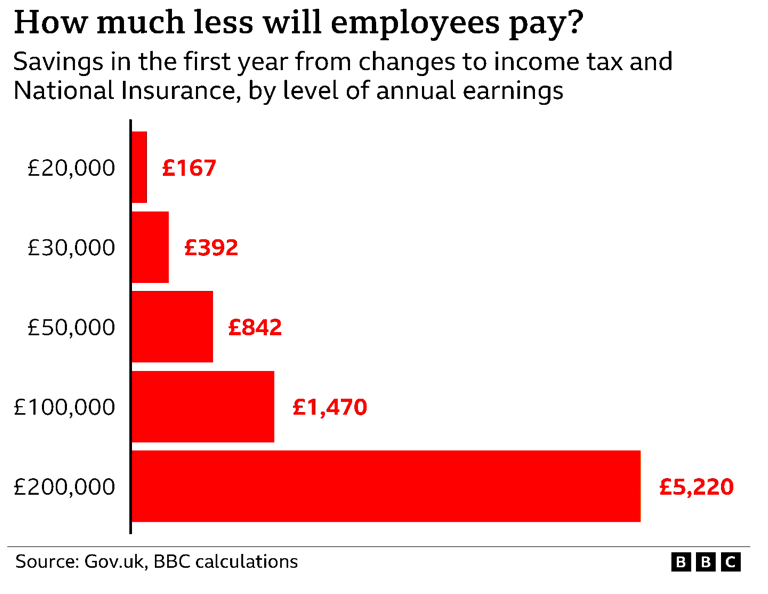
The affect of removing that doesn't seem to be that major, with the figures [1] appearing to work out at almost 1.5% less tax for those on £100k, and a little over 2.5% less tax for those on £200k -- hardly a huge decrease in the tax burden for those people.
Quite frankly, you are hugely privileged to be earning at that level. The median average salary in the UK is just under £26k.
Also, when you are that income level, there are a number of tax benefits you can enjoy - for example the first £40k you put into your pension is before tax - so it effectively reduces your salary (for tax purposes) by £40k. SO if you are doing the sensible thing and putting money into a pension, the threshold you talk of is effectively at a £140k salary.
> Also, when you are that income level, there are a number of tax benefits you can enjoy - for example the first £40k you put into your pension is before tax - so it effectively reduces your salary (for tax purposes) by £40k.
It also reduces your actual salary by £40k, not just for tax purposes, if you'll never end up using your full pension. Either because you've died before doing so, or because the pension fund can't pay you out (fully) since it is increasingly underfunded due to a rapidly aging society.
Answer this honestly for yourself: if you are fairly young, say 25-35, what are the odds you'll see more money in your lifespan from £40k put into a pension now that may or may not be fully available after retirement, versus £40k minus tax invested into an index fund and accessible/reroutable whenever?
Pension funds that are contribution based can't be underfunded, pretty much by definition.
> a pension now that may or may not be fully available after retirement, versus £40k minus tax invested into an index fund and accessible/reroutable whenever?
If we're talking about people putting that 40k into a pension because the tax on going over 100k salary is too much, you've saved 21k straight off by not taking it as salary. So we're talking about 19k in your hand vs 40k in a pension.
The pension fund you contribute to now could just be an index fund (it may be a managed fund though, depends what you pick), and as we have moved away from final salary pensions, there's no danger of underfunding because it's basically just a tax-shielded investment.
So the answer is, assuming you live to retirement (or even to 55, the age where you can take a tax free lump sum from your pension in the UK), that 40k invested in a pension is likely to be a lot better for you than 19k in a similar fund that's not tax-shielded.
And it's more likely to be there when you need it later in life because you won't be able to dip into it during your working years.
Seems potentially relevant that some pension companies were looking at defaulting from margin calls this week. I'm not totally confident that money put into pension schemes is going to be there later.
It's not my "privilege" to earn at that level. I was born into an average economic background. I worked really hard at school and university, and then over a period of seventeen years, I worked really hard in responsible jobs.
If all people from average backgrounds took the attitude that only "privileged" people get good careers, then unfortunately it would be a self-fulfilling prophecy. Luckily there are plenty of aspirational people in the UK looking to better their family's situation by advancing their careers.
Then it's not really a 60% marginal tax rate, is it?
> I worked really hard at school and university, and then over a period of seventeen years, I worked really hard in responsible jobs.
Educated by the state, health taken care of by the state, protected by police and emergency services, defended by the military, enjoying the benefits of scientific research, and lots of other things all paid for through taxes.
You did rather luck out having the combination of interest and talent that turned out to pay very well (as did I).
My wife is a nurse and works really hard, literally saving people from cancer, but she gets paid comparatively little because we don't pay enough tax to fund the NHS properly.
Although worth noting that luck plays a much larger role on most peoples success than is acknowledged. Uk and Us are also much less likely to recognise use role of chance in personal success than wealthy Europeans.


The pound dropped in value a few days ago, but the price has recovered since then.
The media chooses to focus on the drop rather than the recovery, because the drop coincided with a government announcement of some pro-growth economic policies that mainstream pundits disagree with.
If you speak to people in the U.K. many would agree that paying less tax is a positive thing, especially during a global cost of living crisis. But some people on the Left are angry that the wealthiest are also getting tax cuts.
What a lot of those people don’t realise is that the wealthiest 1% are paying 28% of income tax receipts - and this percentage has increased over the last decade.
In my opinion, I’m glad to see government reduce the tax burden on productive workers, as this stifled well-paying jobs, growth and investment.
I speak from personal experience. Due to the insidious tax policy of withdrawing the personal allowance when income reaches £100K, there is a marginal tax rate of over 60% at that income level. For that reason I chose to quit my job as a software team manager in an investment bank and instead went to work as a developer in a startup.
I decided there’s no point in working long hours in a responsible job helping other people advance their careers if I keep less than 40p of every pound I earn at that point. I may as well do less responsible work that I enjoy instead.