And those really don't change anything about my response. Your solution seems to be "if you're at a bad company, quit", and like I said earlier: "Working only with Good code is a luxury decision".
Software engineering is still a seller's market, even with the recent rash of firings. Most engineers are much more employable than they give themselves credit for.
Saying "Working only with Good code is a luxury decision" is like saying "I can't afford to buy fruits and vegetables, so I'm going to live off of instant ramen for the rest of my life." Like, yes there are people who actually live like that. But it's an incredibly short-sighted way to live, and they'd be better-served by making (drastic) lifestyle changes.
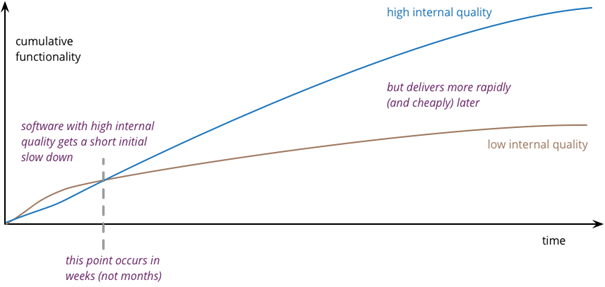
Mandating good code is an investment that costs more in the short term, but provides dividends in the form of faster feature delivery over the long-term.[1] It's a luxury for apps that don't expect to have a "long-term", just like fruits and vegetables are a luxury for people who don't expect to live past 50. But it's a necessity for developers who want their apps to be extensible and responsive to change.
EDIT: looks like we reached the limit on the comment reply chain. I’d agree with your comment below, and I’m not here to defend the naming choice of the method in question. The reason I love the Ruby community is, among other things, because of the whole MINASWAN ethos. And I think the same goal behind the method name could have been accomplished in other ways. I’m here to dispute the idea of code quality as a luxury, that’s all. Sounds like we’ll have to agree to disagree on that point.


That’s what paragraphs 2 and 3 of my comment are for.