Granted. We're still talking about a 3x difference, advantage to Iran, in the face of a lot more territory to defend, population to manage and a technical deficit.
> if the main strategic hit was to destroy 200 trucks
MRBM launchers are not trucks.
> You may be confusing the guidance mechanisms of early ballistic missiles
Guided vs unguided refers to the ability to course correct en route. An unguided missile is a lobber rocket. A guided missile has reaction controls onboard.
> What does that have to do with anything?
That it's a complicated machine you can't whip up in a garagd.
> while Iran uses weapons that simply exhaust interceptors
A strategy undermined by collapsing launch rates.
> If that works and if they can scale production, the advantage Israel has in being very concentrated and densely protected turns into a liability
Absolutely. I'm not saying Israel is indefinitely invulnerable to Iran. Just that in the last war, it neutered Iran's capacity to hurt it.
It's a piston mounted on top of a utility truck. It's a truck! If a semi-truck with a refrigerated trailer is a truck, then an 8x8 utility truck with a hydraulic piston is also a truck.
> Guided vs unguided refers to the ability to course correct en route. An unguided missile is a lobber rocket. A guided missile has reaction controls onboard.
That's not what I'm referring to. Early ballistic missiles only had inertial guidance, and therefore needed an accurate positional and attitude fix provided by the launcher, which made it expensive and complex. Modern ballistic missiles have absolute guidance mechanisms, so the launcher is now much simpler.
> That it's a complicated machine you can't whip up in a garagd.
Iranian UGFs aren't garages. They are called missile cities for a reason.
> A strategy undermined by collapsing launch rates.
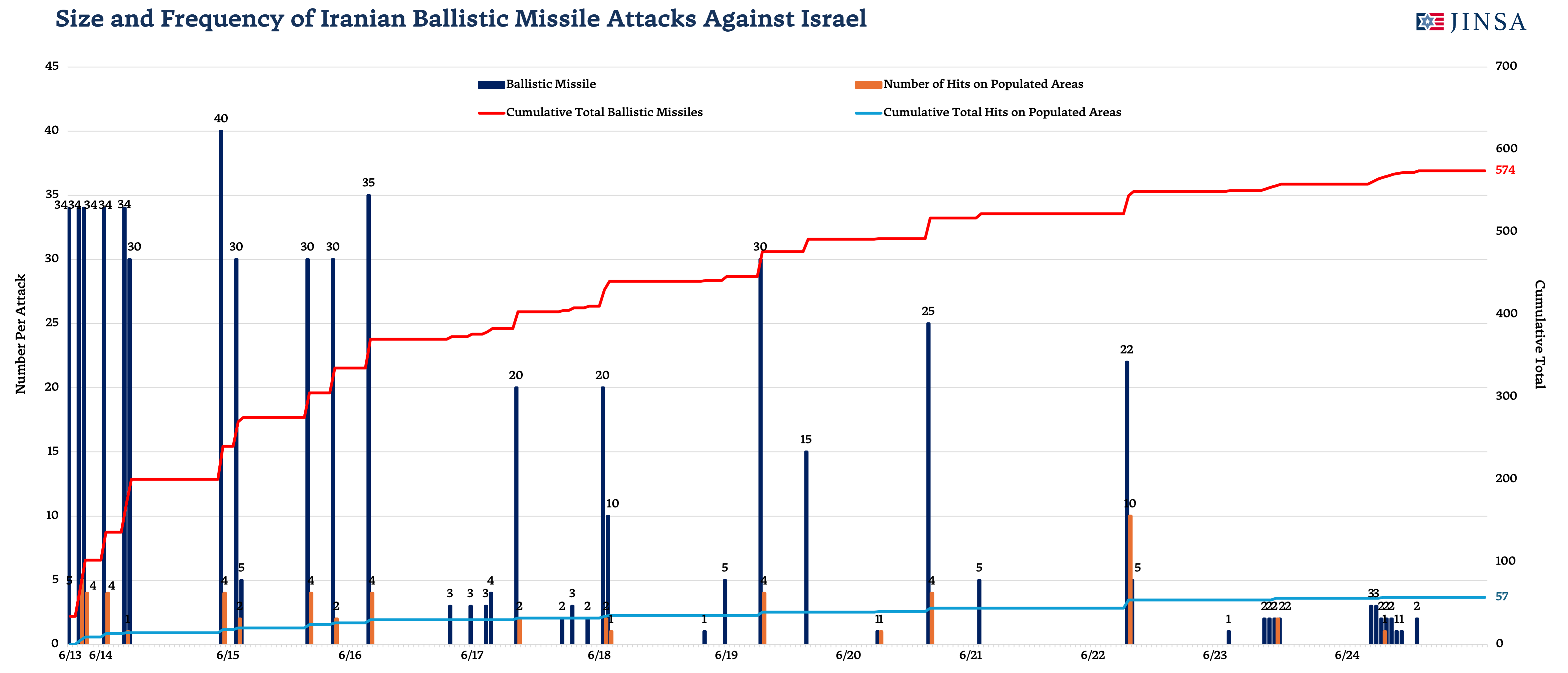
25-35% of ballistic missile impacts on Israel occured on June 22nd. The Iranian capacity to actually hit targets in Israel did not collapse through the 12 day war.
> Absolutely. I'm not saying Israel is indefinitely invulnerable to Iran. Just that in the last war, it neutered Iran's capacity to hurt it.
Iran's ballistic missile strikes were most successful on June 22nd. In the last week of the war, there is plenty of evidence pointing towards Israeli BMD degrading faster than Iran's ability to launch ballistic missiles.
The only way to conclude that Iran's ability to launch was neutered is if you believe that, were the war to continue, Iran's ability to launch missiles would have continued to degrade. The only argument to that effect is that they'd run out of launchers - I find that implausible on the basis of the launchers being simple modifications of extremely plentiful military truck platforms.
after first week or so iran could launch only from bases that were much further away from Israel (way east), because Israeli air control was weaker there


Granted. We're still talking about a 3x difference, advantage to Iran, in the face of a lot more territory to defend, population to manage and a technical deficit.
> if the main strategic hit was to destroy 200 trucks
MRBM launchers are not trucks.
> You may be confusing the guidance mechanisms of early ballistic missiles
Guided vs unguided refers to the ability to course correct en route. An unguided missile is a lobber rocket. A guided missile has reaction controls onboard.
> What does that have to do with anything?
That it's a complicated machine you can't whip up in a garagd.
> while Iran uses weapons that simply exhaust interceptors
A strategy undermined by collapsing launch rates.
> If that works and if they can scale production, the advantage Israel has in being very concentrated and densely protected turns into a liability
Absolutely. I'm not saying Israel is indefinitely invulnerable to Iran. Just that in the last war, it neutered Iran's capacity to hurt it.