But besides the 800 lb gorilla in the room, what worries me more than planned obsolescence is an entire ecosystem primarily composed of glorified MVPs rather than refined products. And that is doing more to disenchant me with technology and applications than any other force, one crash to the desktop at a time.
However, unlike the decisions that eventually led to Detroit’s downfall, planned obsolescence is a good thing for both consumers and hardware vendors alike.
As I understand it, the original academic paper introducing the concept of planned obsolescence, described it as an economic boon -- essentially a form of stimulus. At the time, the intent was not to sabotage the lifetime of products, but to keep introducing desirable new features.
Now, anecdotally, I think that I've witnessed planned obsolescence of a sort, in some kinds of products. I remember the home appliances in my house when I was a kid, being much more reliable than those sold today. I've had to repair literally every appliance in my house over the past decade, in some cases two or even three times. We're already on our second fridge. The cause may simply be due to relentlessly driving the cost out of those products while keeping an eye on the one-year warranty.
Fridges used to be made out of metal (plumbing, freezer etc). Now they are made out of plastic that cracks after ~2 years, perfect time for warranty to run out and force you to buy new one.
Solid washing machines used good quality stainless metal for the Drum Support/Spider. Nowadays they use specially designed alloy that DISSOLVES in washing powder:
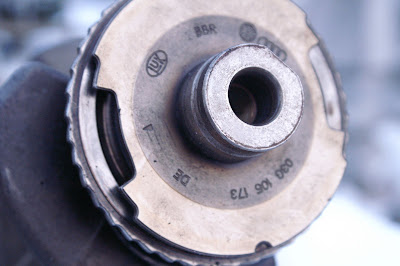
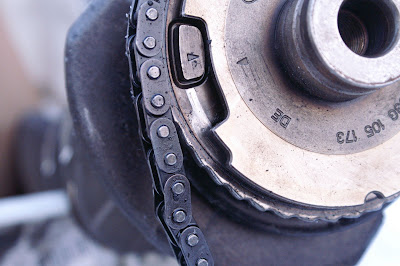
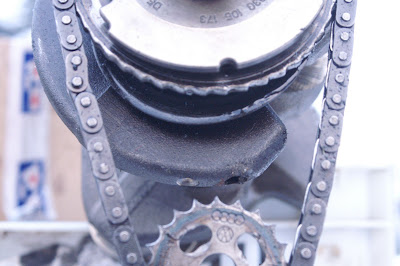
VW answer: this part is non serviceable, whole crankshaft needs to be replaced :D Why is it made out of putty while smaller sprocket (the one taking more force) is still 'working'? Why is it designed not to be replaceable? Good 'old timer/not by the book' mechanic is still able to replace it (heat whole crankshaft, use big hammer).
maybe, but I think that reducing the lifespan by 50% does not produce a reduction of 50% of the price for the seller, but often mean a reduction of 50% of the value of the product for the buyer. It is very bad also for ecology.
Are you sure those appliances weren't repaired? I keep on hearing about planned obsolescence, but between my fridge, oven and washer, I've had one repair in a total of 36 functional years between the three items. I knew the people who lived here before me, and I know they repaired the items I replaced half a dozen times each.
They might of been repaired. Point is things nowadays are designed specifically to be NON REPAIRABLE.
Apple is the perfect example, from using glue everywhere (have fun replacing screens/batteries/keyboards #1) to actively sabotaging servicing by booby-trapping products (screw holes over critical pcb section + carefully selected screw lenght to destroy said pcd section). https://news.ycombinator.com/item?id=9833205
#1 replacing non splash/liquid proof apple keyboard means ripping out about 70 alu rivets! And we all know nobody ever spilled any liquid on a keyboard, right? Its not like it was designed to make you go out and pay $750 directly to Apple for replacement. Its not like its a solved problem and you could go out and but IBM/Lenovo T410 lapto .. oh wait.
Exactly. Lots of people seem to remember how reliable old appliances were, but it's notable that there are a lot fewer appliance repair shops than there used to be.
Is that a result of appliances becoming more reliable, or just cheaper to replace (disposable)?
Apple has actually been doing really well on the software side of this iOS9 will support the iPhone 4S (released in 2011) through to the upcoming 6s. That's 5 generations of devices that will be on the latest version of the OS. To put it into perspective, how many other cell phones out there are able to run the latest version of the OS 5 years after their release date?
Electronic devices don't get "obsolete" as much as they get better so fast that the old device seems lame in comparison. A four-year-old PC is as fast as when it was new, but modern PCs are 10 times as powerful for the same price, so the old PC seems obsolete. My 9-year-old Canon 5D camera takes incredibly good photos, but the modern cameras are so insane (shoot a full movie in moonlight) that the 5D seems like an amateur in comparison.
An iPhone 4S is a great phone compared to everything except newer phones.
>Electronic devices don't get "obsolete" as much as they get better so fast that the old device seems lame in comparison.
Which would be fine if the device still did what you want it to do. But in fact connected electronic devices do go obsolete as soon as vendors stop providing security updates.
I am a bit confused as to how they stop doing 'what you want it to do' when they stop getting security patches. Sure, they won't have the latest security, but you can still 'use' the device in every way you did before... they might be vulnerable, but they were vulnerable before and you still used it.
Let's not forget about the reliance on services. My second generation Apple TV can no longer view YouTube because it will not be updated to Google's new authentication scheme. So I have a product that does less today than the day I bought it.
This is one of the reasons I have no interest in a "smart TV".
I want a good quality screen, a good quality sound system, and enough connectivity to get signals to them at the highest quality they can use. Updates to where those signals come from should not require physically swapping large and extremely expensive equipment. That is just crazy.
And yet today my TV can hang while showing broadcast TV because someone changed a compression algorithm and caused the decoding software to glitch, and when I put a Blu-Ray in my player often the first thing I see is a warning that I might have to update the firmware in the device just to watch the movie.
This is not progress, and the sooner we go back to separating communications devices/protocols/software from the main hardware in this sort of situation and then using appropriate safeguards and updates on the things that actually need them with everything else properly isolated, the better the world will be.
A four-year-old PC is as fast as when it was new, but modern PCs are 10 times as powerful for the same price
No, they aren't. That hasn't been even close to true for many years.
For example, I work with some very high-end PC workstations (think multimedia, 3D modelling, that kind of thing). Sure, the new spec ones are a bit faster, but if you look back those 4 years you mentioned, there really isn't that much difference.
The price/performance sweet spot back then was probably an i7 2600K. Are modern CPUs faster? Sure. Are they an order of magnitude faster? Not even close. The main emphasis in recent years has been on lower power/heat and to some extent on increasing core count particularly at the high end. Actual per-core speeds or instruction processing has improved only modestly. And in most applications, they were already so powerful that you wouldn't even notice the difference.
Graphics cards are a similar story. Of course modern cards are somewhat faster than their counterparts from a generation ago, but unless you use the most demanding software, the card in that i7 2600K machine probably still works just fine with today's applications. Again, most people wouldn't even notice the difference, because the baseline level was already high enough.
The amount of RAM typically supplied in modern PCs hasn't much changed, so no huge jumps in capability there either. In fact, I'd say storage and networking are probably the only major areas where speeds are dramatically better today than they were four years ago in most western economies. This is largely because it has become cost-effective at mainstream levels to use things like SSDs, fibre broadband and 4G mobile networks where the previous generation of devices at a similar price point would have used spinning platters, old phone lines and 3G. These changes really do render the previous generation of devices obsolete at a similar price point and really do make a substantial difference to what an average user can do with the new equipment.
The only other area where there have been dramatic improvements, not in performance but in capability, are displays. The 200+ ppi devices previously reserved for high-end and physically small mobile devices are now widely available in laptops. Your new 48" TV might show 4K material natively. But again, this only helps if you have content to look at that can take advantage of the finer details, which a lot of people won't, so I'd hardly say it makes a good display from the previous generation obsolete.
I have a 10-year-old Athlon 64 x2 desktop which doesn't seem obsolete at all. It's about the same speed as the docked Atom tablet from last year I am using right now as my regular workstation. It even runs most modern games pretty well. So I've lost a lot of weight over the years, gained a little speed, and lost a lot of GPU power. With the expansion of cloud computing and the stagnation of desktop software, I will probably be able to use that desktop for another 10 years unless the hardware fails, but it's used rarely enough that I think it will last.
The 4S is another example of an older device that competes really well with modern hardware.
This seems to have slowed down considerably on the PC side, and mobile devices seems to rapidly be heading towards numeric increase for numeric increase sake.
Well, a lot of computers cost about $1000 and the depreciation schedule for computers is 5 years. Since iOS 10 won't come out until 2016 at the earliest...
That's just because an accountant somewhere decided 5 years was a reasonable average time to write down the value of the PC as an economic asset. Given both the chances of hardware failures and general accounting practices, that probably wasn't unreasonable at the time. But it doesn't mean that the value of a 5-year-old PC has suddenly become zero to a user if it's still working fine.
This is something that played a big role in me going from Android to iPhone.
I was big into Android since the HTC G1, and just liked the feel of it over iOS. But if I wanted the latest release of android (without flashing the device, and usually compromising some feature) I had to buy a new phone, extend my contract, etc. I really like how Apple supports their past phones with updates for years after their release.
That's 5 generations of devices that will be on the latest version of the OS.
You might in theory be able to run it on an iPad of the same generation as well, but ask a few people who upgraded their iPad to iOS7 or above how well it worked afterwards and you'll hear plenty of complaints, particularly about performance being much worse on the older hardware.
Planned obsolescence through sabotaging a product (or at least its quality) is a universally bad thing in my opinion. Planned transition to an upgrade is not. Terms are probably going to muddy the conversation around the importance of these topics, I think. Maybe we shouldn't borrow the term of planned obsolescence at all.
Planned obsolescence can be looked at another way: using less expensive components because you know you don't need them to last longer than (say) 5 years, which results in cheaper, faster, smaller products.
Mechanically, this tends to be true. I don't know about for electronics. The vehicle engine is a good example - a diesel John Deere from the 70s has a massive block that will last through my grandchildrens' lifetimes. The newer engine blocks are not designed to last as long, and thus have tighter tolerances allowing them to build smaller, lighter, more powerful engines for less money - given, again, that they are not intended to last for as long.
There are a bunch of techniques here: market research, price discrimination (i.e. charging more for "enterprise"), engineering techniques (e.g. testing for mean time to failure, and making it two or three times higher than whatever your warranty is).
Right, but aside from the first those aren't techniques for knowing when your product would no longer be useful, they are techniques for forcing it to no longer be useful. That's not so much another way of looking at it as what forced obsolescence is by definition.
I disagree. I believe that the second and third are techniques that also give you a signal as to how strong the product needs to be.
For example, if users buy the more-expensive longer-lasting product, then that's a sign that those users feel they need it. (For example, "ruggedized" laptops sold for military and educational uses.)
Can't we deter planned obsolescence by having stronger consumer protection laws? The USA is so far behind in consumer protection it's crazy. If a company had to warranty up to 5 years maybe they'd be more concerned with keeping the product as good as it can get.
The problem with that is that there are lots of things that don't need to last 5 years because the upgrade cycle is faster than that, and if you have to design them to last that long, they cost more, with little added benefit to the average user.
It's like, the last time I bought a DVD player, it cost $26. They tried to sell me an extended warranty on it, and I laughed, because I didn't expect to actually need a DVD player longer than a year or two. I was right. It lasted a bit over a year, and then I got a bluray player. That's all I needed or wanted for my $26, and I'm glad that there was a cheap little DVD player that could provide it.
Then the question is -- why is the upgrade cycle faster than that? I suspect that we upgrade less because the new feature is something we really need, but because we have a desire to chase after the new for its own sake.
With things like wireless units of all sorts, a short lifetime is better for everyone. Protocol improvements tend to allow better sharing and utilization of the same frequency every few years, along with faster speeds. The issue is one old device can slow all the newer devices down.
Consumer protection laws might help towards things like glued-in batteries, which would already be a big win (but then again you have reviews that praised Samsung for getting rid of theirs as if that was a net positive), but they aren't going to help the software side of things.
If the manufacturer comes out with version +1 and +2 of their OS that still do run on your device, but coincidentally run only badly enough to make it really annoying to use, how can you protect against that? Even if you mandate that any future version of the OS released during the warranty of your device must run on it, you can't mandate that it runs as well as the original.
When new releases come out the manufacturer will just say that "due to all these new features we can't keep the same level of performance on the older devices" and the software ecosystem being incentivized towards moving to these +1 and +2 versions makes holding onto them even more difficult.
In my view, the idea of market forces taking care of things depends on assumptions about public access to information, that probably can't be met. It may be prohibitively hard for consumers to get information on a reasonable expected life span of something like a refrigerator.
My strong belief is that all of them are "more than 10 years". Beyond that, does it really matter? That's a couple dimes to a dollar a day for convenient and safe food preservation in your house.
What would be the basis for predicting the life span of a new design anyway?
My anecdotal experience is that fridges last a few years before requiring repair. In the space of 10 years, my home fridge failed once, ran for a few more years, and then just stopped cooling. Over that time period, I've repaired nearly every appliance in the house. They were all new when we moved in, because we bought a house that was empty of appliances.
Dehumidifier: Defective potentiometer. Repaired, then it ultimately wore out and stopped cooling. Folklore is that the seals in the compressors are short lived, system loses the ability to compress the refrigerant sufficiently. This also causes a gradually rising power consumption until it can no longer hold temperature.
Chest freezer: Starting relay / capacitor failed. Replaced with unit bought online. Currently idle, as we have nothing to freeze.
Microwave: Failed, tried to repair, to no avail.
Cooking range: Loose connection in heating element caused wiring to burn up. Repaired by silver-brazing new wire to Nichrome element material.
Dryer: Repaired twice. First time was an over-temperature sensor. Second time, the motor bearings failed, and the unit was squeaking like crazy.
Waffle iron: Repaired once due to heating of loose connection, second time it was unrepairable.
I've also repaired the furnace, but it was a pretty old unit.
One basis for predicting life span of new design is to base it on known performance of old design. Of course this can't happen if cost reduction results in multiple, radical design changes, including use of lower cost materials.
On the plus side, the Internet has opened up a bonanza of repair information and spare parts, so I have saved a boat load of money by being self sufficient for repairs.
I agree on the "Youtube repair manual" aspect and I've saved a ton of money as well. We've been in our place for 8 years, and in that time, I can only recall fixing the fridge (bad defrost element-$20 or so), throwing out a slow cooker, replacing the igniter on the gas stove, and replacing a working dishwasher and a not working washer (bad bearing seal on a front loader and the bearing was too seized to remove before I damaged it irreparably).
That's in a place with two kitchens, plus a chest freezer, two washer/dryers, and numerous small appliances, plus most of the items were old when we bought the place. I'm sure I'm averaging less than a repair per major appliance per decade.
I don't doubt your contrary experience, but it seems to skew on the unlucky side IME.
Do "normal" markets even exist in the USA? Between the Defense Industrial Base (http://www.dhs.gov/defense-industrial-base-sector), the Department of Defense itself, lobbyists writing laws, industrial espionage by various governmental entities, it seems like all large markets are totally poisoned - there's forces at work that aren't acknowledged, and may be kept secret, that prop up oligopolies.
This becomes more troublesome when modification of the device is made illegal. Forced obsolescence with legal lockout when attempting to "repair" the device.
Perhaps we should call obsolescence over time as the market changes as natural obsolescence?
I imagine in the future manufacturing and supply chain tech - augmented by 3D printers - will put hardware products into a recycled lifecycle, wherein you would trade in your old iPhone 27 to be stripped of its component materials in order to get a discount on your 27S.
I do a lot of amateur repair of various things around the house, washing machines, TV, etc. I remember being really struck by the commentary of this repair book I read:How to Diagnose and Fix Everything Electronic by Michael Geier. He has some insight into this arena in terms of labor costs, and growing complexity of components...
"When I was a kid, there were radio and TV servicers in many neighborhoods. If something broke, you dropped it off at your local electronics repair shop, which was as much a part of ordinary life as the corner automotive service garage. These days, those shops have all but disappeared as rising labor costs and device complexity have driven consumer electronics into the age of the disposable machine. When it stops working, you toss it out and get a new one."
He makes some other points too from a deep technician perspective citing how companies began to view and deal with complexity and liability of having their products be user servicable...
"..."No user-serviceable parts inside. Refer service to qualified personnel," replaced the [repair/service] diagrams. Is it any wonder they call today's gadgetry "consumer electronics"?
Service manuals were cheap and plentiful, and shops kept huge rows of filing cabinets bursting with them. In addition to manuals generated by the products' makers, the Howard W Sams company produced its own comprehensive line of Photofact schematics for just about everything out there. If you couldn't get a schematic from Zenith, you could get a Sams easily enough for a buck or two.
As products got still more complex, manuals grew from a few pages to a few hundred, with large, fold-out schematics and very detailed, color pictorials. Producing these big books became quite expensive, so their prices skyrocketed. Shops continue to buy them--they had little choice--but no consumer would spend more for a manual than the product cost in the first place! Companies gradually reduced and finally abandoned the infrastructure for selling manuals to the public, and today's age of "use it, wear it out and toss it" was in full swing. Many manufacturers will no longer sell schematics or service manuals to consumers, thanks in part to fear of potential lawsuits by injured tinkerers. Some companies won't even sell manuals to service shops unless they're factory-authorized warranty service providers. And, believe it or not, some even refuse to provide diagrams to those facilities! Secretive computer makers, in particular, only let authorized servicers swap boards; the techs work on their machines for years without ever seeing a schematic of one."
Give it a read, you'll come to realize that for any failure something has to break, some component, otherwise for a failure to occur every single component has to go at once simultaneously. I realized this concretely when I had repaired our garage door opener. I could see the designer using substandard material on the teeth of this horizontal slider cog that allowed it to fail first, and it happened to be an easy part to replace, rather than say having the corkscrew fail, which would be much more complicated to replace. I remember reading about the part in amazon reviews where people criticized it, but I felt it was a good choice and had a reasonable lifetime to it. If something has to break, let it be the more serviceable part!
Planned Obsolescence is common lots of other industries. Your washing machine for example is now only designed to last 5 years before replacement is needed. While repair is possible, a lot of non-computing products are now designed to be taken away and recycled and replaced with new because its easier and cheaper to do so.
Good one! Makes me think about those crazy reality shows where they're on the hunt for some sea beast/monster crazy thing. The scale of the lore of the objects they hunt would be so huge that you wouldn't be hearing about such breaking news first by watching the next 30 minutes of characters bumbling around in dark forests and deep seas, etc.


http://www.theguardian.com/global-development/2013/dec/14/to...
But besides the 800 lb gorilla in the room, what worries me more than planned obsolescence is an entire ecosystem primarily composed of glorified MVPs rather than refined products. And that is doing more to disenchant me with technology and applications than any other force, one crash to the desktop at a time.