He's the expert, and I'm not. But I can do math. Influenza this year in the US: 19M infected and 10K fatalities. If you posit 1% mortality rate for coronavirus like he argues, that's 20 times more deadly. And it's twice that in China, it's unclear if that's a statistical anomaly or a structural feature of some difference in how things are tested/reported in China.
So I'm not going to just shrug and say it's no big deal. It could be. I'm a programmer, I know powers of 2 intimately. We're at 2^15 and doubling every 5 days. If that keeps up for a month we'll be at 1M infected and 16K dead. From there it's another 50 days to 1B infected and 1-2M dead. I'm keeping an eye on that, if it doesn't slow down before 2^20 (1M) then I've already planned to bug out with my loved ones to the mountains of Panama for a couple months until this blows over.
I think it won't come to that, but I'm keeping an eye on the progression and doubling rate. The thing with exponential growth is it always ends. The question here is does it end in time?
You can only do the math right if you get counter and denominator right. The number of unreported cases is probably very high.
I found this in the article posted above:
”So the 20,000 cases in China is probably only the severe cases; the folks that actually went to the hospital and got tested. The Chinese healthcare system is very overwhelmed with all the tests going through. So my thinking is this is actually not as severe a disease as is being suggested. The fatality rate is probably only 0.8%-1%. There’s a vast underreporting of cases in China. Compared to Sars and Mers we are talking about a coronavirus that has a mortality rate of 8 to 10 times less deadly to Sars to Mers. So a correct comparison is not Sars or Mers but a severe cold. Basically this is a severe form of the cold.”
I also assumed that the death rate was lower due to under-diagnosis of mild cases -- until a few hours ago when I asked a few questions to someone with connections to Wuhan.
The response indicated that the deaths were likely significantly under-reported, as in: not counting the people dying while waiting to get into the hospital, or who never make it there. Plausible since there is both no incentive to report higher rates than confirmed, and not a lot of spare bandwidth to test cases already lost.
The real question now is which is more under-reported, cases or deaths. Either way, reading here details of the mechanism of death, it is far too virulent and deadly for complacency.
Looks like the prevailing approach is a very healthy Normalcy Bias.
Wuhan's Healthcare system could not handle a widespread cold break out either.
Much of the rest of the world has sufficient capacity to hospitalize patients to prevent an outbreak. China being China is behind both due to recent industrialization and also an authoritarian state which lied about the dangers.
Take it how you want, but this is a severe flu which would not have survived in more industrialized nations.
Saying that it's an order of magnitude less deadly than SARS doesn't exactly allay any concerns when it's still at least an order of magnitude more deadly than the flu, and probably twice as communicable. "A severe form of the cold" is the understatement of the century.
I agree, It's viral pneumonia for those over 60 and heavy smokers. China has 240M people who are 60 or older. Assuming a 2% mortality in that population and the fact that many of the younger infected have mild symptoms, 1/4 to 1/2 of these folks may be infected in the next 3-6 months. That's 1-2M fatalities.
Statistics I saw indicated that 2% of women smoke and 60% of men. This may account for a gender-linked differential between more serious outcomes for men, it could be a selection for smokers. I agree that the air pollution may push even non-smokers into the risk category for smokers in other countries and push smokers into a deeper level of risk.
I'm using his mortality rate of 1%. That's 20x the mortality rate of influenza in the US. If it's 2% like the media reports then it's 40x. It doesn't really matter to me, either way is too deadly for my liking.
That's part of the problem though. Mortality rate outside of Wuhan reflects the mortality rate under ideal conditions (enough ICU beds, enough ventilators and ECMO, etc.) Mortality rate within Wuhan reflects the mortality rate under pandemic conditions.
If the rest of China looks like Hubei in a few weeks, we will be in pandemic conditions throughout all of China. If other countries start to look like China in a month or two, we will be in pandemic conditions throughout the world.
Some of the "repatriates" flown to Travis AFB in California, near SF, have been admitted to the hospital now, showing symptoms... This is being reported in local news as of this evening.
Several weeks already. How long does this super highly infectious disease take to spread outside of China? You have to wonder the claims made on transmission at this stage.
The disease takes about 2-3 weeks to run its course through each patient. It’s slow burning and mildly yet unpredictably lethal. That sounds innocuous but it is a recipe for disaster.
The Chinese government’s senior medical adviser has said the disease is hitting a peak in China and may be over by April. He said he was basing the forecast on mathematical modelling, recent events and government action.
Dale Fisher, chair of the Global Outbreak Alert & Response Network that is coordinated by the World Health Organization, said that predicted “time course” may well be true if the virus is allowed to run free in Wuhan.
The flu-like virus has killed more than 1,100 people and infected nearly 45,000, predominantly in China and mostly in Wuhan.
Singapore has reported 50 coronavirus cases, one of the highest tallies outside China, including mounting evidence of local transmission.
[...]
Asked why there were so many cases in Singapore, he said there were comparatively more tests being conducted on the island.
“We have a very low index of suspicion for testing people so...we do have higher ascertainment,” he said, but added that there was a lot about transmission of the virus yet to be understood.
You sound a lot like the Wuhan government circa late December/early January.
I'm not sure what to tell you. Unless you think that this virus somehow only targets people living in China, it's only a matter of time before it takes hold in other countries. This is not one that you can simply quarantine and isolate away like SARS. This one seems to be communicable at the earliest onset of symptoms, or even perhaps before.
Its been several weeks already people are infected in several countries. Yet no sign of pandemic outside of China. I dont know what other facts you need.
Fast quarantine for example is one big difference. People with symptoms that could be Corona related going to hospitals is another big difference. Tests being developed. Hospitals being on alert. But believe whatever you want.
That certainly helped with SARS. But nCov appears to be transmissible at the time symptoms appear or even earlier. That is a big difference from SARS and makes self-isolation and quarantine significantly less effective.
So we went from "no difference at all" to "the differences won't matter". If want to panic, do it. But please don't spread it, online or offline. Already too many people are doing just that.
While there may be some other protective factors, the status of the infection in North America is similar to what it was in China in early December (the likely start of the outbreak).
> We're at 2^15 and doubling every 5 days. If that keeps up for a month we'll be at 1M infected and 16K dead. From there it's another 50 days to 1B infected and 1-2M dead.
You may be a programmer, but certainly not a virologist. That’s not how that works.
I stated as much in my comment. You can't just take an exponential trendline and plot it out and make predictions from it. But at what point does it start to slow down? Before a million infected - not a virologist, probably, but by how much?
Before a billion infected, well obviously. Flu infects about 9-45 million people a year, so there's a ballpark model. If we take 45M and 2% mortality as the worst case scenario - and really, it could be worse than that even. It's still a million deaths. That hasn't been seen since the Spanish flu at the end of World War I.
So you are programmer and no epidemiologist. I would believe the true experts get their models and math right. And I believe them to have correct data base, plus the experience to read and interpret the data they get from the ground.
The fact that you are already planning to bug out, despite being on a different continent is also a little bit telling.
I said I'm watching it and have planned for a worst-case eventuality. That's telling of what? My paranoia? Or just that I like plan things more than you do? I wouldn't read too much into that, it's not charitable. I'm probably a couple standard deviations smarter than you would guess, maybe smarter than you. Don't be dismissive.


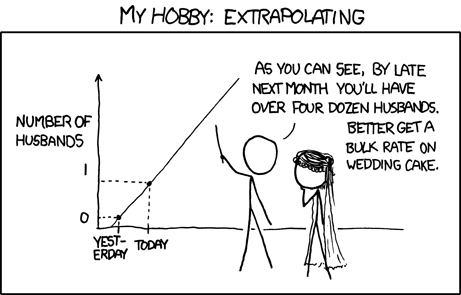
So I'm not going to just shrug and say it's no big deal. It could be. I'm a programmer, I know powers of 2 intimately. We're at 2^15 and doubling every 5 days. If that keeps up for a month we'll be at 1M infected and 16K dead. From there it's another 50 days to 1B infected and 1-2M dead. I'm keeping an eye on that, if it doesn't slow down before 2^20 (1M) then I've already planned to bug out with my loved ones to the mountains of Panama for a couple months until this blows over.
I think it won't come to that, but I'm keeping an eye on the progression and doubling rate. The thing with exponential growth is it always ends. The question here is does it end in time?