Taxi medallions are licenses by the city for taxi companies, to prevent abuse. But if the software is certified, you don't really need the medallions. Drop $500,000 off the cost of a taxi.
You don't have to pay the 2 drivers that normally share a cab. Drop $80,000 a year off.
Assuming the cars no longer crash (version 2.0?), drop $10,000/year off for taxi insurance.
Combine that with Google-quality routing, and smart-phone taxi ordering, and you're looking at a major price drop for taxi service, assuming some sort of competition. I'm guesstimating a 50-75% drop.
Most people in cities will opt out of owning their own car, and use robo-taxis.
  You are looking at an 80-85% drop in the required number
  of cars in cities (even accounting for current peak
  traffic volumes. see the KPMG report. I also came to the
  same number back-of-the-envelope).
Obviously, this will destroy GM and Toyota. Might be good for Tesla as they are still tiny, and I'm sure Elon and Larry have discussed this.
Some other interesting outcomes:
- should increase the total number of trips and miles driven, as lower prices lead to higher quantity demanded, so more wear and tear on cars, and more gas consumed (though less for idling).
- with many driverless cars, they can communicate with each other, driving faster and closer together, and co-ordinating intersection crossing. price of oil change is ambiguous.
- fewer deaths and injuries from accidents, or none at all. The organ transplant industry dies.
- more trees and less concrete lead to cooler cities?
- you can probably get away with more single-lane streets, with no parking, increasing usable land areas in cities by 25%, significantly dropping housing prices.
- in your driverless car, you can talk on your cell, use your laptop, read a book, not be stressed from driving. people may be willing to drive farther to work, increasing sprawl, and also dropping the quantity demanded for housing near the core, dropping prices.
- public transit disappears? though driverless buses would be cheaper too.
- more people bike to work, as it's much safer
- software requirement: interior management for driverless taxis. some video or image recognition for lost purses, people having heart attacks, people throwing up in the back seat.
Today's electric cars would be used for many of these things even they have 80 mile batteries, since the taxi company can manage charging levels very easily. They will end up using it just on a cost basis alone since the cars are cheaper on a marginal basis than gas. Most people don't need a gas car for most of their driving. A tesla model S would do even for most people in large cities today. It's only when you would want to go on long distance road trips that you would need a gas car.
Just this weekend, me and my roomate went on a road trip to san diego and we rented a car because he didn't want to put the ~1200 miles on his car.
Also, since it isn't "your" car, it is perfectly reasonable that on a longer taxi trip the cars just drive to a taxi depot when low on battery and have you switch cars or have the cars switch batteries (as demonstrated by Tesla).
I don't think any of the autopilot cars will be gas guzzlers. By the time they are allowed for consumer use as taxis, the Tesla 300 mile range battery will be half as expensive.
One important consideration: displacing the number of people who drive for a living in a community will be politically difficult. Ever notice how the vegas monorail stops short of the airport? We'll have to suffer a couple generations of protections before the long-run utopia I read in your comment.
Perhaps innovators will offset the protections by having +2 passenger seats in a standard sedan? Or a new car design altogether to side-step arbitrary rules?
We have to stop predicating people's livelihoods on work. Because, most work is going to be automated away, and the only choice we as a society have is: does that mean we all retire, or does that mean we're all sacked?
Ask Uber and the similar services currently embroiled in legal battles in NYC and LA how "no one" cares about taxis politically. Changing incumbents isn't so simple
Or just note that medallions cost hundreds of thousands of dollars (or more). If taxi drivers were politically powerless, why on earth would that be the case?
They will be up against enormous headwinds, though. Unions have power, but it's not infinite, and society's willing to tolerate the unions is going to balanced against the cost of the tolerance... and in this case, after the self-driving cars are about 5 to 10 years in and the cost of making a self-driving car is minimal compared to leaving the hardware out, the price pressure on the unions is probably going to just steamroll them.
If you have trouble with that idea, look at the history of the UAW. Unions are not infinitely powerful, and the further above "market price" they're trying to price their services, the worse off their position becomes.
I work in a start up that has to do with taxi and limo in germany. The limo market is not very political, the taxi market is. Its one of the most distortet markets I have seen. In Berlin you have a state set taxi price.
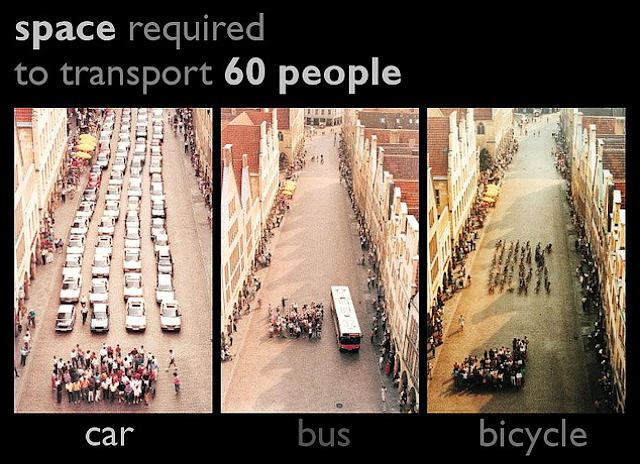
Low-frequency bus-based public transit in midsized cities (mostly provided as a last resort for the poor and elderly) might become outmoded, but there's nowhere near enough roadway space for cars, robotic or not, to replace subways, commuter trains, or even high-frequency buses in dense cities. Mass transit vehicles are, quite simply, much more efficient with space:
http://1.bp.blogspot.com/-933cKv6thVE/TtJfSd3u-JI/AAAAAAAAAx...
To see the future, look to Nairobi's "Mat" system - These vehicles are a sort of hybrid between a large taxi and a small bus. Whilst officially they travel fixed routes, in reality routes and times can be quickly changed to adapt to shifting patterns of demand. I think the future of transport will look a lot like this.
We need vehicles that are big enough to carry a decent number of people, so that during rush hour the available road-space can be effectively utilised: After all, we want to reduce the overall cost and blight of roads for a given peak level of demand, which means maximising the number of passengers per square metre of tarmac. On the other hand, away from rush hour, we want vehicles that are small enough to flexibly be able to tailor their route to the demands and needs of their passengers - so that individuals can be picked up and dropped off at their front doorstep - and at a time that suits them, rather than according to an inflexible schedule.
These conflicting requirements call for a mix of vehicle sizes - both small and large. If you take the cost of a driver away, then I think the minibus might well hit a sweet spot in terms of size and flexibility - although that is little more than a hunch at the moment.
> - public transit disappears? though driverless buses would be cheaper too.
Driverless cars would be a very poor replacement for public transit in traditional cities. Transit has far, far, higher density than cars do, no matter who's driving them.
The problem with cars, for the most part is the immense amount of space that is dedicated to support them, usually at the expense of all other uses, and of the people living there. Driverless cars would reduce this somewhat, but as a 1-for-1 replacement, not nearly enough to be useful.
Probably the best effect of driverless cars will be the other effects you mention: taxi-type services will get cheaper, thus fewer people will own cars, thus fewer people will feel tempted to drive everywhere, thus other modes will get more use, and cities will become more pleasant as car infrastructure shrinks, thus causing even fewer people to drive, etc, etc.
[and yeah, driverless buses etc, are a great application of the tech, maybe more so than actual cars as they're more amenable to simplifications (dedicated routes with supporting infrastructure, etc)...]
I think that's an open question. City busses are only about at parity with cars for fuel economy, due to mostly running at low load factors. That's not a perfect proxy for space, but load factor would be part of the space calculation, too.
However I could see some kind of minibus that could run at both higher density and higher load factor, respond to demand, and sit idle when there is no demand being the optimal kind of vehicle.
I suspect fuel efficiency based on load factors is a very bad proxy for space usage, as fuel efficiency will be calculated as an average, whereas infrastructure is (necessarily) dictated by peak usage. This is true for all modes, of course, but because mass-transit is much more efficient at the high load factors that occur during peaks, it ends up being much significantly more space efficient as well.
[Especially in the U.S., automobile infrastructure is actually often excessive even for peak usage, due to things like ill-considered minimum parking regulations and local politics ("I widened roads! Vote for me!"). But that's a cultural/political problem, not a technical one.]
Another factor in favor of mass transit is that it tends to result in much more focused development around transit networks, resulting in denser and more walkable communities. The fact that it "can't go everywhere" is actually a benefit when it comes to the urban form...
On the routing software. Does anyone see this routing working more like a real-time dynamic airline reservation system ? Routes contain legs that maybe get re-spun based upon changes in demand and capacity as vehicles and people enter and exit this network. Cells phones are the portal into the network telling you where the entry/exit/transit points are and wait-time.
some other ones:
-More electric cars. Robotaxis have higher utilization rates, so it makes the fuel-captial tradeoffs of electric cars much more appealing. Additionally, the range point becomes moot. Taking a trip longer than one taxi can get you on a charge? Just have a new one come pick you up halfway through.
-More multi-mode trips, some car trips are just to have a car available for the return trip (e.g. "Let's take separate cars because you have to leave earlier than I do" or "I would take the BART to SF, but it won't be running at 3 AM when i need to come home").
- cars that actually match their necessary capacity. Lots of people buy trucks, vans, and SUVs for the 10% of the time they really need them. Even 5-seat sedans are overkill for most trips. One-passenger robotaxis would hopefully be cheaper due to reduced fuel and manufacturing costs.
-fewer marginal trips. Currently, most costs of car ownership are fixed: insurance, capital, registration. Once you have a car, the only cost to using it more is fuel, so you still take the car for trips where it's only marginally more convenient than alternative transportation.
> public transit disappears? though driverless buses would be cheaper too.
I don't think so, I think public transport becomes more important. In the same vein as automated cars reduce human dependence, subways and its ilk can become faster and more automated.
In the end, on-rails 1d motion is still much more efficient than 2d rubber on tarmac motion, and the in case of a short airline flight 1d is still more efficient (because you expend most of your fuel ascending and descending from an airport).
In terms of efficiency though, maybe putting everyone in maglev tube pods and having them input a destination and fly along nanotube personal rails like in the Jetsons will be the future.
A Honda Civic's total cost-per-mile (with depreciation) is $0.17 if you're driving 75k/year which is pretty low for a taxi. Even though Civics aren't big cars, the lack of a driver and controls means you can have 2 rows of seats facing each other with a ton of leg room.
If a van in my neighbourhood is ready to pick up anyone going to the closest bus-rapid transit stop, those stops can be even further apart.
Besides the dropping house prices, increased density will increase the number of pedestrians and cyclists, as well as those retail services that cater to the carless.
Correct, hence the competition assumption. City managers will need to be wary of any long-term deals offered by taxi companies in the coming years. Or buy yourself a taxi company now!
Keeping current margins would mean 1000% profit margins since the actual cost of ownership is surprisingly low. The cabby's cut, down time, and the medallion's costs (both up front and in supply restriction) make up the vast majority of fare today.
One company keeps the profit. The next one undercuts the hefty margin to steal customers. The first lowers prices to be competitive.
I mean, something like five+ companies are working on some level of autonomous cars. It's not like we're looking at a future monopoly on the production of them.
The Federal government absolutely would not mandate a monopoly over the country for safety concerns. The vehicles are already licensed on a per-state basis and it stands to reason that states or cities, who already regulate taxis, would extend that power to autonomous taxis.
Which means, if SF gives a monopoly to Google, then LA might give one to Mercedes, while NYC gives one to Ford. (Or whatever). The point being, there is still competition overall to win the business of municipalities.
That's the same argument that allows Comcast to be the only ISP in my area. There's no competition within my area that allows me to make a conscious decision to reject a company.
If my municipality is making the decision, then there is a politician who can be bribed into keeping that utility into place. Really, a terribly system.
> Taxi medallions are licenses by the city for taxi companies, to prevent abuse.
Yeah thats why 'to prevent abuse' sure.
> - fewer deaths and injuries from accidents, or none at all. The organ transplant industry dies.
I have a solution for this, its called, it simply allow people to sell the rights to there organs or even better allow them to sell there organs outright.
While true, I think we are closer to the cusp of transplant organs being manufactured than we think, rather than just swapped out like a car battery like they are today.
Fuck you, you suptid fuck. Im sorry Im so harsh, but I fucking dislike Ayn Rand as much as the next guy.
There are other reasons then objectives to allow markets.
Do you truly belive there is taxi medallions to prevent abuse? If that is what you belive you must be dumb as a stump.
About organs, economists have calculated that you could save a hole lot of people if there was a market in organs. The only reason not to allow it is some ethical bullshit that does not make any sence. We allow people to work in mines and crap fishing bootes, that is a high risk job as well.
Lets see how you will feel when your wife/father/mother is dying and you can not help her/him, with the full knowlage that you could buy a organ for $10k. Lets see if you stick to your shitty ethics and keep looking down on creazy free-market people or if you will gladly spend the $10k and save a life of somebody close to you.
You are looking at an 80-85% drop in the required number
of cars in cities (even accounting for current peak
traffic volumes. see the KPMG report. I also came to the
same number back-of-the-envelope).
The KPMG report seemed very light on details. I'd be interested in reading a more fully worked through example if you know of one.
In a lot of things like city bike sharing there's an aggregate flow of bikes into the city at 9am and out of the city at 5pm, so trucks have to shuttle the bikes back in the opposite direction. Seems to me if one car shuttled three commuters into the city you'd have 1/3rd the number of cars on the roads, but each car driving 6 times as far as it has to drive out empty to pick up the next fare.
What kind of fill rate do you think it's reasonable to expect for cars driving from the city to the suburbs in the morning rush hour?
Its a good swag at effects. I doubt you'd get the cities to 'give back' the space on the streets but it would change how new cities are built. Given how reasonably efficient self driving cars are now, I'm kind of surprised there isn't a move on to make a self driving 'truckway' up and down the state at least. Its got to be easier than hiring drivers and the equipment re-use is huge. Adding technology along the roadbed for extra safety, getting trucks out of the current population on highways, etc etc.
Perhaps Los Angeles can be reclaimed, then. Turn many of the parking lots into high density housing and parks. I've always thought it such a shameful waste that such rare climate and pleasant topography and geography were wasted with the construction of empty concrete lots and massive jammed freeways everywhere. And such a strain on quality of life to be paralyzed by traffic around you at all times, to see the endless sunshine bathed in the brown hues of vehicle emissions.
Because we don't have a good enough socialized safety net in the US, or in many other countries, and if you think that most taxi drivers can retrain rapidly to a highly skilled job that isn't in danger of being automated away, you're delusional.
It's a solvable problem, I think, and eventually people will find a niche, but burying your head and pretending that this isn't an issue at all isn't a good idea.
Exactly. This isn't a problem on its own but a symptom of something else that is not right. I'm against implementing protections of the status quo for the sake of masking the symptoms at the expense of progress.
> - in your driverless car, you can talk on your cell, use your laptop, read a book, not be stressed from driving. people may be willing to drive farther to work, increasing sprawl, and also dropping the quantity demanded for housing near the core, dropping prices.
You can't do too much if you're prone to motion sickness.


Taxi medallions are licenses by the city for taxi companies, to prevent abuse. But if the software is certified, you don't really need the medallions. Drop $500,000 off the cost of a taxi.
You don't have to pay the 2 drivers that normally share a cab. Drop $80,000 a year off.
Assuming the cars no longer crash (version 2.0?), drop $10,000/year off for taxi insurance.
Combine that with Google-quality routing, and smart-phone taxi ordering, and you're looking at a major price drop for taxi service, assuming some sort of competition. I'm guesstimating a 50-75% drop.
Most people in cities will opt out of owning their own car, and use robo-taxis.
You are looking at an 80-85% drop in the required number of cars in cities (even accounting for current peak traffic volumes. see the KPMG report. I also came to the same number back-of-the-envelope).
Obviously, this will destroy GM and Toyota. Might be good for Tesla as they are still tiny, and I'm sure Elon and Larry have discussed this.
Some other interesting outcomes:
- should increase the total number of trips and miles driven, as lower prices lead to higher quantity demanded, so more wear and tear on cars, and more gas consumed (though less for idling).
- with many driverless cars, they can communicate with each other, driving faster and closer together, and co-ordinating intersection crossing. price of oil change is ambiguous.
- fewer deaths and injuries from accidents, or none at all. The organ transplant industry dies.
- more trees and less concrete lead to cooler cities?
- you can probably get away with more single-lane streets, with no parking, increasing usable land areas in cities by 25%, significantly dropping housing prices.
- in your driverless car, you can talk on your cell, use your laptop, read a book, not be stressed from driving. people may be willing to drive farther to work, increasing sprawl, and also dropping the quantity demanded for housing near the core, dropping prices.
- public transit disappears? though driverless buses would be cheaper too.
- more people bike to work, as it's much safer
- software requirement: interior management for driverless taxis. some video or image recognition for lost purses, people having heart attacks, people throwing up in the back seat.