Taxi medallions are licenses by the city for taxi companies, to prevent abuse. But if the software is certified, you don't really need the medallions. Drop $500,000 off the cost of a taxi.
You don't have to pay the 2 drivers that normally share a cab. Drop $80,000 a year off.
Assuming the cars no longer crash (version 2.0?), drop $10,000/year off for taxi insurance.
Combine that with Google-quality routing, and smart-phone taxi ordering, and you're looking at a major price drop for taxi service, assuming some sort of competition. I'm guesstimating a 50-75% drop.
Most people in cities will opt out of owning their own car, and use robo-taxis.
  You are looking at an 80-85% drop in the required number
  of cars in cities (even accounting for current peak
  traffic volumes. see the KPMG report. I also came to the
  same number back-of-the-envelope).
Obviously, this will destroy GM and Toyota. Might be good for Tesla as they are still tiny, and I'm sure Elon and Larry have discussed this.
Some other interesting outcomes:
- should increase the total number of trips and miles driven, as lower prices lead to higher quantity demanded, so more wear and tear on cars, and more gas consumed (though less for idling).
- with many driverless cars, they can communicate with each other, driving faster and closer together, and co-ordinating intersection crossing. price of oil change is ambiguous.
- fewer deaths and injuries from accidents, or none at all. The organ transplant industry dies.
- more trees and less concrete lead to cooler cities?
- you can probably get away with more single-lane streets, with no parking, increasing usable land areas in cities by 25%, significantly dropping housing prices.
- in your driverless car, you can talk on your cell, use your laptop, read a book, not be stressed from driving. people may be willing to drive farther to work, increasing sprawl, and also dropping the quantity demanded for housing near the core, dropping prices.
- public transit disappears? though driverless buses would be cheaper too.
- more people bike to work, as it's much safer
- software requirement: interior management for driverless taxis. some video or image recognition for lost purses, people having heart attacks, people throwing up in the back seat.
Today's electric cars would be used for many of these things even they have 80 mile batteries, since the taxi company can manage charging levels very easily. They will end up using it just on a cost basis alone since the cars are cheaper on a marginal basis than gas. Most people don't need a gas car for most of their driving. A tesla model S would do even for most people in large cities today. It's only when you would want to go on long distance road trips that you would need a gas car.
Just this weekend, me and my roomate went on a road trip to san diego and we rented a car because he didn't want to put the ~1200 miles on his car.
Also, since it isn't "your" car, it is perfectly reasonable that on a longer taxi trip the cars just drive to a taxi depot when low on battery and have you switch cars or have the cars switch batteries (as demonstrated by Tesla).
I don't think any of the autopilot cars will be gas guzzlers. By the time they are allowed for consumer use as taxis, the Tesla 300 mile range battery will be half as expensive.
One important consideration: displacing the number of people who drive for a living in a community will be politically difficult. Ever notice how the vegas monorail stops short of the airport? We'll have to suffer a couple generations of protections before the long-run utopia I read in your comment.
Perhaps innovators will offset the protections by having +2 passenger seats in a standard sedan? Or a new car design altogether to side-step arbitrary rules?
We have to stop predicating people's livelihoods on work. Because, most work is going to be automated away, and the only choice we as a society have is: does that mean we all retire, or does that mean we're all sacked?
Ask Uber and the similar services currently embroiled in legal battles in NYC and LA how "no one" cares about taxis politically. Changing incumbents isn't so simple
Or just note that medallions cost hundreds of thousands of dollars (or more). If taxi drivers were politically powerless, why on earth would that be the case?
They will be up against enormous headwinds, though. Unions have power, but it's not infinite, and society's willing to tolerate the unions is going to balanced against the cost of the tolerance... and in this case, after the self-driving cars are about 5 to 10 years in and the cost of making a self-driving car is minimal compared to leaving the hardware out, the price pressure on the unions is probably going to just steamroll them.
If you have trouble with that idea, look at the history of the UAW. Unions are not infinitely powerful, and the further above "market price" they're trying to price their services, the worse off their position becomes.
I work in a start up that has to do with taxi and limo in germany. The limo market is not very political, the taxi market is. Its one of the most distortet markets I have seen. In Berlin you have a state set taxi price.
Low-frequency bus-based public transit in midsized cities (mostly provided as a last resort for the poor and elderly) might become outmoded, but there's nowhere near enough roadway space for cars, robotic or not, to replace subways, commuter trains, or even high-frequency buses in dense cities. Mass transit vehicles are, quite simply, much more efficient with space:
http://1.bp.blogspot.com/-933cKv6thVE/TtJfSd3u-JI/AAAAAAAAAx...
To see the future, look to Nairobi's "Mat" system - These vehicles are a sort of hybrid between a large taxi and a small bus. Whilst officially they travel fixed routes, in reality routes and times can be quickly changed to adapt to shifting patterns of demand. I think the future of transport will look a lot like this.
We need vehicles that are big enough to carry a decent number of people, so that during rush hour the available road-space can be effectively utilised: After all, we want to reduce the overall cost and blight of roads for a given peak level of demand, which means maximising the number of passengers per square metre of tarmac. On the other hand, away from rush hour, we want vehicles that are small enough to flexibly be able to tailor their route to the demands and needs of their passengers - so that individuals can be picked up and dropped off at their front doorstep - and at a time that suits them, rather than according to an inflexible schedule.
These conflicting requirements call for a mix of vehicle sizes - both small and large. If you take the cost of a driver away, then I think the minibus might well hit a sweet spot in terms of size and flexibility - although that is little more than a hunch at the moment.
> - public transit disappears? though driverless buses would be cheaper too.
Driverless cars would be a very poor replacement for public transit in traditional cities. Transit has far, far, higher density than cars do, no matter who's driving them.
The problem with cars, for the most part is the immense amount of space that is dedicated to support them, usually at the expense of all other uses, and of the people living there. Driverless cars would reduce this somewhat, but as a 1-for-1 replacement, not nearly enough to be useful.
Probably the best effect of driverless cars will be the other effects you mention: taxi-type services will get cheaper, thus fewer people will own cars, thus fewer people will feel tempted to drive everywhere, thus other modes will get more use, and cities will become more pleasant as car infrastructure shrinks, thus causing even fewer people to drive, etc, etc.
[and yeah, driverless buses etc, are a great application of the tech, maybe more so than actual cars as they're more amenable to simplifications (dedicated routes with supporting infrastructure, etc)...]
I think that's an open question. City busses are only about at parity with cars for fuel economy, due to mostly running at low load factors. That's not a perfect proxy for space, but load factor would be part of the space calculation, too.
However I could see some kind of minibus that could run at both higher density and higher load factor, respond to demand, and sit idle when there is no demand being the optimal kind of vehicle.
I suspect fuel efficiency based on load factors is a very bad proxy for space usage, as fuel efficiency will be calculated as an average, whereas infrastructure is (necessarily) dictated by peak usage. This is true for all modes, of course, but because mass-transit is much more efficient at the high load factors that occur during peaks, it ends up being much significantly more space efficient as well.
[Especially in the U.S., automobile infrastructure is actually often excessive even for peak usage, due to things like ill-considered minimum parking regulations and local politics ("I widened roads! Vote for me!"). But that's a cultural/political problem, not a technical one.]
Another factor in favor of mass transit is that it tends to result in much more focused development around transit networks, resulting in denser and more walkable communities. The fact that it "can't go everywhere" is actually a benefit when it comes to the urban form...
On the routing software. Does anyone see this routing working more like a real-time dynamic airline reservation system ? Routes contain legs that maybe get re-spun based upon changes in demand and capacity as vehicles and people enter and exit this network. Cells phones are the portal into the network telling you where the entry/exit/transit points are and wait-time.
some other ones:
-More electric cars. Robotaxis have higher utilization rates, so it makes the fuel-captial tradeoffs of electric cars much more appealing. Additionally, the range point becomes moot. Taking a trip longer than one taxi can get you on a charge? Just have a new one come pick you up halfway through.
-More multi-mode trips, some car trips are just to have a car available for the return trip (e.g. "Let's take separate cars because you have to leave earlier than I do" or "I would take the BART to SF, but it won't be running at 3 AM when i need to come home").
- cars that actually match their necessary capacity. Lots of people buy trucks, vans, and SUVs for the 10% of the time they really need them. Even 5-seat sedans are overkill for most trips. One-passenger robotaxis would hopefully be cheaper due to reduced fuel and manufacturing costs.
-fewer marginal trips. Currently, most costs of car ownership are fixed: insurance, capital, registration. Once you have a car, the only cost to using it more is fuel, so you still take the car for trips where it's only marginally more convenient than alternative transportation.
> public transit disappears? though driverless buses would be cheaper too.
I don't think so, I think public transport becomes more important. In the same vein as automated cars reduce human dependence, subways and its ilk can become faster and more automated.
In the end, on-rails 1d motion is still much more efficient than 2d rubber on tarmac motion, and the in case of a short airline flight 1d is still more efficient (because you expend most of your fuel ascending and descending from an airport).
In terms of efficiency though, maybe putting everyone in maglev tube pods and having them input a destination and fly along nanotube personal rails like in the Jetsons will be the future.
A Honda Civic's total cost-per-mile (with depreciation) is $0.17 if you're driving 75k/year which is pretty low for a taxi. Even though Civics aren't big cars, the lack of a driver and controls means you can have 2 rows of seats facing each other with a ton of leg room.
If a van in my neighbourhood is ready to pick up anyone going to the closest bus-rapid transit stop, those stops can be even further apart.
Besides the dropping house prices, increased density will increase the number of pedestrians and cyclists, as well as those retail services that cater to the carless.
Correct, hence the competition assumption. City managers will need to be wary of any long-term deals offered by taxi companies in the coming years. Or buy yourself a taxi company now!
Keeping current margins would mean 1000% profit margins since the actual cost of ownership is surprisingly low. The cabby's cut, down time, and the medallion's costs (both up front and in supply restriction) make up the vast majority of fare today.
One company keeps the profit. The next one undercuts the hefty margin to steal customers. The first lowers prices to be competitive.
I mean, something like five+ companies are working on some level of autonomous cars. It's not like we're looking at a future monopoly on the production of them.
The Federal government absolutely would not mandate a monopoly over the country for safety concerns. The vehicles are already licensed on a per-state basis and it stands to reason that states or cities, who already regulate taxis, would extend that power to autonomous taxis.
Which means, if SF gives a monopoly to Google, then LA might give one to Mercedes, while NYC gives one to Ford. (Or whatever). The point being, there is still competition overall to win the business of municipalities.
That's the same argument that allows Comcast to be the only ISP in my area. There's no competition within my area that allows me to make a conscious decision to reject a company.
If my municipality is making the decision, then there is a politician who can be bribed into keeping that utility into place. Really, a terribly system.
> Taxi medallions are licenses by the city for taxi companies, to prevent abuse.
Yeah thats why 'to prevent abuse' sure.
> - fewer deaths and injuries from accidents, or none at all. The organ transplant industry dies.
I have a solution for this, its called, it simply allow people to sell the rights to there organs or even better allow them to sell there organs outright.
While true, I think we are closer to the cusp of transplant organs being manufactured than we think, rather than just swapped out like a car battery like they are today.
Fuck you, you suptid fuck. Im sorry Im so harsh, but I fucking dislike Ayn Rand as much as the next guy.
There are other reasons then objectives to allow markets.
Do you truly belive there is taxi medallions to prevent abuse? If that is what you belive you must be dumb as a stump.
About organs, economists have calculated that you could save a hole lot of people if there was a market in organs. The only reason not to allow it is some ethical bullshit that does not make any sence. We allow people to work in mines and crap fishing bootes, that is a high risk job as well.
Lets see how you will feel when your wife/father/mother is dying and you can not help her/him, with the full knowlage that you could buy a organ for $10k. Lets see if you stick to your shitty ethics and keep looking down on creazy free-market people or if you will gladly spend the $10k and save a life of somebody close to you.
You are looking at an 80-85% drop in the required number
of cars in cities (even accounting for current peak
traffic volumes. see the KPMG report. I also came to the
same number back-of-the-envelope).
The KPMG report seemed very light on details. I'd be interested in reading a more fully worked through example if you know of one.
In a lot of things like city bike sharing there's an aggregate flow of bikes into the city at 9am and out of the city at 5pm, so trucks have to shuttle the bikes back in the opposite direction. Seems to me if one car shuttled three commuters into the city you'd have 1/3rd the number of cars on the roads, but each car driving 6 times as far as it has to drive out empty to pick up the next fare.
What kind of fill rate do you think it's reasonable to expect for cars driving from the city to the suburbs in the morning rush hour?
Its a good swag at effects. I doubt you'd get the cities to 'give back' the space on the streets but it would change how new cities are built. Given how reasonably efficient self driving cars are now, I'm kind of surprised there isn't a move on to make a self driving 'truckway' up and down the state at least. Its got to be easier than hiring drivers and the equipment re-use is huge. Adding technology along the roadbed for extra safety, getting trucks out of the current population on highways, etc etc.
Perhaps Los Angeles can be reclaimed, then. Turn many of the parking lots into high density housing and parks. I've always thought it such a shameful waste that such rare climate and pleasant topography and geography were wasted with the construction of empty concrete lots and massive jammed freeways everywhere. And such a strain on quality of life to be paralyzed by traffic around you at all times, to see the endless sunshine bathed in the brown hues of vehicle emissions.
Because we don't have a good enough socialized safety net in the US, or in many other countries, and if you think that most taxi drivers can retrain rapidly to a highly skilled job that isn't in danger of being automated away, you're delusional.
It's a solvable problem, I think, and eventually people will find a niche, but burying your head and pretending that this isn't an issue at all isn't a good idea.
Exactly. This isn't a problem on its own but a symptom of something else that is not right. I'm against implementing protections of the status quo for the sake of masking the symptoms at the expense of progress.
> - in your driverless car, you can talk on your cell, use your laptop, read a book, not be stressed from driving. people may be willing to drive farther to work, increasing sprawl, and also dropping the quantity demanded for housing near the core, dropping prices.
You can't do too much if you're prone to motion sickness.
"There are risks, of course: People might be more open to a longer daily commute, leading to even more urban sprawl."
Gotta love the NYTimes for the tendentious moralizing. People having more choice, and exercising it, is a risk! Attempts to have a backyard or extra bedrooms, or just pay less for real estate, are dangerous and wrong. Worse, if you can buy extra bedrooms you might be tempted to have kids and we wouldn't want any of those consuming the Earth's precious resources would we :P
(Not that there isn't anything to be said in support of that point. But it's tendentious and moralizing all the same.)
The problem is that the costs of sprawl aren't effectively conveyed to the commuter. The increased costs of infrastructure, road maintenance, etc aren't remotely made up for in vehicle, property or fuel taxes.
In which case, yes, it's a risk if it continues. Hell, it's a risk if it doesn't decline as the US approaches a GDP-growth situation not-unlike Japan's.
(Where per-capita GDP may continue growing, but net GDP barely moves due an aging populace and declining birth-rate.)
"People exercising their choice" sounds nice, but there will always be limits imposed by the society. You cannot "exercise your choice" to commute in a school bus today.
Zoning restrictions in the cities exist for the same reason: people just don't respect each other enough to trust them with their choices. Personally I cannot stand HOAs, yet another level of bureaucracy and taxation to deal with, but I will not argue with the fact that HOA buildings/neighborhoods are nicer than "free" ones.
If we're going to be all hyperbole, my old HOA president who had someone booted from their home over the wrong shade of white exterior paint should be dragged out of his home by an angry mob.
Show me someone who has an eyesore, and I'll show you some asshole who is abusing their power.
Decentralization is horrible from environmental standpoint. It also makes cities much less pleasant, it hurts the ability to create useful schools, it horribly limits the pool in which those kids you mentioned can find friends. It makes it almost impossible to provide good public transportation (which is the sensible way to achieve things from this article, see my fav snark at electric cars as well: https://www.facebook.com/photo.php?fbid=552497834771072&set=...). Backyards? We have parks! Bedrooms? Unless you're in Paris or a teenager stuck up on living in the Pijp, you will get bedrooms. Together with places to go out into, for example.
It would only increase choice for people who can afford a car, the cost of operating a car, and the extra travel time. For people who cannot, urban sprawl is a severe limit to their choice.
That being said, if someone can make an extra 40k/year by commuting 4 hours a day, it may very well be worth it to them. The difference in earning potential between commuting to the local city and not can be dramatic.
If you honestly think that urban sprawl is anything other than an inefficient allocation of fixed resources, you aren't looking at the big picture.
Having a backyard is not needed if you have lots and parks to play in and walk dogs; the American suburb idea of a little villa for each person is stupid and wasteful and wouldn't confer any advantages if you fixed the underlying insecurities people had about the hospitality of their own community.
If I could snooze in my driverless car overnight, I would ride instead of subjecting myself to the current flying experience for any such trip of 10 hours or less.
Lots of people jump to the notion that if driverless cars are available, we will go to a dominantly short-term-hire model of car ownership. By why?
Yes, taxis would be cheaper in a world of driverless cars. But they would still be dubiously clean (perhaps even dirtier without a human there to make the passengers clean up). You would still not be able to leave your crap in them. And they would still be only intermittently available at times of high demand (or else they'll be quite expensive).
In contrast, if you privately owned a car, it would have all its present advantages and also it would be usable even if you intended to get drunk; you could use the time that you were driving to read or use the computer or watch TV or whatever; you wouldn't need to circle around and try to park; you could still potentially utilize the car more than the present situation (for example: your car could drop the kids off at school while you get an hour of work in, and then come back and take you to the office), giving a cost savings.
By the way: does anyone who has kids young enough to require car-seats think that they could get away with a taxi-approach to cars, even if taxis were arbitrarily cheap? Don't underestimate the value of a personally owned car as a mobile receptacle of your stuff.
I don't know which of those models would be more dominant in a driverless car world. They both have advantages over the present state of the art. But I'm pretty sure that the people who jump immediately to believe that the taxi model would become massively dominant are basing this more on their wishes than the facts.
I think there will be a hybrid model. Owning a driverless car will still be a very commonplace thing, car ownership is too ingrained in the American mindset to just let it go.
However, I believe owning a car will also come to be seen as an investment option, like owning property. What if your car was loaned out to a taxi service while you're at work every day?
The taxi service has no drivers, no cars, no real capital. It's just a website with a server coordinating cars to people and to destinations.
As a vehicle owner, you are given a share of the profits for the utilization of your capital. Sure there are a lot of kinks to work out, but I could see this being a very common thing.
Renting out your car while you're not using it negates the advantages of owning one that GP points out. In addition, you're now taking on the risk of damage and the onus of maintenance for a car that's used as a taxi. I don't think this will be a popular option.
Also if you want to go home now, or go to the store now and it's rented out by some one: you're basically fucked.
You can program a range limit and certain hours (be no farther than 30 miles away by 4pm and not in use) sure but when anything unexpected comes up (on either end) you don't have a car for X period of time.
Even just sharing the car has this problem, oh it can drive back home empty, but the logistics of making sure it can drop Bob off drive home get Alice drive her some were pick Bob back up up drop him at home in time to go get Alice are only barely more convenient than "sorry I need the car today" for twice the mileage cost natch.
I don't think within-family-car-sharing would be a HUGE deal, certainly. But there are a lot of situations in which I end up chauffeuring my fiancée or vice versa because one of us needs to get to point A, but the other needs the car for the day. And there's lots of little friction points in terms of lining up our schedules there. It's not a huge pain point, but my car would be noticeably more valuable to me if it handled these situations for itself.
It might not be wildly convenient, but it's even less convenient for me to drive my fiancée to where she needs to go and then drive back.
uhhh, essentially we already have this service. It's called Lyft, and it is wildly popular. The only difference, is that the owner has to drive the car.
The problem is that you'd have such a huge supply of available cars between 8-6pm M-F that you'd never be able to turn a profit if driverless cars became commonplace.
The parking lot at my office complex has more capacity than my city's entire public transit and taxi system combined. Releasing that into the market just means razor thin profits with the risk that someone will trash your car.
> Lots of people jump to the notion that if driverless cars are available, we will go to a dominantly short-term-hire model of car ownership. By why?
I'm already part of a short-term-hire model of car ownership for cars that I drive myself. I don't own a car and have no desire to own one but I use small electric cars from a company called car2go whenever I need them. If the cars were driverless I'd be even happier to use them.
I have no affiliation with the company, just as a very satisfied customer.
Self-driving cars can completely change our cities, here in America, because our cities are designed around cars. When I don't have to fight for a parking space, I don't need vast car parks around everything. When the cars drive as members of the same team instead of playing cutthroat, we don't need more lanes, more automotive bandwidth. We can remake our cities on our scale instead. Whether we will or not is the question.
How about "How Driverless Cars Could Reshape Car Ownership"?
Why bother owning a car at all? Couldn't I just subscribe to some service that will have a car drive to me when I need it? And when I need a two seater, or a five seater or a seven seater I just tell the smartphone app that? And when the car is dirty is just drives somewhere to be cleaned?
I make a fair number of "quick trips" that are within maybe 5 miles of my house.
Like most suburbs, we have no public transportation. It's not practical for me to bike to these destinations, due to either weather, or bulk/size of items being purchased.
I wouldn't want to have to wait around for as long as the total trip takes just for a car to arrive. I see no problem with owning private vehicles, it would be nice, at times, if my vehicles were more autonomous though.
It works in some places and not in others. In San Francisco, it would work pretty well. In larger metropolitan areas, it may work with a hub-like form of public transportation. An autocar takes you to the train, which takes you to the destination city, where you can use another autocar or other public transportation to get to your destination.
Will it work in rural areas? Of course not. The sun belt cities may have trouble utilizing it. But the Boston - DC corridor opportunity would be enough to make it worthwhile. Add to that many European cities and there's enough of a market.
This is already the case in urban environments. Many people do not own cars but just use taxis. I think there are even some subscription taxi services too.
As for why this will probably never take on in less urban environments:
- 5-10 minute wait times (people are inpatient)
- Can't leave belongings in car
- Keeping the car clean would add cost to the service
> This is already the case in urban environments. Many people do not own cars but just use taxis. I think there are even some subscription taxi services too.
There are people that share a small garage of vehicles, or are members of a club that rents out a lot of vehicles on an hourly or daily basis. It seems like an economical choice for people that don't need a car every day, but sometimes. Plus, the assortment of cars is varied so they can probably get things like a van if they are going to move out of their apartment or something.
I dunno. In well developed cities people used bikes and public transport instead since decades now. Driverless cars sounds so silly, if I ever used a car, it wouldn't be in the city, be to go out somewhere outside the normal infrastructure.
I don't know why people are expecting this to happen so soon (if at all). Even if we have the technology for driverless cars sometime in the next few decades (QAed for all possible conditions and failures, of course), there will be no way that they'll be street legal without a (sober) driver at the wheel. We have fully automated TRAINS -- vehicles that only have to go back and forth along a single axis -- that still require conductors. Airlines, despite being 99% automatic, are very, very strict about pilot safety and training. How could you possibly expect something that's an order of magnitude more complicated to be any different? Top it off with some of the most advanced AI (yet to be) invented and you have a problem with a solution much farther into the future than one might think. Me, I'd rather stick with good old fashioned public transit.
> Imagine a city where you don’t drive in loops looking for a parking spot because your car drops you off and scoots off to some location to wait, sort of like taxi holding pens at airports.
What location is that? The magic one? Just "some" location that apparently will magically appear when the magic cars come.
Actually, your driverless car takes up the same room on the road or in the parking lot as everyone else's. YOU don't drive in loops, but your car still does.
Imagine a theatre at 10PM. The show is letting out. Traffic is snarled for five miles in all directions because a theatre's-worth of empty cars have been circling the block for an hour, making sure they are ready to pick up their ever-so-important passengers.
In effect, adding traffic to roads no longer imposes a personal cost on your time - it's only a financial cost on your bank account, which is highly affordable to some people. The same people who currently have 14 cars in the garage of their mansion can now take all 14 cars with them to the Hamptons for the weekend, in case they want to drive one. Just order them to circle the block near your beach house - well, not your block of course, the neighbors would complain, but someone else's block. Maybe the traffic on the Long Island Expressway is terrible, but your 14 empty cars don't care, they'll make it out to the beach house eventually.
Cost of housing getting you down? Just buy a van and a sleeping bag, and order it to drive around randomly all night and arrive at your work at 9AM. Now you've effectively perma-rented a 9'x14' spot on the nation's roads, without paying a cent.
The push for carpooling is a way to use our limited road space more efficiently, by increasing the number of persons per car up from the current average of 1.59. Driverless cars are the anti-carpool - cars driving with zero humans going anywhere, pushing that average down.
Driverless cars are a net negative for the way the world is going, not a net positive.
I have to say, this is one of the most cynical and unimaginative posts I've ever read on HN. I think you should save it somewhere so you can laugh at yourself if someday driverless cars become prevalent.
The positive economic effects and the transformative effect driverless cars will have on society is pretty hard to overstate. You seem to falling into the trap of thinking that infrastructure will not be updated around the assumption that cars are autonomous, and clever people will not exploit this new reality in ways that benefit the world. To attack your specific example, why do you assume the cars will drive around passenger-less, and not merely continually make productive uses of themselves, such as by servicing other passengers or acting as deliverymen for physical goods? Why do you assume people will own cars in general, when a service which provides on-demand autonomous transportation in clean, well-maintained, up-to-date vehicles will be more convenient, less work, safer, and will be cheaper? Why does the car that drops you off need to be the car that picks you up? Why do you think highways will not become wildly more efficient and safe even if the average passenger per car (one of several metrics of efficiency) goes up? Why do you think parking garages and cars themselves will not be able to be packed in more efficiently and quickly when they can autonomously coordinate their insertion and removal from a fixed area? Why do you even think that centralized parking garages will be as necessary when autonomously controlled vehicles can coordinate to efficiently fill any designated parking space that is road accessible?
When the assumptions of society change in such a dramatic way (that a human must navigate a road-based vehicle manually) the downstream effects are hard to predict but undoubtedly will follow the same path all automation has: more efficient, less polluting, and more productive use of time and energy. When you're dealing with something as ingrained and as prevalent as the automobile, you're talking about a massive boost in these things across the entire world.
If people wanted to share things with others, the world would be an entirely different place. But people are selfish.
The city block you're living on probably only needs one stand mixer, one waffle iron, one clothes iron. You could all just share one of these rarely-used appliances between you. Why don't you?
We could already build the world you are envisioning, trivially. Any municipality in the world could create an excellent fleet of mass transit vehicles - I mean a truly excellent system, capable of getting you anywhere you want to go at a very reasonable price and high speed. But no place does that. It exists nowhere.
Because people want their own cars. They don't want to share. And the cheaper these vehicles get - a requirement for your techno-utopia - the more people want their own.
Do you think Bill Gates' car will be out delivering packages when he's not in it? Okay, now why do you think everyone else is different from Bill Gates?
> Why do you even think that centralized parking garages will be as necessary when autonomously controlled vehicles can coordinate to efficiently fill any designated parking space that is road accessible?
That doubles the road problem, not decreases it. The autonomous cars spend four hours in a traffic jam on the two-lane bridge in order to park in the $1.50 parking lot instead of the $2.00 lot. You don't mind because you aren't in them. Anyone who has to actually cross the bridge is screwed. Traffic jams are actually BENEFICIAL to autonomous vehicles - free unpaid parking and low fuel usage - as long as the vehicle isn't needed immediately. Autonomous cars will SEEK OUT and JOIN traffic jams, when not needed, to minimize their cost of operation.
As I mentioned elsewhere, this argument somehow equivocates black car services with car sharing. The point is, why own a car that you have to maintain, depreciates, and requires parking when you can have brand new, well-maintained vehicles transporting you around for a small monthly fee?
Your Bill Gates analogy only seals my argument. Bill Gates, in all liklihood, has a personal driver and rides in a top of the line vehicle most of the time, that he may or may not own. (He likely doesn't care.) The reason this lifestyle is only available to the rich is not because of the cost of the car, but because of the cost of the driver. If the driver were to be removed, your average person could likely afford to be transported in a clean, new, safe, well-maintained vehicle they pay for on-demand from an autonomous vehicle fleet.
> The city block you're living on probably only needs one stand mixer, one waffle iron, one clothes iron. You could all just share one of these rarely-used appliances between you. Why don't you?
If I can press a button on my iPhone and have nearly any brand or quality of waffle iron appear on my counter in 30 seconds, then disappear automatically to save counter-space once I no longer need it--then wow, yes, please, sign me up for "sharing." It sounds vastly, absurdly better than ownership.
> Do you think Bill Gates' car will be out delivering packages when he's not in it? Okay, now why do you think everyone else is different from Bill Gates?
Well first, there's the obvious question: do you think Bill Gates rents an apartment? Okay, now why do you think everyone else is different from Bill Gates?
Besides--when Bill Gates travels, I highly doubt he buys a new car in every city he lands in. He probably gets into a limo. Just like buying a new car while traveling would seem absurdly wasteful today, owning a car (plus a garage/insurance/gas) might seem absurdly wasteful when you can get the exact same feature-set for a fraction of the cost.
Freaking American biases. There are cities in the world where infrastructure sucks, people are many, and parking is rare. I already take a taxi to and from work, this robo car thing will catch on really fast here, of only to optimize throughput in a very congested city where there is no room for new roads.
America has lots of space, low cost of car ownership and operation. Parent was talking about parking costing only $1.50 or $2, I mean, nowhere else in the world, even developing world, is parking ever that cheap!
It is cheaper for me to take a taxi than drive because the taxi doesn't have to park, obviously, the taxi doesn't just go back to where they came from after taking me to my destination. Crazy americans, they live in such a fantasy world and they don't realize it.
Do you really think an autonomous car will seek out and join a traffic jam? How many times do you think an owner of an autonomous car will have to be left stranded because their car intentionally got itself stuck in a traffic jam and couldn't pick them up before they trade that vehicle in for one without such a short sighted "optimisation"?
The point is at any given moment, a given car is not "your car." If car A gets stuck in a traffic jam, and car B suddenly becomes the optimal vehicle from the fleet to get to you from a cost/time perspective, then suddenly car B begins travelling to you. Congestion on highways becomes a shared cost to all travelers, those who are in transit and those who are awaiting transit, and as such those travelers are able to potentially bid or pay in commensurate to how they value the time they have or will lose due to the congestion.
Basically, there is no free lunch, a traffic jam is a capacity problem where demand outstrips supply, so unless you assume autonomous vehicles (once collectively networked as part of a national system) are somehow going to be less efficient at using road capacity than the same vehicles being driven by independent humans who have no global information, they will be a better solution. The fact that autonomous vehicles will be able to utilize alternative routes off-highway pre-emptively before actual congestion occurs alone is huge. Nevermind the fact that a large reason traffic jams occur is actually not a capacity problem per se, but due to a propagation of small jams into larger ones, in both time and space, due to human beings controlling the vehicle and propagating traffic waves:
In other words, traffic jams caused by accidents, road blockages, merging, or any other non-capacity related issues will likely no longer occur if the vehicles are autonomously controlled.
Why not a tragedy of the commons with "rational agent" cars that are attempting to minimize parking fees. A neat idea but I think if driverless cars did this then cities would adopt traffic jam fees to realign their cost/benefit strategy in the "driving" game.
> The city block you're living on probably only needs one stand mixer, one waffle iron, one clothes iron. You could all just share one of these rarely-used appliances between you. Why don't you?
Probably because they can't be bothered with the small logistics of a sharing system. But it isn't totally unheard of:
If not for some sense of selflessness, such systems should at the least motivate the more frugally-minded people: only borrowing or renting rarely used appliances, offering and getting services from each other with minimal bureaucracy, and optionally operating within a sort of currency system that isn't taxable.
unimaginative? I see plenty of ideas, and wouldn't call all of them obvious.
I also think there is at the very least a core of truth in it. For example, that 30% time gain in not looking for a parking spot. If people now want to spend an hour on travelling and gain 10 minutes that way, it isn't strange to assume that they will be willing to move 10 minutes driving farther into the suburbs (cheaper house, larger garden, etc).
So, I expect traffic to increase. An extra reason for that to happen is that time currently spent operating your car could be spent in other ways. For example, you could watch a full-length movie/do some yoga on your way to work every day. For a movie/yoga enthusiast, that could make the 1.5 hour trip preferable over the 1 hour one, especially since it will come with the cheaper/better housing.
"the downstream effects are hard to predict but undoubtedly will follow the same path all automation has: more efficient, less polluting"
You mean as in "living in a suburb and driving a SUV to work is less polluting than living in the center of town and driving a bicycle or walking to work?"
The original smart was 2.5m long. That is surprisingly spacious if you replace the petrol engine with electrical ones in the wheels, the petrol tank by 10 cm of batteries in the floor and give up the back trunk (you wouldn't really need one for commuting)
I also don't see why all people would start using smaller cars. If these driverless ones make economic sense, they can't be more expensive than current ones, and currently there are plenty of people driving cars larger than smarts.
You are assuming a society where everyone shares everything. I don't think that's likely with the introduction of cars that drive themselves. Most early adopters may not be "sharers" either, so they may not push the technology in that direction.
I think jellicle is right, that this invention can cause just as much harm as good.
When intelligent people make decisions, they consider the worst and best possible outcomes.
I don't consider Uber a "sharing service." Uber's model will probably be the model for the future, I don't see any reason why it shouldn't be, with the difference that they may maintain the fleet themselves. What is the upside to owning a car if you can dispatch one to your house to take you anywhere in a few minutes, or if you can have micro-rentals of a few days at a time where the car will not return back into the network if you really want "instant gratification" of hopping in the car the instant you want to go somewhere. Look at what Uber is done in cities if you want evidence that this model can have a massive effect on the incentives of car ownership.
Add to this that the public will probably be incentivized to tax or otherwise limit car owners, and the value proposition gets even worse. It could turn out waiting for an automated vehicle from a network to arrive is still faster door-to-door, since it may have privileged access to high-speed roads or lanes that owned vehicles may not, due to regulation a la HOV, etc.
edit: Also I don't disagree that in the early adopter phase autonomous cars may introduce inefficiencies. But the autonomous car is a 100, or even 1000 year invention, not a 10 year one. In many ways it may just be a single one-time event, when ground-based personal transportation for a civilization becomes automated, so it may have no shelf life at all.
> To attack your specific example, why do you assume the cars will drive around passenger-less, and not merely continually make productive uses of themselves, such as by delivering other packages or acting as deliverymen for physical goods?
Because they won't most of the time? Let's say that during peak rush hour, N people + M packages need to be transported. That means that in order to satisfy peak demand efficiently, we need N+M cars and road capacity. During off-peak hours, lets say that only 20% of the population needs to travel. That means you've got the other 80% of the cars sitting around doing nothing just like they are today. If the average distance to nearby parking is say 2 miles, then we have 80% of the cars just driving empty 2 extra miles to prevent themselves from taking up road capacity (while today we trade off by creating parking lots).
Despite that, I do think there will be some improvement in terms of car use. Namely:
* the average car size will shrink to probably that of a smart car (2 seats, little cargo room)
* parking lots will shrink (but not disappear) due to effective stacked parking
* vehicle efficiency will increase (human drivers are inherently bad at maintaining fuel/energy efficiency with acceleration/deceleration)
The danger is that this once again will make car use "cheap" and like the article suggests, extends sprawl yet again. So we'll just have another half a century of poor land use just it might be slightly more efficient this time around.
Regarding you point on peak demand, I would expect that any 'autonomous taxi service' would use demand based pricing to mitigate the impact of peak hours. Essentially this means, that for a lot of people, the cheapest way to get to and from work will still be public transportation/biking/walking (at least during peak hours). Of course, if autonomous vehicles become cheap/ubiquitous enough, at some point along the price curve, it would make sense to have a ton of extra capacity to satisfy peak demand. Also, car sharing services would add another factor into the equation. Taxi companies would need to be profitable, whereas car sharing companies would only need to return enough value to the individual car owners to convince them to participate (i.e. participating in the service does not necessarily have to be 'profitable' for the owner, it just needs to offset enough of their costs to convince them it is worth it).
On your point about sprawl, I can just as easily envision the opposite happening. As car ownership becomes less of a necessity, I do not need to worry about a garage or parking when considering where to live. Additionally, I don't think that autonomous vehicles will necessarily make car use cheap, I think more realistically, the marginal cost of driving (i.e. cost per mile) will still be a non-insignificant amount, but the convenience will increase dramatically (especially for people who do not own cars), but I imagine commuting an hour to work each way using an autonomous taxi service will still cost you a pretty penny (partly due to the demand issues mentioned above). Also, long commutes still suck, even if you aren't driving the car. I participated in carpool for a year (one hour each way, my car was too crappy, so I never drove, just pitched in for gas), and I was able to get some work or reading done, but I still hated it.
> The positive economic effects and the transformative effect driverless cars will have on society is pretty hard to overstate.
I'm sorry, but (to me) something that makes it more convenient to be an utterly gluttonous consumer of energy is not a positive transformation for society.
Modes of transportation that weigh 10-20 times their payload are not the solution. We should be focusing our attention on ones that weigh < .20 times their payload. Bicycles and feet.
If people wanted an immensely efficient and affordable taxi system instead of the illusion of freedom granted by owning their own four-wheeled icons of conspicuous consumption, they wouldn't need to wait for practical driverless cars.
Every hour driving my own car is an hour I'd be paying a human to do the same task I can do myself in a situation where there is little else for me to do. Can you see how cost-inefficient this is on a labor basis until the need for labor is removed? Taxi drivers are up there with gas station attendants and toll collectors in terms of "jobs where the person who is being serviced could perform the same task easily for free." These types of jobs are extremely at risk to automation (see FaskTrak and self-service gas pumps) since if the person being serviced can perform their job, likely a computer can too.
The reason Uber works in cities is not because it's somehow cheaper to take taxis on a per-hour basis than owning cars there, but because the need to do so is less frequent so the overall net cost per year is less than owning a vehicle where parking space is at a premium. As soon as you get into a situation where you need to use your car regularly for (relatively) long periods of time, like living outside of the city in America, the labor costs of the driver go through the roof and the "illusion of freedom" is a very real one.
Taxis are not practical. They're too expensive, in most cases. If they weren't, they'd already be everywhere. You have to pay for the human, and in developed countries, the human isn't cheap enough. (This is, generally, considered a good thing.)
- Driverless cars will reduce the total number of cars, thereby reducing the total space we use to store cars. If people share cars, we only need one car per five or ten people. NYC has only 13,000 taxis for eight million people.
- Having cars drive around in circles wastes lots of expensive gasoline, which someone has to pay for. If gas is $4/gal., the car gets 20 mpg and it drives at 60 mph, we're talking $12 per hour, or $150 to drive around all night.
- Right now, there is nothing illegal, or even difficult, about renting a van, driving out to the middle of nowhere and living in it. Almost no one does so, because it's uncomfortable and inconvenient. Where would you shower, cook, do laundry, etc.?
I'm a fan of driverless cars but I enjoyed 'jellicle's take. Applied in their most selfish mode, driverless cars could really suck.
Sharing cars might work for people currently using taxis, but 1) why aren't they using taxis right now already, and 2) there are things people like having in their own car. Car seats are a big example for families. And LATCH doesn't work anywhere near as good as it does on paper.
Re taxis, right now you have to pay for the human driver's wages, and for the driver's medallion. This makes taxis much more expensive.
Re car seats, obviously if there's a lot of demand for them, driverless car companies will pre-install them on some of their fleet.
This is a bit of a tangent, but also, Selfishness Does Not Work Like That. When you look at a totally "selfish" part of the economy (eg. consumer electronics, or sports cars), it often works beautifully efficiently - every year, we get better stuff for less money. When you look at "selfless" parts (eg. education, health care), they are often giant clusterfucks. Are there exceptions? Certainly. But one can hardly say it's axiomatic that "selfishness" = "bad".
(Re healthcare, yes, in America it's unusually bad, but in Germany/Canada/Switzerland/etc. the price we pay per suffering alleviated still keeps going up and up and up.)
Having a driverless car pull up with a child seat littered with food in various states of digestion and other bodily fluids is not my idea of the future.
Considering some adults can be more unsanitary than children, it seems we may also need a way to automate the cleaning of interiors.
Yup. Unfortunately, easily cleanable interiors are not generally compatible with attractive luxury interiors. Why do taxis have plasticy seats? Because it's easy to clean them.
I don't think he said it would reduce the demand for cars, instead his theory is that it would reduce the demand for individual ownership of cars. The demand would probably increase, but be serviced by fewer cars because of more efficient use.
I think the assumption is that the cars won't literally circle the streets forever and that some parking will remain, just that it can be more efficiently allocated when the proximity from parking-space to destination isn't as-critical. [1]
Though, like you, I am highly skeptical about the curb-side-pickup fairy tale, due exactly the same sorts of situations you describe: concerts, theaters, last call -- even something as routine as picking the kiddies up from school.
People don't seem to realize that if automated cars delivered themselves to the curb at the end of a concert, a 200 space lot would more than wrap an entire city block. [2]
[1] Some breathless fantasists seem to think automated parking will somehow result in more-cars-per-structure, simply assuming valet stands translate into efficiency -- though almost certainly never having been a car porter or valet and knowing it's primarily just a convenience. You're just not going to see the 50-100% space-efficiency gains they seem to imagine.
[2] Assuming a city block of 1/8 of a mile and 20' per parallel space. That's 33ish spots per side of the block, not counting curb-cuts, hydrants, padding for intersections, etc. In reality, a 200 space lot would probably wrap a block twice or more.
Why would I pay for parking? The streets are free. "Only SUCKERS pay for parking" will be the motto.
People will be hacking their vehicles, right? They can program any behavior they want, right? NYC's off-street parking rates can easily exceed $20/hour. It is CHEAPER to tell your car to drive around aimlessly waiting for you than for it to park. Sure, traffic is miserable. But you aren't in it, so it's okay.
Find 15-minute loading zones. Park there for 15 minutes. Move to another one (your spot immediately taken by another empty vehicle). Repeat.
Park next to fire hydrants at no cost. Use the same visual scanners you use to navigate to detect approaching police and parking enforcement, and if one is detected, drive away.
There are limitless opportunities for self-serving behavior that ends up being hugely anti-social when any significant portion of the population does it. Basically there are three choices:
1. self-driving cars are locked down as all hell, The Man controls them all (proactive enforcement)
2. all the bad stuff is fined out the wazoo - Arab sheiks and Steve Jobs just pay the tickets, but no one else does - (reactive enforcement)
3. self-driving cars create a miserable traffic situation for everyone, in a massive tragedy of the commons problem (no enforcement)
Are the streets really free? Don't property and gas taxes pay for them? Is it really that hard to imagine a system that charges per-mile for driving on them? I don't think the three options you list are the only three and I also don't think this is an intractable problem.
I think the assumptions in the article are most applicable to an urban context, where car ownership is already nowhere near 100%, and alternative modes already exist that accommodate concerts, movies, etc. I'm reasonably certain, for example, that none of the movie theaters in the city where I live (Washington, DC) have surface parking lots. People are already used to not driving here, and I don't think the sudden arrival of self-driving cars will mean every single person will want curb-side pickup from the movie theater that's already half a block from a metro station.
1. What if self-driving cars ends the idea of car ownership as we know it. Self driving cars turn the concept of driving from one place to another, into getting from one place to another. You could book your commute to work the night before, and a self driving minibus will come and pick you, and 15 other people up.
2. With self driving cars, an existing car park could potentially fit way more cars; cars could just park themselves in super tight, because they don't need to worry about leaving space to give humans access to the cars.
So they wouldn't have to "circle around" while you're watching a movie.
Driverless cars allow for the ultimate carpool: Centralized car ownership. I pay a company a determined amount of money every month (say $50, because why the fuck not?), and I have access to a car. Think the best parts of City Car Share + cars that you don't need to somehow find your way to.
Car ownership itself, I can imagine would evolve based on this. Who the hell wants to deal with owning and paying for a car for things like hopping over to the grocery store when they can just phone one up, have it take them, and then pick them up.
The first users of driverless cars aren't going to be general public; it's going to be exactly what I'm talking about here, and that's going to set the tone of the whole driverless car conversation.
Here's the problem with centralized car ownership: Everyone wants access to a car at roughly the same time. Everybody in your "carshare" will want the car at 8AM & 5PM on weekdays, and all day on weekends.
Thus, the "carshare" company will need almost as many cars as it has subscribers- at which point you will be paying $300/month instead of $50/month, comparable to paying a loan on your own car.
Of course, pricing models can pressure some people to give up the car on weekends or drive to work at 7AM, so the "carshare" can indeed have somewhat fewer cars than it has subscribers. However, unless it can cause a dramatic shift in usage and field far fewer vehicles than it has subscribers, the cost of subscribing will be so close to owning a car many people will opt to continue owning their own.
I'm told ZipCar already suffers from this, and by nature is most popular among people who need a car extremely infrequently- a fairly small portion of the population.
I mostly agree with this. Any rational business model would probably require some demand and usage based pricing, and if you are using a shared car the same way you would if you owned it (i.e. commuting to work during peak hours, weekend trips), than it should come out to roughly the same cost as ownership. However, in high density urban areas, parking is still a real pain. In my opinion, this is really where the potential for driver less cars is. A dedicated parking spot can be expensive, and street parking can be a nightmare.
> Are bikes somehow magically different than cars?
It's not so much that bikes are magically different than cars, but that NYC has many more viable transportation alternatives than ordinary American cities. If you find yourself missing a bike for the return trip, public transport is a reliable backup in NYC. This is not the case in most other cities in the US.
> Who the hell wants to deal with owning and paying for a car for things like hopping over to the grocery store when they can just phone one up, have it take them, and then pick them up.
Well, I don't know, everyone?
Is it the case that everywhere people are yearning for more taxi service, or to own their own vehicles?
Why does "making cars better" result in lowered demand for cars? Is that how it worked for cellphones? Microwaves? Televisions? Anything?
Let's try your argument for cellphones: they're so good and cheap now that people can share them. We could put one in a booth on every corner, and people could just rent them when they needed one. We could call them "payphones".
Maybe we'll try it for washing machines: As washing machines got better and cheaper, people yearned to have fewer of them, shared, in a centralized facility. That's why no one owns a washing machine nowadays and we all just go to laundromats when necessary. Right?
> Is it the case that everywhere people are yearning for more taxi service, or to own their own vehicles?
Everywhere? You can't make generalizations like that, because there isn't a global trend. In developing countries, demand for car ownership is up, because of increasing affluence and the poor state of infrastructure in those countries. In developed countries, demand for car ownership is down, because of halting suburbanization, increasing awareness of expenses and externalities of car ownership, and availability of comparable alternatives. This is most apparent in Europe, but the long-term trend is downward in North America as well.
As for your analogies, they do not seem very apt. A major benefit to cell phone ownership is the ability to be contacted by or to contact people at any time, which a payphone does not provide. A major benefit to washing machine ownership is the ability to do laundry without schlepping your heavy clothes three blocks to the laundromat. The major benefit to car ownership—point to point transportation, on demand—would be provided by a competent robotaxi service. It won't kill car ownership, but for a significant number of people, robotaxis would provide everything they need out of a transportation, at a fraction of the cost.
Contrary to what you've been stating, there is precedent for replacing goods with services. Quite recent precedent, in fact. How many people do you know who subscribe to a service like Netflix? Of those people, do you think their consumption of DVDs (and, prior to that, VHS tapes) went up or down once they got Netflix? What about music: How many people are buying physical CDs these days, do you think, compared to in 2000? Sometimes a centralized service is superior, sometimes it isn't. The market will decide.
Between car ownership and robotaxis, I know which one I'd choose. There are a lot of people in this thread who agree with me. I think your "I don't know, everyone?" is entirely unjustified and I think you're vastly underestimating the frustration and expense involved in car ownership for a large number of people.
In North America, where I live, what I see everywhere around me is that people are literally putting themselves in financial jeopardy to buy the largest, shiniest, most luxurious car they can possibly make payments on.
So, I have to ask: do you have some stats for this long-term downward trend in car ownership you speak of in North America?
Sorry I can't link directly to the info for the United States, but if you look at the data the peak was in 2007. People who analyze this data are predicting the trend to continue. That doesn't mean it will, necessarily, but it seems to me the forces pushing car ownership down aren't going away any time soon.
Taxis are incredibly expensive compared to a car on a per mile basis. $1.00 is considered pretty cheap for a taxi while owning a Honda Civic averages out after all costs to around $0.35 per mile if you drive 15k per year. Now spread the registration, property tax, depreciation, and maintenance among 5 people and that cost is down to $0.17 per mile for 75k miles per year. I got these numbers from Kelley Blue Book if you're interested.
So in the end, you can run a 100% margin on top of the overhead of the car itself and still make fiscal sense for consumers.
I think you are confusing "demand for cars" with "demand for what a car provides", i.e. transportation from one location to another.
A driverless car isn't necessarily "making cars better" but rather making transportation easier. So the demand for transport may increase while demand for individual car ownership may decrease.
Personally I don't think I'm in favor of a driverless car, and I certainly can't imagine the impact it they will have.
Some of the hype we're hearing about driverless cars reminds me of the hoopla surrounding the Segway. Other than niche cases, neither will have much impact in the next 20 years.
Why wouldn't there just be on-demand car rentals? Wanna go to the movie? Request a car 5 minutes in advance and the nearest ones with capacity for your passengers show up. Let the car go right after you get to the theater and make another rental call afterwards. Far fewer cars will be in much more use.
Sure there'll be some negative aspects to just renting on demand, but it'll probably be a lot less than the negative aspects of everyone owning a car.
The biggest net negative is the continual replacement of labor with capital, putting more power into the hands of a few.
Think carefully- what about your described usage is truly distinct from what ZipCar offers? What significant value-add would an autonomous car provide?
I argue that ZipCar is already a perfect model of what it would be like, because ZipCar already does what you describe.
* The car would come to you
* An area that has heavy usage could see cars called in from lower utilization areas
* I don't really enjoy driving
* Ride sharing could reduce customer cost.
I mean, seriously, if busses would just show up when I was ready to leave and went pretty much where I want with only a few stops, I'd just ride busses all the time.
So, this request a car and it shows up 5 minutes later only works in the densest urban areas. In less dense cities and suburban areas, I don't see how there's any chance. Try ordering a taxi from the suburbs, see how long it takes to show up.
I'd treat this criticism as a list of issues to resolve, rather than an argument for your conclusion.
One thing I'd be interested in hearing explored: if we manage to reach a critical mass of driverless cars, can we start orchestrating their timing and pathing so that traffic light usage can be minimized? Traffic is modeled as a flow, but AFAIK there isn't another flow out there where we actually have near-total control over the movement of individual particles.
You're correct that the article is a puff piece, twisting the notion that suddenly all streets are going to be parking free. Your vision of cars endlessly circling events and houses day and night is even more absurd and completely disregards the cost of petrol.
But, somehow you then end your argument with: "therefore driverless cars are bad". As if this stupid future envisioned by the article is now the only possible future for driverless cars.
Wouldn't that location be those distant lots that are always empty now? That real estate is mostly wasted today because nobody wants to walk 2-3 miles and transportation options are either slow, expensive, or unavailable. You call your car right when the show lets out (maybe you can even set an alarm 10 minutes before its over if you're a good planner) and it's there after a comparatively short wait. Even overly congested airports like JFK have abandoned lots within a 10 minute drive.
I also don't see the point about traffic jams. How would they be any worse than a parking garage hemorrhaging visitors at the end of every event like we have today? I can't see the situation being anything but improved by having the cars already out on the side of the main road ready to head in the right direction.
Human nature is such that carpooling does not work unless you make it 'very' financially attractive. We've had decades to figure out a way to make it work, and it hasn't happened, nor will it. The only workable schemes of carpooling i can think of involve driverless cars.
The average users per car matters less than the total usage per car. The bulk of the environmental cost of a car is production. A car once made must be used instead of parked. Dual-purpose vehicles that move people during the commute and goods outside of it will boost usage a great deal, cutting down on the number of vehicles needed.
Oh, it's not human nature so much as complexity. Carpooling is most popular for regular commutes at set times, for exactly this reason.
When I decide to visit the hardware store on Saturday, there is probably someone I have never met that I could carpool with. But how do I contact them and arrange a carpool in minutes? If I have to post a listing a week in advance, it just isn't worth it.
Surely it will only be a minority that will actually own a personal car when a self-driving taxi will be cheap and without the hassle of insurance, servicing etc.
I envisage a variable pricing system where a journey booked earlier is cheaper as it can be fitted in more efficiently, and a significant discount for a vehicle shared with other passengers with similar journeys.
I don't see cars circling with no passengers, I see cars in constant use, only stationary to pick-up/drop-off or recharge. Way more efficient than what we have currently.
Actually, the prices will be cheaper when booked later, as the value diminishes to zero as time runs out. As the airlines and hotels have learned, an empty seat/suite is zero revenue.
> Driverless cars are the anti-carpool - cars driving with zero humans going anywhere, pushing that average down.
How so? Who's to say that the driverless car doesn't pick up another passenger once it drops you off at your destination? Who says consumers even have to be the ones who own the car? There could definitely be a taxi-based system put in place to keep cars efficiently moving people around.
I agree that all of this speculation is wild, but why add artificial constraints on a system that's still in an infancy stage?
Couldn't that "location" be a parking lot? The article did mention that some 25 - 30% of a city is devoted to the car today. Some of that is the street, street parking and parking lots. Why would the car circle instead of 1) returning home 2) performing a secondary function (delivery, driving another family member) or 3) parking?
Highways and empty parking spots will be used for driverless car parking during off-hours. When leaving a movie theatre, you will need to enter a digital queue.
"And the regulatory issues to be addressed before much of this could come true are, to put it mildly, forbidding."
Yeah, how about the massive laundry list of liability issues that come around without a human controlling the wheel? What happens if the car hits a biker? A pedestrian? Another car with a driver? Another driver-less car? The driver causes an accident and then blames it on the car (surely logs of some sort will prevent this, but this all has to be established). So. Many. Scenarios. And bloggers always seem to avoid this topic because no one wants to deal with all this necessary clout must be sorted out before these things ever become an actual thing. To me, they have a looonnnggg way to go before I feel comfortable behind a 2 ton moving death machine and have no control whatsoever.
I didn't mean that literally, like some sort of hologram of a car. I meant that the presence of a bike in the path of a car should trip the collision avoidance system.
Right, except they won't crash. Google has driven almost a million km without an accident.
The car takes in a gigabyte of data a second to analyze. It knows the biker is behind it. It will slow down if the situation is risky and stop if something is imminent.
The car has 360° cameras and LIDAR and records everything.
Cmon, you and I both know software is never perfect. You can spout all the facts you want about how safe it is but it would be ludicrous of both the government and Google not to take into account what happens when something goes haywire and the panoply of scenarios that could occur.
"Google has driven almost a million km without an accident."
Current rates in the United States, for normal, run-of-the-mill automobiles, is about 1 fatality per 100,000,000 vehicle/miles[1] and 1 "crash" per 500,000 vehicle/miles[2].
This is not unrelated to last week's discussion "Why Green Architecture Hardy Ever Deserves the Name"[1]. The urban form that allows and requires the car is an obsolete artifact of the "oil interval" which is passing into history. In the future you will neither need nor want a car, driverless or otherwise.
Until everything or everyone I interact with is within walking or public transit distance of me, I'll still require a car. Not everyone I know wants to live in the city with me. Not all of my service providers will be in the city with me.
I would like to add some more interesting changes that will happen with driverless car (sounds familiar..um horseless carriage?)
You don’t need drivers license, so no more DMV lines.
Fewer parking lots means more parks,house and office space for people.
No more DUI
Car theft will go significantly down because there is no one to drive and steal it.
Car will be smaller and lighter because it will not need drivers seat and steering wheel and other driver related gears. This change will make cars more fuel efficient.
Less Pollution
More comfortable rides. The car will know when to gracefully slow down and speed up because it knows the "shake map" of the entire city at a very minute details. For example, it can remember in what area it experiences bumps and can slow down in those areas.
No road rage. All cars will be driven by machines so no need to show aggression.
By my rough estimate, 180 billion hours of time americans spend driving their car every year. These hours will become free to do basically anything. Another wave of Cognitive Surplus!
In car entertainment will mature to the level of in-home entertainment industry, because of more room and free time in the car.
In car office model will pop up. Professionals that rely on heavy traveling will prefer their offices right in their car.
As others have mentioned the commercial possibilities of driverless taxis seem to be the biggest positive from this. The issues around the infrastructure to support driverless cars I think is a bit questionable. Eliminating traffic lights, self-aware parking spots etc sound a long way off, especially in poorer municipalities. I'm also really skeptical that the general public will adopt driverless cars the way they are expecting, I can definitely see the general populace rejecting them out of fear and frustration for a long time.
But in the case of taxis that are subject to city-wide mandates a bit of urban planning and infrastructure to facilitate an automated city-wide taxi network sounds like a realistic scenario and kind of exiting. And for other commercial applications as well, the efficiency advantages are obvious. Any business with a fleet of vehicles will suddenly get enormous cost savings in terms of fuel, salaries, and insurance premiums.
The biggest changes are that we will suddenly have a lot of old box trucks and taxis to deal with disposing of, and an entire workforce of drivers left unemployed.
I don't think you need any infrastructure changes for robo-taxis. You don't need to eliminate traffic lights, they understand them. You don't need to do anything with parking spots, the car can find its own, or pick up someone else.
parking tickets could become a rarity since cars would be smart enough to know where they are not supposed to be.
Unintended consequences spew from: "then what?"
How much traffic (and energy waste) will come from parked cars deciding "I'm not supposed to be here any more, the 0.5 hour max parking time has expired, now I must leave and find another parking spot until Master summons me"? What "strange attractors" may arise from the chaos of dozens/hundreds/thousands of cars programmatically cycling thru "go park yourself" scenarios? Will parking spaces likewise be self-managing, negotiating with driverless cars over "first come first served" vs "reservations" vs "highest bidder" pricing & availability? How well will a self-parking car deal with grocery carts left in otherwise available spots? How will people game/abuse the system? People regularly leave cars illegally parked because they know the odds of being ticketed in the couple minutes overage costs less than completing what they're doing; how annoyed will you be when returning to your parked car, only to find it left 30 seconds ago to find another parking spot (location as yet unknown), and summoning it will require another 5-10 minutes for it to get back to you? What of "can't get there from here" scenarios: the car reserves a parking spot, and along the way gets trapped in a one-lane road behind a stopped (breakdown, double parked, unloading) vehicle...now what?
Sure, the problems will be solved. Getting to the point where they need solving will enjoy much schadenfreude, and solving them will be interesting - and profitable. Eventually it will all sort out, akin to us living today what Clifford Stoll decried as inane to expect from 1995. In the meantime, I'll be looking for a manual-transmission manual-drive Jeep to get around the strange attractors of flocks of low-IQ vehicles.
[ROM][LineSkipper v3.0.1][Now fixes crash bug when joining line behind Audi's]
Although perhaps ridiculous at face value, I wonder how automobile manufacturers and legislators will prevent modders from tweaking driving algorithms to win the prisoner's dilemma of traffic.
This is the thing that scares me the most. If the self driving cars need to cooperate for maximum efficiency what if there are some cars that don't do it and exploit that?
I'm just hoping I'll be able to drink in a driverless car before I can use electronics in an airplane. If the same safety-at-all-costs model applies to driving these cars, they won't be nearly as fun as we dream.
I can certainly see driverless cars leading to longer commutes all else being equal. If you can workout, read a book, work on your laptop, watch tv, etc. while your car drives you to work, you probably will care a bit less about the time involved. All else will not be equal however. Nothing in this scenario alleviates concerns relating to gas prices, which are likely to be the dominant consideration for most people. Your driverless car might be better at sipping gas than you, but not by much.
I don't understand why anyone thinks that driverless cars will reshape existing cities -- it seems to me much more likely that they'll just shape how cities are built in the future. (Judging by the way modern-day suburbs are built, I suspect that it won't be for the better -- at least, not at first.)
Traffic lights could be less common because hidden sensors in cars and streets coordinate traffic.
I wonder how motorcycles would fare.
I'd hate to give mine up, unless driverless cars were faster and cheaper than motorcycles. Perhaps cheaper by means of a partial ownership model, a la netjets.
You'd move the signaling to the vehicle. I too own a motorcycle, and could see a day when the bike warns me at intersection approaches that I have to give way to an automated vehicle.
Driverless cars will increase miles driven, so let's hope they're efficient. Reduce the cost of something and people will use it more and find new uses of it -- and by far the largest cost of driving is the driver's attention.
Uuurrghh - we have no idea the real practicality of driver-less cars, small technical / political issues such as needing own lanes for the first ten or more years, processing power and cost, all make this kind of stuff guesswork.
Add to that the combination of other shifts - a move away from everyone into the office at the same time, distributed remote working, shifts in employment vs freelancing - and it all adds up to massive change, but not predicatable change at this level of detail
Fasten your seatbelts, its going to be a bumpy ride, but no-one can tell which bumps we will hit first.
There is nothing I dislike more about big cities then the cars they are home to. Walking in the busy parts of town, waiting every 100 meters for my signal to pass, sometimes eight lanes wide roads, the never ending noise... I think how can people live right in the middle of this?
I welcome the day that driver-less cars make a mainstream entrance into my society, but it seems like this will just make the urban car drivers more indulgent in their car habits. "why take the subway, we can just drive right up to the avenue because parking is not a problem! We rule this land!" A very, very good taxi-like system, or very flexible car sharing might alleviate this.


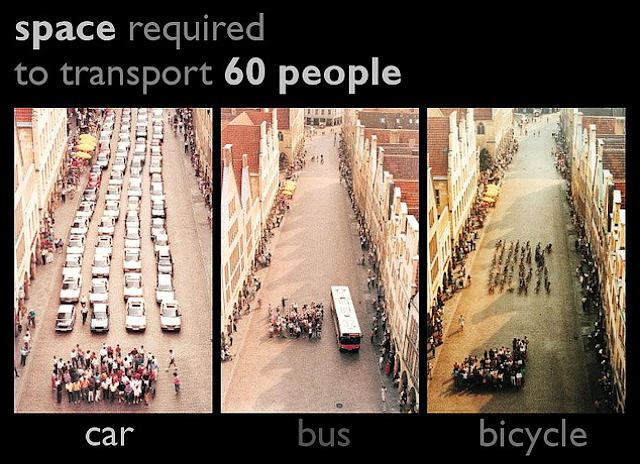
Taxi medallions are licenses by the city for taxi companies, to prevent abuse. But if the software is certified, you don't really need the medallions. Drop $500,000 off the cost of a taxi.
You don't have to pay the 2 drivers that normally share a cab. Drop $80,000 a year off.
Assuming the cars no longer crash (version 2.0?), drop $10,000/year off for taxi insurance.
Combine that with Google-quality routing, and smart-phone taxi ordering, and you're looking at a major price drop for taxi service, assuming some sort of competition. I'm guesstimating a 50-75% drop.
Most people in cities will opt out of owning their own car, and use robo-taxis.
You are looking at an 80-85% drop in the required number of cars in cities (even accounting for current peak traffic volumes. see the KPMG report. I also came to the same number back-of-the-envelope).
Obviously, this will destroy GM and Toyota. Might be good for Tesla as they are still tiny, and I'm sure Elon and Larry have discussed this.
Some other interesting outcomes:
- should increase the total number of trips and miles driven, as lower prices lead to higher quantity demanded, so more wear and tear on cars, and more gas consumed (though less for idling).
- with many driverless cars, they can communicate with each other, driving faster and closer together, and co-ordinating intersection crossing. price of oil change is ambiguous.
- fewer deaths and injuries from accidents, or none at all. The organ transplant industry dies.
- more trees and less concrete lead to cooler cities?
- you can probably get away with more single-lane streets, with no parking, increasing usable land areas in cities by 25%, significantly dropping housing prices.
- in your driverless car, you can talk on your cell, use your laptop, read a book, not be stressed from driving. people may be willing to drive farther to work, increasing sprawl, and also dropping the quantity demanded for housing near the core, dropping prices.
- public transit disappears? though driverless buses would be cheaper too.
- more people bike to work, as it's much safer
- software requirement: interior management for driverless taxis. some video or image recognition for lost purses, people having heart attacks, people throwing up in the back seat.